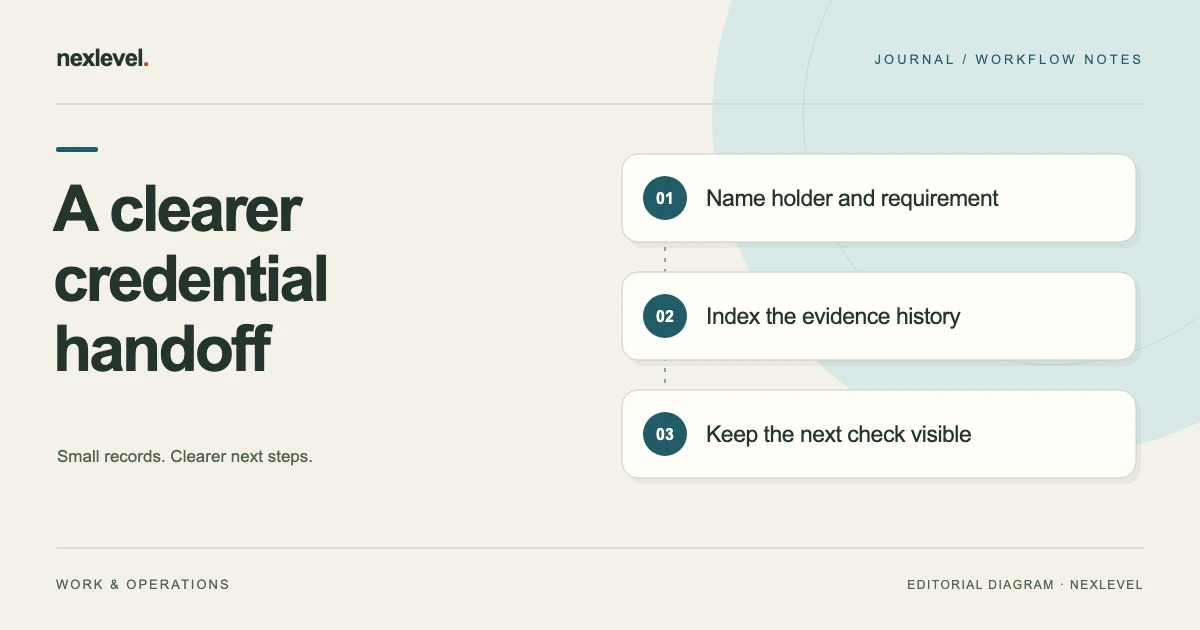
A credential handoff needs the correct holder and credential, labeled dates, accessible evidence and a named next action. State the responsibility being transferred and the cutoff date. A recipient’s acknowledgment confirms receipt of context; it does not establish a renewal or satisfy a requirement.
Give the next owner a usable evidence trail
- Name the holder, credential, outgoing owner, successor and handoff cutoff.
- Identify the relevant requirement version and the source for each date.
- Index current and earlier evidence and test the recipient’s authorized access.
- Review reminder ownership, open questions and the scope of any shared report.
Working fields:
Holder/credential | Requirement version | Date/source | Evidence location/role | Open question | Next owner | Cutoff | Access checked
Useful next steps: Use the credential register structure, Prepare the register for a role change, Retain the completed credential packet.
Identify the holder and credential
Record the holder reference, credential type or readable title, relevant issuer reference, and current record identifier. Similar titles can belong to different people, periods, or requirements.
Use the intended privacy arrangement for identifiers. A masked summary can be useful when the recipient needs status information rather than the full number. Keep the authorized route to fuller evidence separate.
Do not infer holder identity from a general filename. Establish the relationship through the actual source and recordkeeping process before moving dates or evidence between entries.
Name the responsibility being handed over
State whether the recipient is maintaining the register, collecting evidence, coordinating a renewal task, or reviewing a report. These roles need not involve the same authority or access.
Record the outgoing owner, successor, and cutoff. New information after that cutoff should remain identifiable rather than being assumed part of the original packet.
Keep actual issuer or provider actions separate. Receiving a tracking record does not renew a credential or establish that an application was accepted.
Keep the relevant requirement version
If the record is associated with a requirement template, identify its edition and scope. A later template may serve future work without explaining what an earlier review used.
Preserve the source of the requirement and any open applicability question. The tracking tool can organize entered information; it does not independently establish which rule applies to the holder.
Use the responsible organizational or qualified process for those determinations. The handoff should expose a question, not fill it with an assumed universal requirement.
Separate entered dates by event
A date may describe issue, expiry, renewal, evidence receipt, or a planned administrative check. Keep the source label clear so another person does not substitute one event for another.
Record complete dates and the relevant source context. A note saying “next month” can become ambiguous when carried into a later handoff.
Do not change an expiry field merely because a renewal task was started. Record what the source actually establishes and keep pending work visible.
Preserve renewal history
Keep the earlier credential period distinguishable from a later renewal. A new source can be the current evidence while the previous dates remain useful history.
Use the application’s actual history workflow rather than overwriting an earlier period without explanation. Identify the source and event behind the update.
History can help retrieval without establishing legal eligibility. A record that contains several periods still needs the relevant current source and responsible review.
Build an evidence index
List the evidence reference, holder and credential relationship, relevant period, source, location, and current or historical role. Distinguish a file from metadata that points to evidence held elsewhere.
Check whether the recipient can open the intended material through the actual access arrangement. A local filename alone may be useful context but not a usable handoff.
Keep earlier versions identifiable when evidence is replaced. A new scan should not make a different historical document appear to have always been the source for the current record.
Use a credential handoff worksheet
Useful fields are holder ID, credential reference, requirement edition, date labels and sources, current state, evidence index, unresolved questions, next action, responsible person, reminder status, and handoff cutoff.
Add a distinction between information checked and action completed. A colleague may confirm that a file opens without deciding whether it satisfies the actual requirement.
Keep the summary readable and link to details where needed. The purpose is a useful transfer, not a new record that competes with the main register.
Work through a fictional renewal packet
Imagine holder H3 and credential C12. The register retains an earlier period and a later document supplied for the next renewal. The source relationship to the new period is awaiting review.
The outgoing coordinator records both periods, identifies the evidence location, and assigns the successor to check the relevant source through the organization’s process. They do not describe the new file as an accepted renewal merely because it was uploaded or copied.
The recipient can now distinguish the historical record, the proposed current evidence, and the remaining administrative action. No eligibility decision is created by the handoff worksheet itself.
Keep missing evidence visible
A record can have a date and identifier while the supporting evidence remains unavailable. Record what is missing and who can locate or establish it.
Do not use an older document or a similar holder’s file as a substitute simply to remove a Missing state. Preserve the actual source relationship.
If metadata-only evidence is the chosen arrangement, state that scope. The record should explain where the authoritative material is held and how an authorized reviewer can access it.
Inspect reminders as administrative prompts
Check the underlying recorded event and the selected reminder pattern. A local alert supports the owner’s planning; it is not an issuer confirmation or a determination about current eligibility.
When the record changes, inspect the actual tool’s reminder state and any separately maintained task or calendar copy. Do not assume every copy updates together.
Name the person responsible for acting on the prompt during the handoff period. An alert on the outgoing owner’s device does not by itself transfer the work.
Prepare a dated report deliberately
If the recipient needs a report, inspect the actual output for holder references, requirement versions, date labels, current states, evidence notes, and preparation cutoff.
Choose identifier masking according to the intended audience and actual tool options. A broad readiness summary may not need the same detail as an authorized evidence review.
State what the report contains versus what remains elsewhere. A dated PDF or CSV does not automatically recreate the complete working register or every source file.
Handle new evidence after the cutoff
Identify what arrived, its source, and which holder, credential, and period it concerns. Add it through the supported workflow while retaining the relationship to earlier evidence.
Update the next action if the new source resolves a question. If it raises a different question, preserve that result instead of treating any newly received file as automatic completion.
Keep the successor informed through the actual coordination arrangement. A source added to one local workspace is not necessarily visible to every person using a separate copy.
Test reconstruction with the recipient
Ask the recipient to identify the current question, locate the evidence, distinguish the earlier period, and name the next action for C12. They should be able to use the packet without reconstructing the entire history aloud.
If they infer that copying the new document completed the renewal, clarify the state and source relationship before relying on the handoff.
Record access gaps and ambiguous date labels found in the check. This tests administrative usability, not compliance or the substantive validity of a credential.
Return temporary cover with a source-based update
At the end of cover, summarize actual source checks, evidence received, actions performed, and unresolved tasks. Name the next owner and cutoff.
Keep issuer results separate from tracking edits. A current register can describe what was recorded without claiming that the provider acted differently.
Use recurring ambiguities to improve the handoff template. A clearer period label or evidence reference can prevent the next coordinator from repeating the same investigation.
Prepare a filled H3-C12 packet
The fictional packet begins with a cover note: holder H3, credential C12, current register reference, selected requirement-template edition, and handoff cutoff. It names the outgoing coordinator and the person responsible for the next source check. The note explains that evidence review is pending and does not describe the credential as renewed merely because a new file exists.
The evidence index contains an earlier document E1 and a later candidate E2. Each entry shows its source, relevant period, location, and current role. E1 remains historical. E2 is not silently substituted for E1 in every retained report, because the new source relationship is still being checked. The recipient can see the intended sequence instead of a folder of unexplained similar files.
The action row asks the successor to establish which period E2 concerns and whether the intended requirement reference is the one being reviewed. It identifies the responsible organizational route for the question. If the source confirms the relationship, the coordinator can record that administrative result through the supported workflow. If not, the question remains visible with a specific next task.
The packet also identifies the report copy prepared for the handoff. Its date and masking choice are stated, along with which evidence remains separately held. The recipient can open the intended material through an appropriate arrangement without receiving unrelated holder records or assuming that the PDF recreates the full working register.
Check a same-name evidence mix-up
A second fictional case involves two holders with similar readable names and credentials with the same broad title. One source file was placed in the wrong convenience folder. The recipient starts with holder and credential references, then inspects the actual document relationship rather than trusting the folder name.
The reviewer records the discrepancy and the source values. They do not copy the expected holder number into the evidence description as if it appeared on the document. The next action is a specific identity clarification through the responsible process, with the current evidence question preserved.
If the correct relationship is established, the working record is updated using the tool’s actual method. A short explanation connects the earlier mismatch to the current source. This lets another coordinator understand why the record changed without treating an administrative file correction as an issuer’s renewal or eligibility decision.
The report copy is then inspected again if it is intended for use after that correction. A previously prepared masked summary may still be readable, but its source relationship can be outdated. Label the current copy and preserve any retained earlier edition according to the actual records arrangement.
Write the handoff receipt as an observation
A useful receipt can state that the successor located C12, opened the intended evidence reference, identified E1 as historical, and understood that E2 still needs a source check. It names the next task and owner. That records the transfer of usable context without asserting that the underlying credential has been accepted or renewed.
If access fails, record the specific limitation and who will resolve it. The handoff can still identify the required next step, but it should not say the evidence was inspected. Keep the distinction between a visible filename, an opened document, and a completed source review clear.
At the next check, record the actual result and update the relevant action state. This creates a readable sequence of administrative events. It also prevents a polite acknowledgment of the handoff from being reused later as supposed evidence that every requirement was satisfied.
Use VeraDue within its recordkeeping scope
VeraDue records holders, credential states, renewal history, evidence references, and reminders. Its current listing describes Pro requirement templates, evidence history, and PDF or CSV reports with identifier-masking choices.
Use the actual source and responsible process for eligibility questions. Check current capabilities and plan details in the official VeraDue App Store listing, and keep the handoff’s administrative role clear.