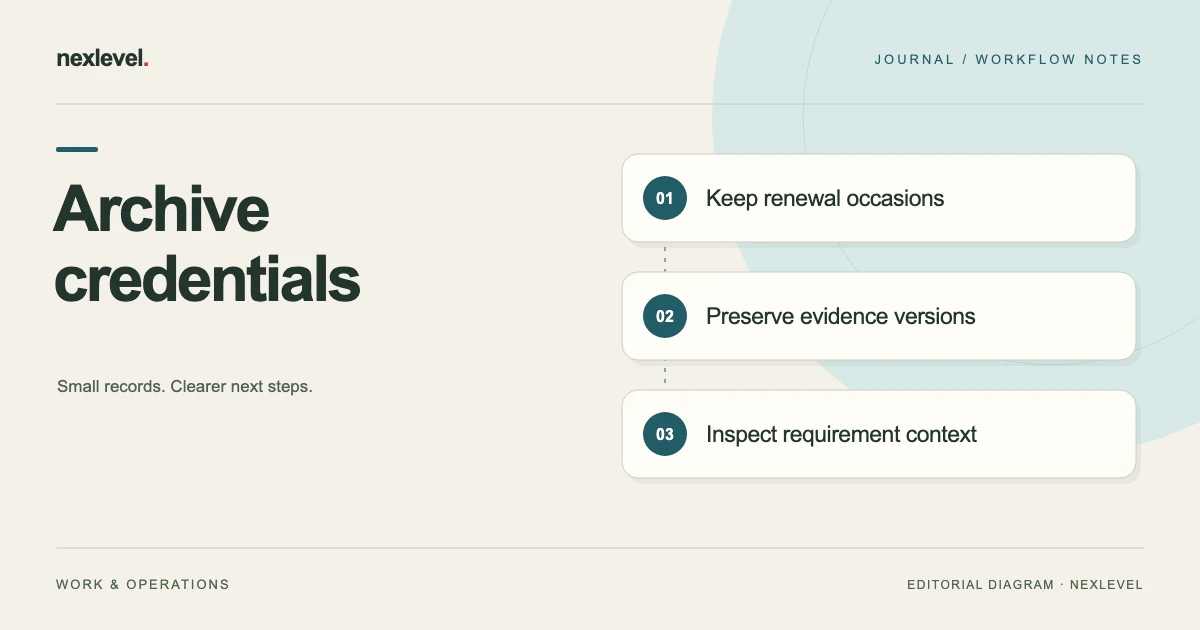
Archive a credential review with its holder and credential references, renewal occasions, evidence versions and selected requirement version. State what the packet actually contains and what remains elsewhere. A dated readiness report summarizes entered records at its cutoff and does not replace the source history.
Retain the evidence behind one dated review
- Choose the historical question and record the selected review cutoff.
- Index earlier and later evidence with their holder, credential and event roles.
- Retain the requirement version used by the report and inspect masking in the actual output.
- Test retrieval from both the report and an evidence reference; record any access gap.
Working fields:
Holder/credential | Renewal occasion | Evidence role/location | Requirement version | Report/date | Masking | Retrieval question
Useful next steps: Preserve earlier renewal evidence, Check a replacement evidence relationship, Transfer the archive with source access.
Choose the historical question
A later reader may need to reconstruct one renewal, identify an earlier evidence version, or understand the requirement context used in a retained report. Those questions can need different sources.
Write the holder/credential scope, source cutoff, preparation occasion, intended reader, and actual output. A packet about one review should not appear to represent every later role or requirement change.
Keep access proportional. A companion index can preserve authorized source routes without copying unrelated identifiers, credential files, or personal material into a broad shared folder.
Preserve holder and credential identity
A credential title can recur across holders or occasions. The archive needs enough actual identifying context to distinguish the selected record and its sources.
VeraDue’s current description includes holder records, masked identifiers, entered renewal dates, evidence history, metadata-only evidence, requirement versions, local reminders, and supported reports.
A familiar display name should not be the sole basis for assigning an evidence file. If the source relationship remains uncertain, preserve the precise question.
Use a renewal-and-evidence archive index
One row can identify each selected source role. Keep identity, renewal occasion, evidence, requirement context, report, and limitation separate where their sources differ.
| Field | What to preserve |
|---|---|
| Holder and credential | The selected identifying context |
| Renewal | The entered date/source occasion |
| Evidence | The selected file or metadata-reference role |
| Requirement version | The actual review context used |
| Output | The retained report/register and cutoff |
| Limitation | The next source question |
These are independent companion prompts, not a named archive module or a guarantee that every explanatory line appears automatically in a PDF or CSV.
Work through a fictional credential packet
Imagine holder H17, credential C4, earlier evidence E2, later renewal evidence E3, and selected requirement version V5. Retained report R8 represents one source cutoff.
A later working requirement V6 belongs to its own occasion. It should not silently replace the context under which R8 was prepared.
The first rows identify H17/C4 and the two evidence occasions. Separate rows preserve V5/R8. A limitation row asks which source establishes one shortened evidence reference.
No real holder, identifier, issuer, date, credential, or authorization is supplied. The references demonstrate administrative relationships without creating genuine qualification history.
Keep earlier dates and later renewal evidence distinguishable
A renewal occasion, evidence replacement, and correction can have different roles. The archive should preserve their actual source meaning rather than flattening them into one latest date.
VeraDue currently describes recording renewals without overwriting prior dates and retaining earlier evidence versions. Check actual Pro access for evidence history and related tools.
Use the renewal-history guide for that narrower review. Preserve its actual result or precise limitation.
Distinguish a file from a metadata-only evidence reference
A stored document and a metadata-only reference can support different retrieval arrangements. The reader needs to know what the selected packet actually contains.
The current app explicitly supports metadata-only evidence when the user does not want to store a file. That choice should not automatically be described as a missing attachment.
For E2/E3, identify the actual authorized source route or limitation. A filename in an index does not embed the original or grant another reader access.
Keep requirement versions tied to the selected review
A requirement template organizes the user’s entered review context. It does not independently establish legal requirements or prove that every relevant credential has been included.
For V5/R8, preserve the actual source occasion. V6 may be useful current information without making the historical report wrong as a representation of its cutoff.
For a role change, use the role-change register guide. A new current question may need a fresh source review rather than copying an older ready-looking list.
Give status and reminder settings their actual role
A Ready, Expiring, Expired, or Missing state organizes attention around entered information. A local prompt is a selected reminder configuration. Neither independently verifies issuer records.
Preserve the actual source behind an entered date and the distinct setting that creates a reminder. A notification should not become proof of renewal or another person’s receipt.
This guide recommends no reminder lead time or qualification decision. The actual source and responsible review process determine those matters outside the archive task.
Preserve masking context deliberately
The current app describes masked identifiers and a choice about masking in reports. A working view and intended reader copy may need different representations under the actual private arrangement.
Open the selected output and inspect what it exposes. Do not assume that an identifier hidden in one view is automatically hidden in every exported file.
A companion index can preserve identity relationships without putting a complete identifier into its general cover note. Keep access within the authorized arrangement rather than treating a polished report as permission to share.
Inspect the actual PDF or CSV
VeraDue Pro currently advertises dated PDF readiness reports and CSV credential registers with requirement-version context. Check actual access and open the selected representation.
Inspect holder/credential identity, renewal occasions, evidence roles, requirement context, masking, and cutoff. A companion explanation may be needed for relationships not represented automatically.
The public description does not establish arbitrary CSV import or universal full-system restoration. A portable packet can support bounded retrieval without being the complete editable workspace.
Prepare a cover note for R8
The first line can identify H17/C4, the selected cutoff, and the archive purpose. Separate evidence lines name E2/E3 with their actual roles.
A requirement line identifies V5 and its source route. A later-context line can identify V6 without substituting it for the historical review.
A contents line should name only what was retained. A report, CSV, source document, metadata reference, and companion index can serve different purposes. A filename called complete does not establish their presence.
Test retrieval from the evidence and report
Ask a reader to begin with E3 and locate its selected holder/credential context. Then begin with R8 and identify the actual requirement version and source cutoff.
Introduce another fictional holder H18 with a similarly titled credential. The reader should use actual references rather than assign E3 to the first familiar label.
If the retained copy loses a relationship preserved in the working source, repair that copy. If the original source remains uncertain, retain the exact question rather than inventing issuer evidence.
Keep later clarification visibly later
A later source may clarify an evidence or requirement relationship. Retain its own occasion and connection to R8 rather than making the historical packet appear to have known it earlier.
A correction to a companion note is different from recording another renewal or replacing evidence. Keeping those purposes distinguishable prevents archive repair from creating qualification history.
A concise receipt can name sources inspected, representation opened, relationships established, and next question. It documents an administrative review without certifying compliance or authorization.
Separate retention from handoff and method selection
Another person taking over the records needs source access, current questions, and responsibility for the next authorized review. Use the credential handoff guide for that task.
For tool selection, use the renewal-system comparison. Choosing a method and preparing one historical packet have different scopes.
The fictional references remain teaching inputs. Reuse the source-index structure with actual authorized records while keeping issuer requirements and professional conclusions in their appropriate arrangements.
Complete the renewal-and-evidence cover sheet
The R8 cover note can separate holder identity, renewal occasions, evidence versions, requirement context, and output. This is an independent explanatory worksheet rather than a promise that every line is a native report field.
| Reference | Role in the packet | Question to test |
|---|---|---|
| H17 and C4 | The selected holder and credential | What distinguishes another similarly titled record? |
| E2 and E3 | Earlier and later evidence occasions | What is a replacement, renewal, or correction? |
| V5 | The selected requirement context | Which review source does it represent? |
| V6 | Later working context | How is it kept distinct from V5? |
| R8 | The retained representation | What status, masking, cutoff, and contents were inspected? |
Ask the reader to begin with E3 and identify its holder/credential context, then begin with R8 and locate the selected requirement version. The routes should converge where actual sources establish the relationships.
Compare two possible credential archive packets
Imagine packet A contains only a dated readiness report. Packet B contains the selected supported output and a companion evidence/version index. Neither is automatically sufficient; compare each with the actual retrieval question.
If the task is to locate one selected report, packet A may provide a useful route once its identity and cutoff are established. If the task is to explain E2/E3 or distinguish V5/V6, the additional source relationships in packet B matter.
Now suppose packet B calls metadata-only evidence an embedded original file. Its extra detail does not make it accurate. Repair the explanation rather than adding a guessed attachment or changing the selected evidence arrangement.
A bounded continuation question can ask which authorized source establishes the shortened evidence reference. This is more useful than reconstructing the whole holder register when one link remains uncertain.
Keep identity, evidence role, requirement version, masking context, and cutoff inside the packet as well as in filenames. A copied report can lose its original folder path.
If later issuer information clarifies a source question, preserve its own occasion and relationship to R8. It should not make the historical report appear to have known later evidence earlier.
The completion receipt can name sources inspected, representation opened, relationships established, and next question. It records an administrative review without a claim about qualification, issuer verification, or regulatory compliance.
The fictional references remain teaching inputs. Reuse the source-role structure with actual authorized records while preserving external requirements and professional-review boundaries.
For a final practical check, give the reader only R8 and the companion index. Ask them to identify the holder, credential, renewal occasions, evidence roles, requirement version, masking context, and actual cutoff. Then ask which source would establish the most specific relationship still missing. The answer should remain bounded to C4 rather than become a conclusion about all of the holder’s qualifications. Record any manual explanation needed and whether the intended reader can use the actual authorized source route.
If metadata-only evidence is selected, identify what the reference establishes and where the original remains, if relevant. A later reader should not infer that an absent embedded file means no evidence exists, or that a filename guarantees access. Keep those retrieval dependencies beside the affected record. A useful archive can make the next review task specific while preserving uncertainty. It should not claim issuer verification, authorization, or compliance merely because the report has a ready-looking state. Retain that evidence limit inside the packet so another reviewer can continue without reconstructing the original conversation.
Keep a metadata-reference route distinguishable from a retained original. If the intended reader cannot use that route, record the access dependency rather than copying a complete identifier into a general cover note merely to make retrieval easier.
Use VeraDue for clear entered renewal history
VeraDue connects holders, entered dates, evidence versions, requirement context, local prompts, and plan-dependent reports without requiring an account.
Check the official VeraDue App Store listing for current capabilities. Preserve what was entered without treating a status or report as independent issuer verification.