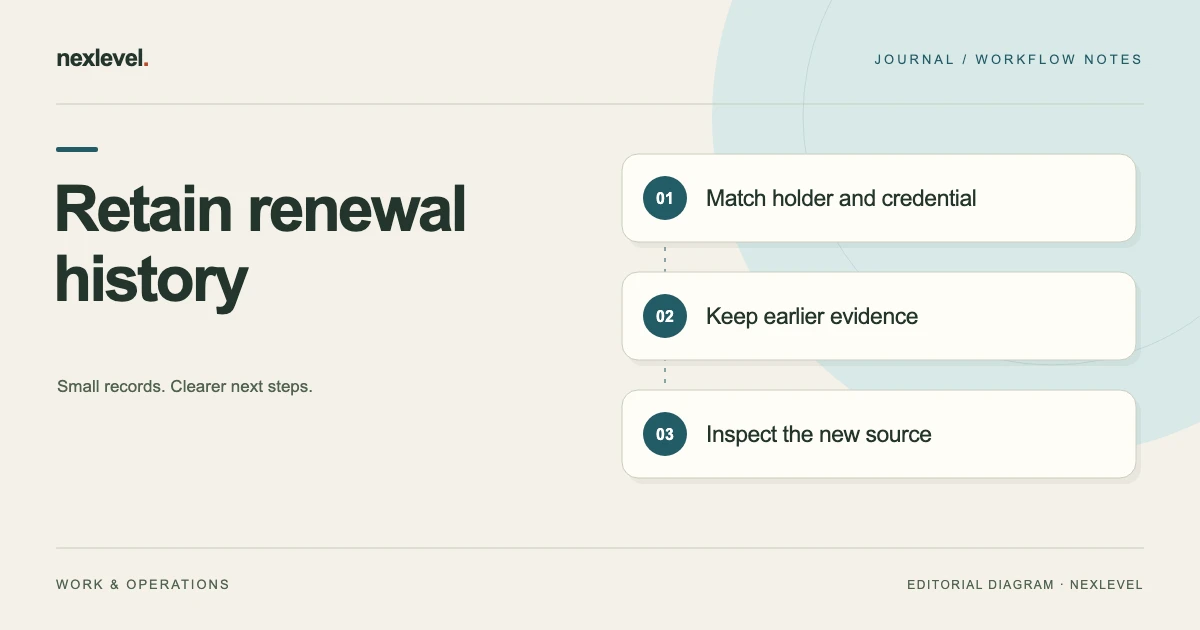
Record a renewal as a new event with its own source dates and evidence, while retaining earlier periods. First establish what the new document actually says: a request acknowledgment, replacement scan and issuer-established renewal have different roles. Correcting a copied date is a separate action.
Identify the event before changing the record
- Confirm the holder and credential before using the new source.
- Read the new evidence and distinguish submission from an established renewal.
- Retain prior dates and evidence while recording the supported new event or correction.
- Review requirement versions, reminders and any report that depends on the changed record.
Working fields:
Holder/credential | Prior event/evidence | New source role | New dates | Renewal or correction | Requirement version | Reminder/report review
Useful next steps: Set up a source-aware renewal register, Check which occasion a replacement file supports, Review the next readiness report.
Identify the holder and credential before updating
Similar names or credential labels can belong to different holders or records. Match the actual identity through the appropriate private source before changing a date or attaching evidence.
Use enough context to distinguish the selected credential without exposing unnecessary identifiers in a general review summary. A masked reference can help an authorized reviewer find the record through the intended arrangement.
VeraDue’s current listing describes masked credential numbers that are revealed only by choice. A masking feature helps control display; it does not independently establish the credential’s authenticity or the recipient’s authorization.
These identity checks belong before the renewal update. Accurate evidence attached to the wrong holder is still an inaccurate record.
Separate request, evidence, and established renewal
A renewal request is an attempted or submitted action. A received file is a source artifact. An issuer-established outcome has its own actual wording and dates. Do not treat these stages as interchangeable.
Read the source for the selected credential and record what it actually establishes. An acknowledgment of receipt may not establish a completed renewal.
This guide supplies no issuer policy or deadline rule. Where the source meaning is unclear, retain the specific question and obtain the appropriate clarification.
The tracker organizes entered information. It should not supply a verified-looking conclusion merely because a reminder or new attachment exists.
Use a renewal-history worksheet
Suggested fields include holder reference, credential reference, prior renewal event, new source event, evidence reference, source dates, requirement version, current question, supported record action, and next reviewer.
| Record role | What to preserve |
|---|---|
| Prior renewal | Earlier dates and their source context |
| New evidence | Which event the source actually supports |
| Requirement context | The selected entered version and source |
| Reminder | The prompt tied to the current record |
These are proposed independent review fields. VeraDue’s actual supported renewal and evidence-history workflow should establish how the working register is updated.
Keep unknown details explicit. A blank source date should not be filled with the day the reviewer downloaded a file unless that is genuinely the event the field represents.
Work through a fictional renewal
Imagine holder H2 and credential C8 in an independent worksheet. Earlier event R1 has evidence E1 and its source dates. A later file E2 arrives during a renewal review.
The reviewer first confirms that E2 belongs to H2 and C8, then reads what it establishes. If it supports a new renewal event R2, the new event should preserve its own source context while R1 and E1 remain identifiable.
If E2 is only a request acknowledgment, the worksheet retains that role and the outcome question stays open. It should not be used to overwrite the prior record with an invented new validity period.
The example gives no real credential dates or issuer interpretation. Its purpose is to show why evidence identity and event meaning come before a polished current-state label.
Preserve the earlier dates rather than editing them away
The current VeraDue listing describes recording renewals without overwriting prior dates. Use the actual supported workflow instead of treating every renewal as a correction to the original event.
A genuine entry correction and a new renewal are different. If R1’s date was entered incorrectly, identify the original source and use the supported correction process. If R2 is a new event, retain that distinct relationship.
The independent summary should explain which case occurred. “Updated date” is too broad to tell a later reader whether history was corrected or a new source event was added.
After the action, inspect the actual register. A successful tap does not establish that the intended earlier and current context remains readable.
Keep evidence versions attached to their occasions
VeraDue’s description includes replacing evidence while retaining earlier versions. That is useful when the new source and old source establish different occasions.
Open the actual files where the authorized workflow permits. A filename containing “renewed” or “latest” does not establish the contents, holder, credential, or outcome.
For C8, E1 can remain the source for R1 while E2 supports a later event if the actual evidence establishes that relationship. Do not attach both indiscriminately to a generic current summary and leave their meanings unexplained.
The listing places evidence history in Pro. Check actual feature access before promising that every plan or portable copy includes the same version history.
Use metadata-only evidence honestly
The current product supports metadata-only evidence when a user does not want to store a file. That record should be described according to what is actually retained.
A source reference can be useful without a local document copy. It is not the same thing as having inspected the file’s contents during this review. Preserve that distinction in the worksheet.
If the source is stored elsewhere, use an appropriate private route that the intended authorized reviewer can access. Do not put passwords or unnecessary personal information into a broadly shared register.
For fictional E2, the review can say “metadata reference retained; source content not inspected in this check” if that is the actual result. Honest limitations make later review easier.
Review requirement versions separately
A new evidence document and a new requirement template are different changes. The current VeraDue listing describes reusable versioned requirement templates, with expanded template features under Pro.
Identify the selected requirement version and actual source. Do not assume that changing a template proves every holder satisfies the new requirement or that historical records always used the latest version.
If a requirement’s meaning is unclear, retain that source question for the appropriate responsible reviewer. This guide does not interpret laws, licensing rules, or professional eligibility conditions.
The weekly register can remain useful while showing an unresolved requirement relationship. An invented “Ready” conclusion does not improve the evidence.
Keep displayed status within its entered scope
The product describes Ready, Expiring, Expired, and Missing views based on entered dates and evidence. These help organize review. They are not independent issuer checks.
A current-looking status should not be described as certification that a person may perform regulated work. Use actual issuer sources and qualified advice where those questions matter.
Likewise, a missing file state can describe the register’s evidence context without proving that the holder lacks the underlying credential. Identify which source is absent and what needs checking.
For C8, the recipient should understand whether the summary reports entered register status, a source-confirmed renewal event, or an unresolved verification question.
Inspect reminders after the record changes
VeraDue’s listing includes local renewal reminders and changes or cancellation when the underlying record changes. Expanded multi-stage reminders are described under Pro.
After a supported renewal update, inspect the actual reminder context. Do not assume a retained notification refers to the newly selected source date, or that a reminder disappearing establishes issuer confirmation.
The listing’s reminder offsets are product capabilities, not universal recommendations for satisfying any particular requirement. Use the actual source and responsible process for real deadlines.
A reminder prompts review. It does not submit a renewal, retrieve issuer records, or establish that a person completed the required action.
Review multiple holders without mixing sources
A similar credential label across holders can make copied templates convenient and source matching risky. Reuse structure without copying another person’s dates, evidence, or identifiers into a newly completed-looking record.
VeraDue Free describes one holder and a limited credential allowance, while Pro expands holders and credentials. Check the actual selected holder when reviewing an expanded register.
In an independent worksheet, keep H2 attached to C8 and R2 throughout the review. A source for another holder does not resolve H2’s missing evidence question.
For a transfer to another reviewer, use the separate credential-record handoff guide. A renewal update and a reviewer transition have related but different boundaries.
Inspect the actual readiness report or register copy
The current listing describes dated PDF readiness reports and CSV credential registers, including requirement versions and choices about identifier masking. These export features are described under Pro.
Open the intended file and check its date, holder scope, credential reference, evidence context, requirement version, and masking choice. Do not assume a prepared report contains every independent worksheet detail.
A dated report is a representation of entered information at its preparation point. It is not a live issuer feed or a regulatory certificate.
Share only the appropriate copy through the intended arrangement. Preparing an export does not establish recipient delivery, access, or understanding.
Test the history with one selected credential
Ask an authorized reader to reconstruct fictional C8. They should identify R1 and E1, explain the role of E2, and distinguish an established R2 from a still-pending request.
If they assume the newest filename proves renewal, improve the source explanation. If they think the displayed status is an issuer verification, clarify the tool’s role.
A short receipt can identify the holder and credential, actual source relationship reviewed, supported action inspected, earlier history retained, and open question owner. Replace generic template wording with the actual result.
The review is useful when the history remains understandable without the original writer’s memory. It does not determine legal authorization or certify compliance.
Correct the summary when the history is already right
In a second fictional C8 review, suppose the app’s renewal and evidence history is clear, but an independent summary shows only E2 and calls it “current proof.” The ambiguity may belong to the summary rather than the working register.
Open E2 through the appropriate authorized route and establish its role. If it is a request acknowledgment, correct the summary’s description and retain the actual renewal question. Do not rewrite accurate R1 history merely because the summary used an imprecise label.
If E2 establishes R2, explain that relationship while preserving R1/E1 as earlier context. The reader should know whether the copy is showing one current event or a historical sequence. Neither a newer filename nor a later download date is enough to decide that meaning alone.
Then inspect the intended recipient copy. If the old summary was already shared, identify the correction through the actual arrangement. Do not claim that every retained export or screenshot updates automatically.
This gives the review a proportionate ending. Once the source relationship and intended copy are clear, there is no need to keep modifying the underlying record for appearance. If the issuer outcome remains unestablished, retain the exact source question and next owner. A transparent register can preserve that limitation without pretending to verify professional status or regulatory compliance.
Keep the report date distinct from any source date it displays. Preparing a current report does not make an older source newly issued or a pending request newly approved. A reader should be able to identify both the copy occasion and the evidence occasion without guessing.
Use VeraDue for a source-aware renewal register
VeraDue organizes entered credential dates, renewal history, evidence versions, requirement templates, masked identifiers, and local reminders. Its current Pro description expands holders, evidence history, templates, reminders, and portable reporting.
Check the official VeraDue App Store listing for current capabilities and plan details. Preserve earlier evidence while recording new events, and keep issuer verification questions with their actual sources.