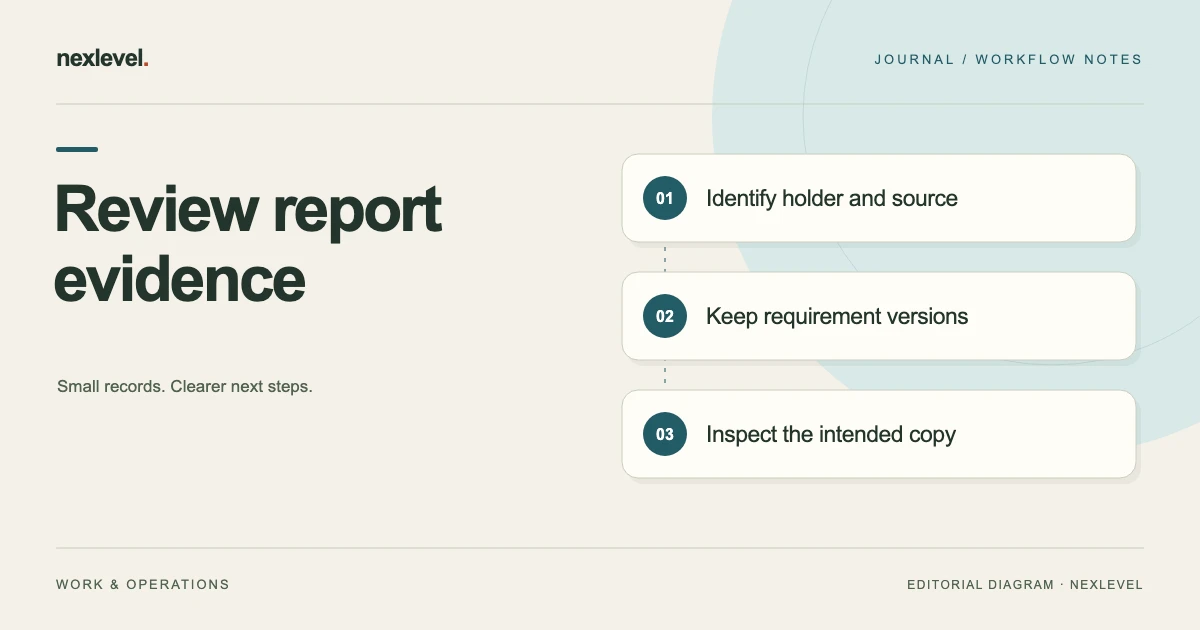
Before sharing a credential report, open the actual output and check its holder, credential, evidence roles, requirement version and date. Confirm identifier masking and explain any evidence held elsewhere. A Ready label describes the entered register and does not independently verify the issuer’s records.
Inspect the report the reader will receive
- State the report purpose, intended reader, selected holders and cutoff.
- Match each credential to its source dates and earlier or replacement evidence.
- Check the selected requirement version and distinguish stored files from metadata references.
- Inspect masking and contents in the actual PDF or CSV and assign any remaining source question.
Working fields:
Report/date | Holder/credential | Evidence role | Requirement version | File or reference | Masking checked | Access gap | Next owner
Useful next steps: Check an unclear replacement evidence relationship, Prepare a credential handoff, Retain the report with its evidence context.
Choose the reporting purpose and trigger
A recurring reminder may help organize records, but a new report, replacement evidence, role change, or source clarification may be the more relevant trigger.
Write the selected holder/credential scope, reporting purpose, intended reader, source cutoff, and output. A check for one report should not appear to verify every holder or requirement.
Use fictional sources for the exercise. There is no need to expose real credential identifiers or create a real issuer report merely to test the worksheet.
Separate working state and intended report
A current record, a source document/reference, and an exported report can contain different information. The intended reader needs the actual selected representation inspected.
VeraDue’s current description includes entered dates, evidence versions, metadata-only evidence, versioned requirement templates, masked identifiers, local reminders, and Pro PDF/CSV reports.
Those capabilities organize entered information. They do not verify issuer records or certify regulatory compliance.
Set up a fictional pre-report packet
Imagine holder H24, credential C3, earlier evidence E2, later evidence E4, requirement version V5, and intended report R8.
A metadata-only reference M6 is used for one selected source. A later working requirement V7 belongs to its own occasion and should not silently replace the report’s selected context.
No real holder, identifier, issuer, credential, date, evidence file, or authorization is supplied. The references evaluate administrative preparation without creating qualification history.
Use a report-preparation checklist
| Check | Source question | Result to retain |
|---|---|---|
| Identity | Which selected holder/credential does the packet represent? | Actual context or precise question |
| Renewal evidence | What distinguishes E2 and E4? | Source occasions and roles |
| Requirement version | Which context is selected for R8? | V5 relationship and limitation |
| Metadata/file | What is actually stored or referenced? | Contents and authorized route |
| Masking | What will the intended copy expose? | Actual inspected representation |
| Cutoff | Which later information remains outside the report? | Selected source scope |
These are independent preparation prompts, not a native all-purpose validator or a claim that every legal requirement is included.
Confirm holder and credential identity first
A credential title can recur across holders and renewal occasions. Preserve enough actual context to distinguish H24/C3 before interpreting dates or status labels.
A familiar name or filename should not be the sole basis for assigning E4. If the relationship remains uncertain, retain the precise source question.
The checklist should identify what was actually inspected. It should not invent an identifier or copy another holder’s evidence to make the packet look complete.
Check earlier and replacement evidence roles
A renewal, replacement, and correction can describe different changes. E2/E4 should retain their actual source occasions rather than collapse into one latest-looking file.
Use the renewal-history guide for that narrower task. Preserve its actual result or precise limitation.
Check actual Pro access for evidence history and related tools. A purchase does not establish the accuracy or authority of an entered source.
Preserve metadata-only evidence deliberately
M6 may be the intended evidence arrangement rather than a failed attachment. The current app explicitly supports metadata-only evidence when the user does not want to store a file.
The report preparation note should identify what the reference establishes and what remains in another authorized location. A filename or route does not automatically embed an original or grant access.
If the intended reader cannot use that route, retain the access dependency. Do not label the report self-contained merely because the reference appears in a table.
Identify the requirement version selected for the report
V5 should have its actual source relationship to R8. V7 may be useful current working context without making the historical selection wrong.
For a role change, use the role-change register guide. A new reporting purpose may need its own authorized source review.
A requirement template organizes entered review context. It does not independently establish every legal or professional requirement relevant to a real holder.
Keep dates and local prompts distinguishable
An entered credential date, evidence occasion, reminder setting, report preparation, and actual issuer action can have different meanings.
The current app describes local reminder stages and changes/cancellations when records change. This guide recommends no lead time or renewal strategy.
A configured prompt should not become proof of notification delivery or completed renewal. Preserve the actual source basis and precise limitation.
Inspect identifier masking in the intended copy
VeraDue currently advertises masked identifiers and a choice about report masking. Open the actual intended output and inspect what it exposes.
A hidden identifier in one working view should not be assumed hidden in every exported representation. A companion note can preserve identity context without putting a complete identifier into a general cover sheet.
Keep access within the actual authorized arrangement. A polished report does not itself establish permission to share every underlying field.
Review status wording within its actual scope
Ready, Expiring, Expired, and Missing organize attention around entered records. They should not silently become issuer verification, legal qualification, insurance eligibility, or certified compliance.
For R8, identify what the selected source actually establishes. If an evidence relationship remains unresolved, preserve the exact question rather than use confident wording to hide it.
A report can be useful as an administrative representation while still leaving an external-source question open.
Open the actual PDF or CSV before relying on it
VeraDue Pro currently includes dated PDF readiness reports and CSV credential registers with requirement-version context. Check actual access and open the selected representation.
Inspect holder/credential identity, evidence roles, requirement context, masking, source cutoff, and limitations. A companion explanation may be needed where the output omits an independent source relationship.
The public description does not establish arbitrary CSV import or universal full-system restoration. Keep the preparation task within actual supported capabilities.
Run a second-reader pre-report test
Give an authorized reader the fictional intended R8 and checklist. Ask them to identify H24/C3/E2/E4/V5/M6 and explain what the selected copy actually contains.
Introduce another holder with a similarly titled credential. The reader should use actual references rather than assign E4 by the closest name.
If a copy loses a relationship preserved in the working source, repair the copy. If the source itself remains uncertain, retain the exact question instead of inventing evidence.
Write a bounded preparation receipt
Name the selected scope/purpose, source representations inspected, relationships established, masking/output context, and precise next question.
A later clarification should retain its own occasion and connection to the selected report. It should not make the preparation note appear to have known later evidence.
The receipt documents an administrative contents review without certifying eligibility, issuer records, or professional authorization.
Connect the result to handoff and retention
For another person taking over, use the credential handoff guide. A checklist does not itself grant source access or decision authority.
For a historical packet, use the credential archive guide. For method selection, use the renewal-system comparison.
The fictional references remain teaching inputs. Reuse the structure with actual authorized sources while preserving external-requirement and professional-review boundaries.
Complete the pre-report source table
The fictional R8 review can keep identity, evidence occasions, requirement context, masking, and output on separate lines. This is an independent companion worksheet rather than a claim that every line is a native validation result.
| Reference | Role to preserve | Question before reliance |
|---|---|---|
| H24/C3 | Holder/credential identity | What distinguishes another similarly titled record? |
| E2/E4 | Earlier/later evidence | What is renewal, replacement, or correction? |
| M6 | Metadata-only source route | What is included versus referenced? |
| V5/V7 | Selected/later requirement context | Which occasion belongs to R8? |
| R8 | The intended report representation | What masking, contents, and cutoff were inspected? |
A readable table can still leave a source relationship open. The actual evidence arrangement determines what the intended reviewer can inspect.
Work through a report-contents branch
In one fictional branch, the selected source establishes H24/C3 and E4’s later renewal role, but M6 points to an original retained elsewhere. The supported result is to identify that reference and actual access dependency, not call the report a complete embedded evidence vault.
In another branch, the working record is accurate but the exported copy loses the requirement-version context. Repair that selected representation or its companion explanation. Do not change correct historical evidence merely to match a shortened report.
A third branch has V7 as current working context while R8 is deliberately prepared under V5 for a historical question. Preserve the two occasions. A newer template should not automatically rewrite the earlier report’s meaning.
A fourth branch concerns masking. Inspect the actual intended copy rather than infer its contents from a hidden identifier in another screen. If the selected representation exposes more than the actual arrangement permits, repair the copy under that arrangement before relying on it.
Then give an authorized reader only the fictional report and preparation receipt. Ask them to identify the holder/credential, selected evidence roles, requirement version, metadata/file distinction, masking context, cutoff, and precise remaining question.
The reader should not need a complete identifier in a general cover note or an invented original attachment to understand the selected record. Record any manual explanation and source route still required.
Keep these roles inside the receipt as well as in filenames. A copied report can lose its original directory context.
A bounded preparation result can identify the next administrative check while leaving an issuer or external requirement question unresolved. It does not certify compliance, qualification, insurance eligibility, or legal authorization.
The fictional references remain teaching inputs. Reuse the source-role worksheet with actual authorized material while preserving professional-review and external-verification boundaries.
Finish with an intended-reader contents review
For a final practical check, give the reader only the fictional R8 and preparation receipt. Ask them to identify the selected holder/credential, evidence occasions, metadata/file role, requirement context, masking choice, source routes, and cutoff. The answer should describe the copy actually inspected rather than assume it contains every original file or every current requirement.
If M6 points elsewhere, identify the actual authorized route and access dependency. If that route cannot be used by the intended reader, preserve the precise limitation. A reference can support an administrative record without making the report a self-contained evidence vault.
If V7 is later working context, keep it distinct from V5’s selected relationship to R8. Do not make a historical report appear to have known later information merely because a current dashboard shows a newer template.
Record any manual explanation needed and the exact next source question. A useful preparation result can identify a bounded repair while leaving an external verification issue open. It should not claim issuer confirmation, professional authorization, or regulatory compliance merely because a status is Ready or a report is polished. Keep that evidence limit inside the receipt so another reviewer can continue without reconstructing the original conversation.
Use VeraDue for clear entered report context
VeraDue connects holders, entered dates, evidence history, requirement versions, local reminders, and plan-dependent reports without requiring an account.
Check the official VeraDue App Store listing for current capabilities. Keep report preparation, source availability, masking, readiness states, and issuer verification in their appropriate roles.