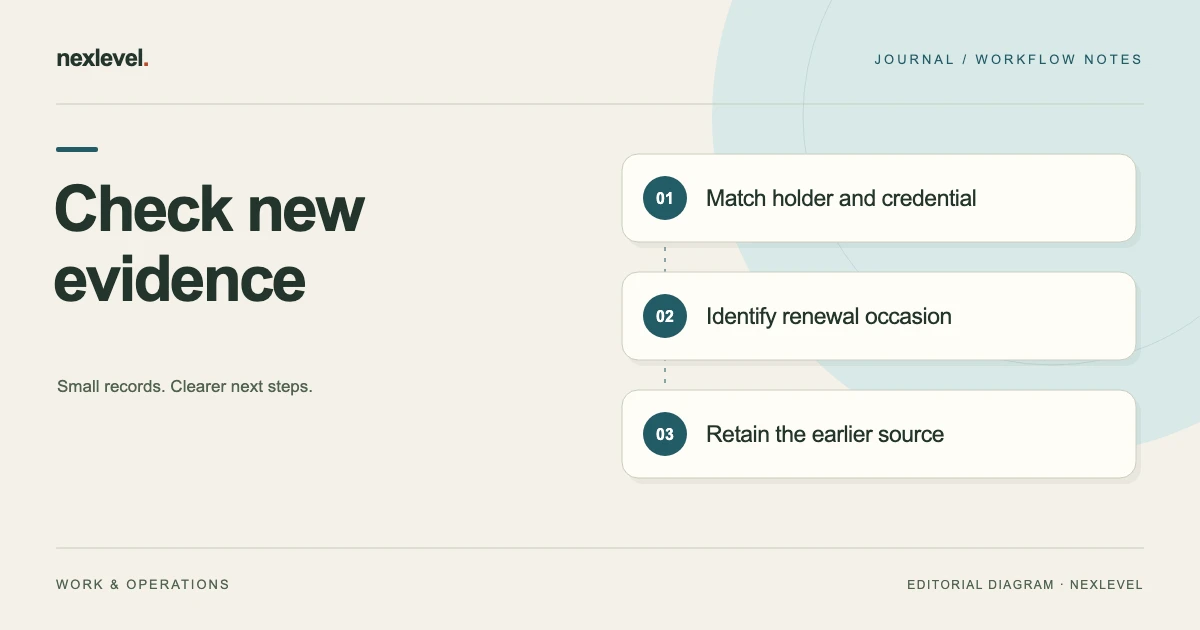
A newer evidence file may document a new renewal, correct an earlier record or simply provide a clearer copy of the same occasion. Check holder and credential identity, then establish the file’s role before changing dates. A recent filename alone cannot resolve that relationship.
Match the replacement to its actual event
- Identify the holder, credential, earlier evidence and replacement source.
- Read the authorized source to establish the replacement’s identity and occasion.
- Classify the finding as a new renewal, same-occasion replacement, correction or open question.
- Correct only the supported record or summary and inspect any affected report.
Working fields:
Holder/credential | Earlier evidence | New source | Occasion/renewal | File or reference | Supported correction | Open question/owner
Useful next steps: Record the supported renewal event, Check the next report’s contents, Keep replacement and earlier evidence retrievable.
Choose the selected replacement question
Write the holder/credential scope, earlier and later evidence references, source cutoff, intended reader, and exact ambiguity. A check for one replacement should not appear to verify every credential.
Useful questions include which renewal occasion a later file represents, whether a replacement is only a documentation correction, or which source establishes its holder relationship.
Use fictional records during the exercise. There is no need to expose real identifiers or private files merely to test the worksheet.
Separate evidence version and renewal occasion
A source file, metadata-only reference, entered renewal date, replacement occasion, and requirement version have different roles. A newer-looking file does not independently settle them.
VeraDue’s current description includes renewal history without overwriting prior dates, evidence replacement with earlier versions retained, versioned requirements, metadata-only evidence, and supported reports.
Those tools organize entered records. They do not verify issuer databases or decide whether a real holder is qualified or compliant.
Set up a fictional replacement packet
Imagine holder H32, credential C4, earlier evidence E2, later source E5, renewal occasion R3, and selected requirement context V6.
Retained copy P8 represents a selected cutoff. A shortened cover label says latest evidence without establishing whether E5 belongs to R3 or another occasion.
No real holder, identifier, issuer, date, evidence document, or authorization is supplied. The references evaluate administrative matching without creating qualification history.
Use an evidence-to-occasion check table
| Selected source | Relationship to establish | Result to retain |
|---|---|---|
| H32/C4 | The selected holder/credential identity | Actual reference or precise question |
| E2/E5 | The earlier/later evidence roles | Source occasions and limitations |
| R3 | The selected renewal context | What actual source establishes the relationship? |
| V6 | The requirement version used in the selected review | Actual scope rather than automatic currentness |
| P8 | The retained representation | Contents, masking, and cutoff inspected |
These are independent review prompts, not a native issuer-verification or all-purpose evidence classifier.
Check holder identity before interpreting dates
A credential title can recur across holders or document versions. Establish the actual H32/C4 relationship before assuming E5 belongs to the selected record.
A similar filename, matching organization name, or recent-items position should not be the only explanation. Preserve the actual authorized source route.
If identity remains uncertain, retain the precise question rather than attach another holder’s source to make the packet look complete.
Compare the actual evidence roles
Identify what E2 and E5 represent. A replacement can be a clearer copy of one occasion, a correction, or evidence associated with a later renewal; the selected source determines which relationship is established.
Use the renewal-history guide for that narrower recording task. Preserve its actual result or limitation.
Do not infer a new renewal merely from a file’s modification date. Source precision should remain limited to what the actual record establishes.
Keep metadata-only evidence deliberate
The current app explicitly supports metadata-only evidence when the user does not want to store a file. A reference can be the intended arrangement rather than an attachment error.
Identify what is included, what remains elsewhere, and which authorized source route the intended reader can use. A filename does not embed an original or grant access.
If E5 is a reference rather than a retained file, preserve that role. Do not label the packet self-contained unless the actual selected contents support the claim.
Preserve the selected requirement context
V6 organizes the selected review. A later template may be useful current information without being the context under which R3 was recorded.
For a role change, use the role-change register guide. A new purpose can require its own authorized source review.
A requirement template does not independently establish every legal/professional obligation. Keep those conclusions outside this evidence-matching task.
Classify the discrepancy before correcting it
Distinguish an incorrect copied label, missing source route, wrong holder relationship, different renewal occasion, and later requirement context. Those findings may need different next steps.
If the working source is accurate while the cover says latest evidence too broadly, repair the cover. Do not change correct historical dates merely to make the summary agree.
A documentation correction is different from a renewal, file replacement, or new report. Keep those purposes distinguishable.
Keep status and reminders separate from verification
Ready, Expiring, Expired, and Missing organize attention around entered information. A local reminder is another selected configuration role.
Neither independently establishes that E5 belongs to R3 or that an issuer recognizes a credential. A precise-looking queue should not hide an unresolved source question.
This guide recommends no renewal timing or professional decision. Actual requirements and appropriate review govern those matters.
Inspect the intended PDF or CSV
VeraDue Pro currently advertises dated PDF reports, CSV registers, evidence history, and requirement context. Check actual access and open the selected representation.
Inspect holder/credential identity, evidence roles, renewal occasions, requirement version, masking, and cutoff. A companion explanation may be needed for relationships not represented automatically.
The public description does not establish arbitrary CSV import or universal full-system restoration. A portable report does not automatically contain the entire editable evidence arrangement.
Run a reverse retrieval test
Begin with E5 and ask a reader to locate its selected holder/credential and renewal context. Then begin with R3 and identify the actual evidence relationship.
Introduce another fictional holder with a similarly titled credential. The reader should use established references rather than the nearest display name.
If one route fails, identify the missing relationship precisely. More documents are useful only when they supply the source context the bounded question needs.
Write a bounded replacement-check receipt
Name the selected records, evidence representations inspected, identity/occasion relationships established, actual copy correction if any, and precise remaining question.
A later clarification should retain its own occasion and connection to P8. It should not make a historical packet appear to have known later evidence earlier.
The receipt documents an administrative source check without certifying issuer records, insurance eligibility, or professional authorization.
Connect the result to reporting and handoff
Before relying on an intended report copy, use the pre-report evidence checklist. Its contents/masking task differs from this selected replacement match.
For another reviewer taking over, use the credential handoff guide. For historical material, use the archive guide.
The fictional references remain teaching inputs. Reuse the worksheet with actual authorized records while preserving source uncertainty and professional-review boundaries.
Use a concrete replacement-review record
A source-review record can separate the displayed file label from the actual holder/credential and occasion. Two sources can share the label renewal record while representing different evidence versions.
| Companion field | Fictional selected context | What to inspect |
|---|---|---|
| Holder/credential | H32/C4 | Actual source identity rather than file-name familiarity |
| Earlier source | E2 | The occasion it actually represents |
| Later source | E5 | Replacement, correction, or new renewal relationship |
| Renewal context | R3 | Which selected date/source role belongs here? |
| Requirement context | V6 | The selected review scope |
| Result | Established relationship or precise question | What changed in the explanation, if anything? |
This is an independent worksheet. It does not claim the app automatically parses a document, verifies an issuer, or recognizes every evidence occasion from a filename.
Work through a supported replacement match
In one fictional branch, the authorized sources establish H32/C4 on both E2 and E5, and E5’s selected relationship to R3 is clear. The supported result is to record that specific match and retain E2’s earlier role. It does not certify the issuer’s current records.
In another branch, E5’s displayed label looks correct but its available source does not establish the holder relationship. The useful next task is an exact identity check. Do not attach it to C4 merely because it is the newest file.
A third branch has E5 as a clearer representation of an earlier occasion rather than another renewal. Preserve that role instead of inventing a new renewal date to make the replacement look current.
A fourth branch concerns V6. A later requirement template may be relevant to a new review while the selected historical packet keeps its actual earlier context. Do not silently change evidence history to match the latest template.
Prepare a bounded outcome for the next reviewer
Give another authorized reader only the fictional P8 and check receipt. Ask them to identify holder/credential context, earlier/later evidence roles, selected renewal occasion, requirement context, actual masking, and cutoff.
The reader should distinguish a metadata-only reference from a stored original and know which authorized route is still needed. An index can be useful without being self-contained.
If the source is accurate but the cover label overstates it, repair the label. If the original relationship remains uncertain, retain the question. A stronger status word should not substitute for evidence.
Record source representations inspected, identity/occasion relationships established, actual copy correction if any, source-access dependency, and precise next question.
Keep those roles inside the receipt as well as in filenames. A copied report can lose its original directory context.
A useful result can remain conditional on one source clarification. It should not claim qualification, legal compliance, insurance eligibility, or professional authorization merely because the replacement is readable.
The fictional references remain teaching inputs. Reuse the replacement-review record with actual authorized sources while preserving external-verification and professional-review boundaries.
Write a concrete replacement-review outcome
In a fictional successful-match branch, the check receipt can say that the selected sources establish H32/C4 on E2 and E5, that E5 has the recorded relationship to R3, and that E2 remains identifiable as the earlier evidence occasion. This describes the relationship actually reviewed. It does not add an issuer-verification claim.
If P8’s cover merely says latest evidence, replace that broad phrase with the selected reference and role. A clearer label preserves what the reviewer established without silently changing earlier dates or deleting context.
In an unresolved branch, the receipt can state that E5’s holder or occasion relationship is not established by the available sources. The next task is to inspect the authorized source that would distinguish the selected relationship. More confident wording would not supply that evidence.
If the source is metadata-only, name what is referenced and what remains elsewhere. A reader should not infer an embedded file from a text route or infer absence of evidence from the absence of a local attachment.
For a final check, give another authorized reader only P8 and the receipt. Ask them to identify holder/credential context, earlier/later evidence, renewal occasion, requirement version, masking, source routes, and cutoff.
Record any manual explanation needed and the most specific remaining relationship. A useful result can identify a bounded repair while preserving uncertainty. It should not claim professional qualification, insurance eligibility, or compliance merely because the newer source is readable or a status is Ready. Keep that limit beside the affected reference so another reviewer can continue without reconstructing the original conversation.
Use VeraDue for traceable entered evidence history
VeraDue connects holder/credential context, entered dates, evidence versions, requirement templates, local reminders, and plan-dependent reports without requiring an account.
Check the official VeraDue App Store listing for current capabilities. Keep evidence replacement, renewal occasion, report contents, and actual external verification in their appropriate roles.