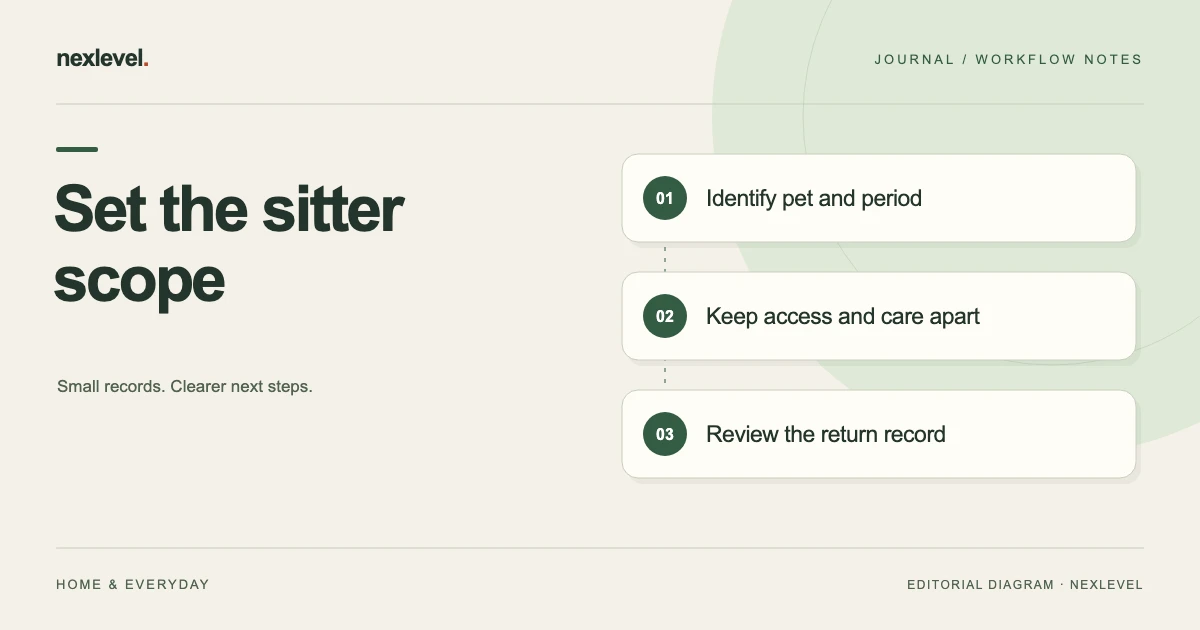
A pet-sitter handoff needs to explain the care record and the period of responsibility. An app invitation, an access window, a routine list, and a recorded check-in answer different questions. Keeping them distinct helps the sitter understand which source is current and which question belongs to the owner.
Prepare the selected pet context, actual care-plan route, routine references, recorded events, access arrangement, and return review. Use the responsible care process for any practical or health question.
This guide provides a fictional administrative exercise and a companion worksheet. It gives no feeding quantity, medication instruction, veterinary advice, or care schedule. Start with the pet-care handoff checklist for the underlying record.
Define the sitter’s actual responsibility period
Identify the agreed beginning and end of the handoff through the household’s real arrangement. A device-access period and a person’s physical responsibility can be related without being the same thing.
Clarify any transition occasion that could be assumed to belong to either person. The worksheet can identify who will resolve a source question without inventing an automatic app assignment or a new care instruction.
Keep the period explicit in the recipient copy. A retained note saying “this weekend” can become ambiguous later. Preserve the actual source context rather than making a current date stand in for the original agreement.
Match the pet and routine before sharing
Use enough identity context to distinguish the selected pet and routine. Similar task names can refer to different pets, days, or household arrangements.
PawHandoff’s current listing describes pet notes and photos, routine check-ins, and a caregiver-attributed activity timeline. Those features help organize entered information. They do not independently determine what care should be provided.
Keep the actual care-plan source available through the intended private arrangement. Do not infer feeding, medication, or other instructions from a task nickname or a previous check-in.
Use a period-aware handoff worksheet
Suggested fields are pet reference, responsibility period, routine source, current recorded events, caregiver context, access arrangement, open question, next owner, and intended return review.
| Role | Question to preserve |
|---|---|
| Care plan | Where are the actual responsible instructions? |
| Routine record | Which selected task is being logged? |
| Activity | What check-in and attribution were recorded? |
| Access | Which supported arrangement applies during this period? |
These are proposed independent fields, not a claim that the app has a dedicated sitter-contract or automatic responsibility-transfer module.
Keep the worksheet narrow. It should not distribute unrelated household details merely because a sitter needs one pet’s relevant context.
Work through a fictional sitter transition
Imagine pet P8, routine R3, and sitter arrangement S2. Rowan prepares a packet for Riley. The independent worksheet identifies the actual agreed period, selected routine source, and current activity view.
A short note says “all set.” The reviewers clarify whether that means the packet was prepared, access was arranged, or an actual check-in was recorded. Those meanings should not be treated as interchangeable.
If the source establishes only preparation, retain that state. If it establishes a supported access or activity event, inspect the actual resulting source. Do not create a completed-looking care event merely to make the handoff appear finished.
Keep local and household features distinct
The current free description supports one pet and a daily local routine without an account. The optional Household plan adds multiple pets, caregivers, secure household synchronization, expiring sitter access, and care-history export.
Check actual feature access and the supported arrangement before promising a sitter shared history or an expiring access flow. A local record on the owner’s device is not automatically the same thing as a sitter’s authorized household view.
The listing’s local-first behavior also does not make a retained screenshot continuously current. Identify the actual source the sitter will use and what remains a static companion copy.
Inspect the access period through the supported workflow
PawHandoff advertises expiring sitter access under Household. Use the current actual controls and inspect the selected result. This guide does not invent a particular screen, button, token lifetime, or cross-device revocation guarantee.
Keep access configuration separate from proof of receipt or understanding. A prepared arrangement does not establish that the intended sitter opened the source or understood the household’s actual instructions.
Retained exports or notes need their own privacy context. Do not assume an access-period change automatically rewrites or removes every copy already held elsewhere. Share only what the actual task and authorization require.
Separate reminders from recorded check-ins
A reminder prompts an action. A routine defines entered organization. A check-in records an action through the supported workflow. A caregiver-attributed timeline helps identify who the record says handled it and when.
Do not infer completion from a reminder alone or infer missing physical care solely from a blank selected view. Clarify practical questions through the responsible people and actual care plan.
The current listing includes optional local reminders and opt-in care updates. Inspect the actual chosen settings rather than promising that every device or retained copy receives equivalent notifications.
Review warnings without assuming duplication
PawHandoff’s current description includes warnings for recent check-ins and supported Undo or removal of mistaken entries. A warning is useful context, not automatic proof that two records describe one occasion.
Compare pet identity, routine, source time, and caregiver context before changing anything. If a source establishes separate events, retain that distinction. If it establishes a mistaken repeat, use the actual supported correction workflow and inspect the result.
Use the separate conflicting-note review guide for that task. The period-aware handoff should preserve its actual outcome or open question.
Prepare the sitter copy deliberately
Choose the actual supported source or output the sitter needs. The current Household description includes private care-history export; inspect actual access and the prepared copy rather than assuming every plan has identical output.
Check pet identity, selected period, routine references, current activity scope, and open questions. Do not assume every independent worksheet field appears automatically in an export.
A static copy is a representation at a preparation point. Keep its source cutoff clear when later activity could change the working record. Preparing a file is separate from its actual delivery.
Plan the return review as a separate event
At the end of the agreed period, identify which record will be reviewed and who will clarify remaining questions. Ending the sitter’s responsibility is not itself a new care check-in.
Keep any actual access-state review separate from the activity history. A configuration change should not be summarized as proof that every routine was completed or that all practical questions were resolved.
The worksheet can retain the selected period’s unresolved source question and next owner. It should not delete accurate history merely to make the transition look tidy.
Test the handoff before relying on it
Ask Riley to identify P8, R3, the actual care-plan route, the agreed period, the source view, and the next unresolved question. They should distinguish access setup from a recorded care event.
If they infer an instruction from a nickname or a completion from a reminder, improve the explanation. If they cannot locate the actual responsible source, improve the private route.
A useful receipt identifies the sources checked, arrangement inspected, copy prepared, and actual limitation. It does not certify care quality, determine a treatment response, or calculate medication doses.
Build the fictional S2 handoff packet
The packet can begin with P8’s actual identity reference and the agreed responsibility period. Keep that period in explicit source context rather than a relative phrase that becomes unclear later. The record should help Riley identify which arrangement the packet concerns without exposing unrelated household information.
The next row identifies R3 and the actual care-plan route. It should not copy a generic instruction from another pet merely because the routine label looks similar. This article supplies no care instruction; the row points to the actual responsible source.
A third row identifies the activity source available during preparation. If it is a retained screenshot, say so. If the actual current household view is being inspected, describe that narrower result without claiming every device or future copy is identical.
The access row records only what the actual supported arrangement establishes. A plan for expiring access is not the same event as an actual configured result. Inspect the selected period and intended recipient through the current workflow before describing them as established.
The open-question row should name a source check. For example, Rowan may need to clarify whether a short earlier message refers to R3 or another routine. Riley should not have to infer that relationship from a generic “all set” note.
The packet’s final row identifies the intended copy and return review. A prepared export or summary can be useful while still being static. Keep its cutoff visible if later check-ins could change the working record.
These rows are a hypothetical companion structure, not a claim that PawHandoff provides a formal sitter-contract screen. Replace the example references with actual established context only through the intended private arrangement.
Check the beginning and end as different source occasions
At the beginning, ask Riley to identify P8, R3, the actual care-plan route, and the agreed period. A successful read-through establishes understanding of the selected packet; it does not prove that every later task will be performed or logged.
If the actual shared source is unavailable, preserve that limitation and the next owner. Do not repeatedly add the same check-in to force a retained view to match. A device-state question and a physical care event should remain distinguishable.
During the arrangement, keep new questions attached to their actual routine and occasion. A later clarification should not make an earlier message appear to have contained information it did not. The history remains useful when it preserves what was known at each point.
At the end, review the selected activity period and actual access context separately. Ending responsibility is not a care event. An access setting also does not establish the meaning of every earlier check-in or erase every independent retained copy.
If a discrepancy exists, compare the actual caregiver attribution, source time, and routine before using the supported Undo or removal workflow. The recent-duplicate warning can prompt review without deciding the answer by itself.
A return note can name the selected period, actual sources inspected, unresolved question, and next responsible person. Keep practical care questions with the owner and appropriate professional process rather than deriving an action from a blank row.
The handoff can finish administratively with an honest limitation. It does not need a claim that all care was independently verified. A readable period, usable source route, and assigned next question give the household a concrete way to continue without inventing certainty.
Keep a new sitter arrangement separate from a previous one even when the same person returns. The earlier S2 period can remain useful history without establishing current access or responsibility. Inspect the actual supported arrangement for the new occasion rather than copying a completed-looking access note forward.
The companion worksheet can reuse its structure while retaining new source facts. Ask which period the record concerns, which selected pet and routine are included, and which actual source establishes the current arrangement. A repeated sitter name is not enough to answer those questions. Keeping that distinction visible makes the return review easier without changing accurate earlier check-ins or inventing a new care event.
Use PawHandoff for a clear caregiver record
PawHandoff organizes routine check-ins, caregiver context, duplicate warnings, notes, and optional reminders. Its current Household description adds shared workflows, expiring sitter access, and care-history export.
Check the official PawHandoff App Store listing for current capabilities and plan details. Keep the period and source responsibilities explicit while leaving actual care decisions with the household’s responsible process.