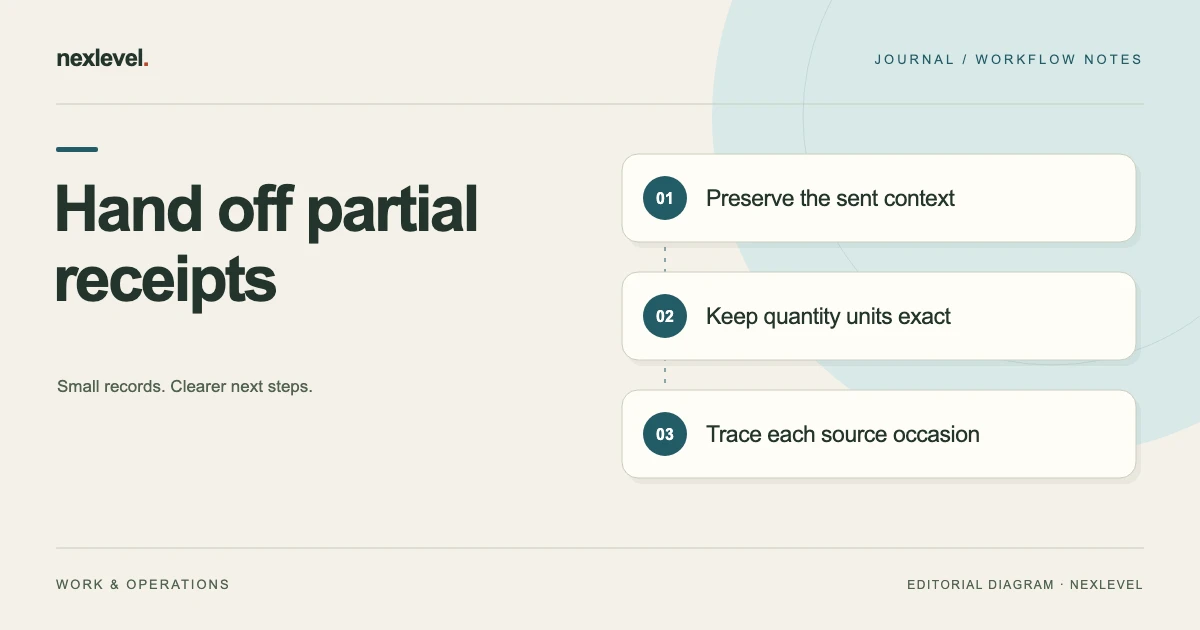
Hand off a partial receipt by showing the next reviewer what was ordered, what each receipt records and which quantity or source question remains. Include the sent snapshot and exact line units so the reviewer can reproduce the balance without changing the original order.
Prepare the partial-receipt handoff
- Name the order, sent snapshot, line and next reviewer’s specific task.
- Connect each receipt entry to its delivery source and exact unit basis where available.
- Reproduce the cumulative and remaining quantities, checking repeated documents before treating them as new events.
- Include discrepancies, cutoff and a named next action in the actual packet the reviewer will use.
Working fields:
PO/snapshot/line | Ordered quantity/unit | Delivery source | Receipt event | Cumulative received | Remaining basis | Cutoff | Next task/owner
Useful next steps: Maintain the receipt-event log, Archive the checked order packet.
Define what the next person needs to do
Start with a purpose such as “Review the selected order line after a partial receipt and identify the remaining quantity under the stated model.” That is narrower than transferring every vendor record or deciding whether an invoice should be paid.
Identify the selected order, sent snapshot, relevant line, actual receipt sources supplied, cutoff, intended reader, and next question. A handoff for receipt review may need different material from a handoff for supplier clarification or historical archiving.
Keep the sharing stage explicit. A prepared packet is not automatically delivered, read, accepted, or adopted as the next person’s working record.
Use the sent snapshot as historical order context
Vendraft advertises an actual Letter or A4 PDF preview. Marking an order Sent preserves its order number, totals, vendor details, and document snapshot. This provides a defined historical reference rather than relying only on current reusable vendor data.
Sent does not establish that a supplier received or accepted the order. If acceptance evidence is needed for the handoff, identify the actual supplied source rather than infer it from a state label.
A later vendor contact change should not silently rewrite what the selected sent document represented. Keep the historical snapshot and any current reference information in their respective roles.
Set up a fictional partial-receipt example
For this exercise, O51 identifies the order and S2 its selected sent snapshot. Line L3 orders ten individual units of a neutral item. Source D4 describes a partial delivery of four individual units, and R5 identifies the corresponding receipt-record role.
The example assumes that all quantities refer to the same item and individual-unit basis. It supplies no real goods, supplier, delivery evidence, invoice, tax treatment, price, or quality decision.
Keep H6 as the independent handoff note and N7 as the next review task. These labels are companion worksheet references, not undocumented Vendraft field names or a claimed import schema.
Reconcile quantities without changing their units
Under the explicit teaching assumptions, ten ordered units minus four received units leaves six units not yet represented as received in the model. The independent arithmetic is 10 minus 4 equals 6.
Do not describe six as an actual shortage, supplier failure, overdue balance, or refund entitlement. Those conclusions require their relevant delivery, schedule, acceptance, and other sources. The example establishes only a limited quantity relationship.
If the order unit is a pack and the receipt unit is an individual item, stop the direct subtraction until the actual relationship is established. Correct arithmetic with mismatched units can produce an unhelpful result.
Keep delivery evidence separate from recorded receipt
A source describing a delivery and an entry describing what was recorded as received may concern the same occasion while remaining distinct evidence roles. Identify both when they are supplied.
If D4 says four units but R5 records another quantity, preserve the discrepancy rather than silently selecting whichever makes the remaining balance look simpler. The next task may be to clarify the actual source association or correct a mistaken copy.
If no delivery source is supplied, state that limit. A recorded value may still be readable as entered history without proving a physical event by itself.
Use a copy-ready partial-receipt handoff worksheet
A practical companion worksheet asks for order and sent-snapshot references, selected line/item, ordered quantity and exact unit, relevant delivery source, entered receipt reference, receipt occasion, cumulative received basis, and independently modeled remainder.
Add discrepancies, unknown relationships, representation inspected, cutoff, next reviewer task, and delivery stage. Keep any acceptance, invoice, payment, or quality source under its own explicit role.
The worksheet is an administrative structure that can accompany an actual supported representation. It does not assert an automated reconciliation control, native field layout, or universal completeness rule.
Show how a later partial receipt changes the model
Suppose a later fictional source D8 describes two more individual units for the same selected line and basis. A corresponding entered receipt role R9 is supplied separately. Under the teaching assumptions, four plus two gives six cumulatively received units.
Ten minus six leaves four units not represented as received in the independent model. Preserve the earlier four-unit occasion and the later two-unit occasion rather than replace both with an unexplained total.
The earlier H6 can remain accurate history at its cutoff. A later handoff should identify the additional source occasion rather than imply that the older packet already contained it.
Do not record a source twice because it arrived twice
In a separate fictional branch, D8 turns out to be a second copy of D4 rather than a new delivery. Two files would then not establish two independent receipt events.
Compare the actual source identity, occasion, selected order line, and supporting detail before treating a familiar-looking record as additional quantity. A matching filename alone is insufficient either to merge or distinguish events.
This is an independent review practice, not a claim that Vendraft automatically detects duplicate delivery evidence. The guide performs no native entry and prescribes no undocumented correction mechanism.
Preserve the app’s advertised receipt boundary
The official description says receipts cannot exceed the ordered quantity. Keep that advertised native constraint separate from the arithmetic in this companion worksheet.
If a fictional proposed receipt would make the independent total exceed ten units, flag the inconsistent source set. Do not recommend entering an unsupported quantity, changing the order merely to force acceptance, or bypassing a control.
A source discrepancy can remain an explicit next review question. Neither the worksheet nor a paid plan supplies the missing physical evidence or changes the advertised native boundary.
Explain state labels without inflating their meaning
Vendraft advertises entered states including Sent, Accepted, Partially received, Received, and Closed. Explain the selected actual state alongside its source context rather than reading every label as independently verified external behavior.
A closed record need not answer a new question about whether a particular delivery source belongs to the selected line. A partial receipt need not establish that the remaining goods are late. A sent snapshot need not prove acceptance.
Where a handoff needs an external fact, identify the relevant actual evidence and its relationship. Keep substantive purchasing or payment decisions with the appropriate actual review.
Choose an output that supports the recipient’s task
The current listing advertises purchase-order PDFs and, with Pro, JSON backup and formula-safe CSV. Review the actual supported output before describing what the recipient will receive.
A readable CSV can help inspect quantities while still requiring order, unit, and source context. A PDF can preserve a selected document representation without necessarily being a receipt-evidence packet. A backup format should not be described as arbitrary import or guaranteed complete restoration without supporting documentation.
Do not invent a native schema or suggest that the independent worksheet can be imported as purchase-order data. This exercise imports and restores nothing.
Keep local review independent of account creation
Vendraft is advertised as local and does not require an account. Preparing a review of locally supported core records should not introduce a mandatory website or supplier login.
Sharing a chosen representation is a separate action. Confirm the intended recipient and actual stage when sharing occurs; the existence of a local snapshot does not establish delivery to another person.
Supply only the material needed for the selected task. A reviewer reconciling one partial-receipt line may not need unrelated orders, customer records, or a complete supplier catalog.
Match current access to the needed capability
The advertised free allowance is three purchase orders per calendar month with watermarked PDFs. Pro expands order volume, unwatermarked output, custom numbering, JSON backup, and formula-safe CSV.
The annual plan advertises an eligible seven-day trial. Do not infer that every plan has the same introductory offer or that access changes the truth of a receipt record.
Choose a representation based on the actual task and current capability. A purchase cannot establish supplier acceptance, delivery condition, invoice correctness, or a missing unit relationship.
Run a handoff reading test
Give an authorized reviewer the fictional references and note without the original folder context. Ask which order and line apply, what S2 preserves, what D4 and R5 each represent, and why the first modeled remainder is six.
Then supply the later two-unit branch. The reviewer should explain why the cumulative model becomes six received and four remaining, while preserving both source occasions.
Finally, introduce the duplicate-copy branch. They should retain the identity question instead of automatically adding quantity. Record any explanation needed before relying on the handoff.
Write a bounded resulting note
A compact fictional note can state: “O51/S2 orders ten individual units on L3. D4 describes four units and R5 is the selected entered receipt role. Under the stated same-item, same-unit teaching assumptions, six units remain outside the recorded-receipt model. Acceptance, invoice, payment, and physical condition are not established by this packet.”
Add actual source occasions, discrepancies, output inspected, and next task when they exist. If later two-unit evidence is supplied, give it its own reference and cutoff rather than silently rewriting the earlier packet.
The review can make a next quantity-source question clear without issuing an order, recording a receipt, claiming a shortage, or requesting payment.
Connect the handoff to ongoing order records
For the broader receiving workflow, use the partial-delivery tracking guide. For the original issue context, use the pre-send draft review guide.
For historical retention, use the order snapshot and receipt archive guide. Keep the selected handoff task visible when choosing what to retain.
A good packet makes the selected quantity basis reproducible while preserving the limits of the actual evidence.
Handle a changed order basis as its own question
If another supplied document changes the selected quantity or unit basis, identify its relationship to O51/S2 before recomputing a remainder. A later draft, supplier suggestion, or copied note does not automatically amend the preserved sent snapshot.
The companion worksheet can retain both references and ask which one actually governs the selected receiving task. This does not claim a native amendment feature or prescribe a contractual interpretation.
Similarly, a source describing a return or damaged item should keep its own actual role. Do not silently treat it as a negative receipt unless the supported workflow and relevant evidence establish that relationship. This example supplies no return, damage, or quality record.
At handoff, make the unresolved question actionable: identify the conflicting source, the line affected, and the relationship the next reviewer needs to establish. That is more useful than an unexplained quantity total or a general instruction to check everything.
Keep the original source material intact while correcting a companion explanation that used the wrong basis. A better note can clarify the next task without changing actual order history.
Use Vendraft for traceable order and receipt context
Vendraft connects reusable vendor and item references, draft previews, preserved sent documents, entered order states, receipts, and supported exports in a local workspace.
Check the official Vendraft App Store listing for current capabilities and access. Keep ordered quantities, delivery evidence, receipt entries, prepared handoffs, and external acceptance distinguishable.