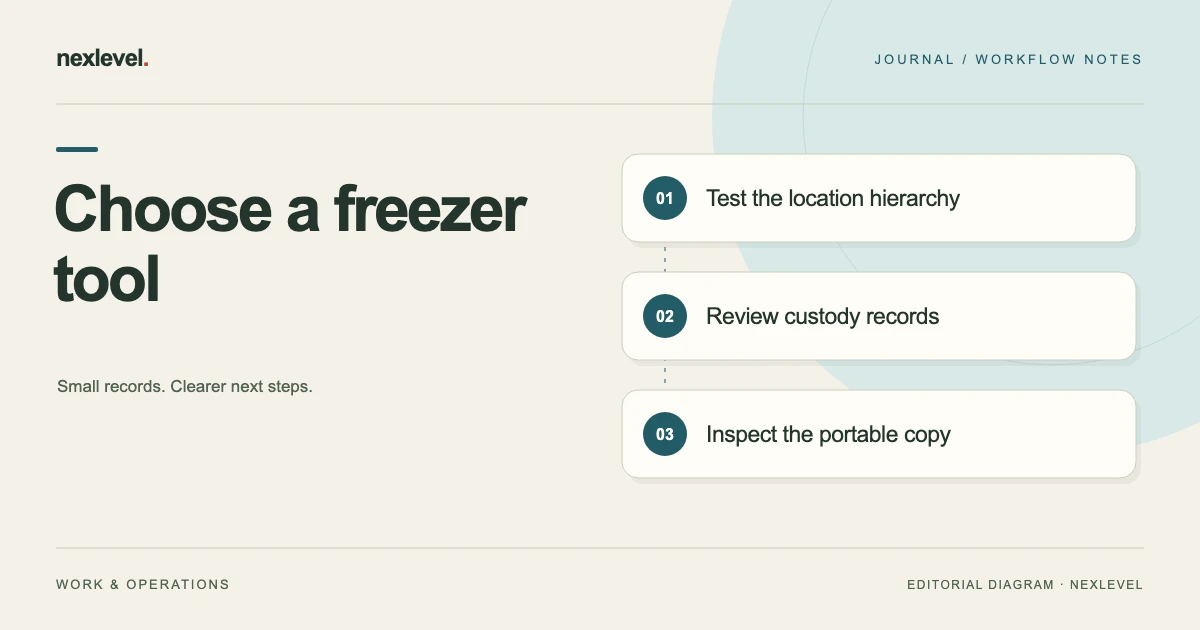
Choose a freezer inventory tool by checking whether the same fictional sample can be found with its full location and relevant custody history. Evaluate paper, spreadsheets and an app on the work your laboratory needs to maintain, including the actual portable-copy and recovery process.
Compare the same record relationships in each tool
- Define one lookup question and its identity, hierarchy and history requirements.
- Use the same fictional sample, aliquot and repeated position label in each option.
- Record correction and export dependencies alongside what each option demonstrates.
- Test the required recovery task before making a conditional choice.
Working fields:
Candidate | Lookup/hierarchy result | Custody result | Manual dependency | Portable copy | Recovery result | Limitation
Useful next steps: Define the inventory records first, Test a move discrepancy, Distinguish an archive from a readable index.
Define the task your current system makes difficult
Write a specific question such as “Find the selected sample’s current recorded box position and identify the latest check-out or return action.” That is more useful than a broad requirement to make inventory digital.
The question tests identity, location, and history together. A system can search a sample name successfully while leaving the current location ambiguous. It can also display a position without explaining whether a retained checkout note is still relevant.
Use fictional data for initial testing. Do not scatter real research records across unrelated tools merely to compare their appearance. Keep actual access and data-handling decisions within the responsible organization’s process.
Build a comparison around relationships
Useful comparison rows include hierarchy, position uniqueness, sample and aliquot identity, lookup, check-out and return history, correction workflow, offline access, controlled export, and tested recovery.
| Task | What to demonstrate |
|---|---|
| Lookup | Find the intended record rather than a similar name |
| Location review | Trace freezer, rack, box, and position |
| Custody review | Distinguish recorded actions from planned moves |
| Recovery | Use the actual supported backup process |
Record what you tested and what remains dependent on a manual convention. “Possible if I maintain a separate index” is different from a feature you actually demonstrated.
The worksheet is an independent selection aid. It does not establish that any candidate meets a regulated or validated laboratory requirement.
Test paper with a realistic lookup
A paper map can provide a readable local reference when its identifiers and update process are consistent. Test the actual filing and indexing arrangement rather than assuming handwriting is either always sufficient or always inadequate.
Can the intended reader distinguish two boxes with similar names? Does each sheet identify the freezer and rack it belongs to? If a page is copied, does that context remain attached?
Then review a recorded checkout and return. The reader should be able to tell which record the note concerns and whether it describes a completed recorded action or a plan.
Consider recovery separately. A photographed page is a copy with its own readability and access limitations. It is not automatically a searchable archive or a demonstrated restorable system.
Test a spreadsheet’s structure before filling it
A spreadsheet can organize identifiers and support filtering, but the row model matters. Decide whether a row represents a sample, aliquot, position, or custody event. Mixing those meanings can make later comparisons unreliable.
If you use several sheets, test how they point to one another. A box name alone may not distinguish the same label used in two freezers. A repeated position code should be read with its full hierarchy.
Check how the spreadsheet distinguishes current location from historical events. Replacing a location cell without preserving relevant history answers a different question from retaining a custody sequence.
These are modeling questions, not a universal spreadsheet template. Use an arrangement the responsible people can maintain and explain through their actual process.
Test a dedicated app against its current listing
FreezerGrid’s current description includes hierarchical freezer, rack, and box navigation, visual position maps, sample and aliquot records, barcode lookup, and durable checkout and return history.
Use a representative fictional record to test those advertised relationships. A visual map should help you identify the selected record’s position without losing the surrounding freezer and box context.
Do not infer unadvertised capabilities. The current listing does not establish general import of arbitrary spreadsheets, automatic physical location sensing, or a validated compliance workflow.
The software organizes entered inventory. Actual physical handling, research procedures, and organizational authorization remain with their proper responsible processes.
Run a fictional hierarchy exercise
Imagine freezer F1, rack R2, box B3, and position C4. A fictional sample S18 is recorded there, with aliquot A2 identified separately where relevant to the test. Another box elsewhere also has a position labeled C4.
Ask each candidate tool to locate S18 without confusing the two C4 positions. The full hierarchy, not the position code alone, establishes the selected location reference.
Now add a recorded checkout and later return through the candidate’s actual workflow. Can an authorized reader distinguish the current location from the earlier action? Can they trace the event to S18 rather than the nearby aliquot?
The exercise contains no real specimen or handling instructions. It tests whether the record model stays readable when names and position labels repeat.
Keep barcodes in their actual role
A barcode can support intake or lookup when the recorded relationship is established. Scanning a code does not independently establish the physical contents of a container or validate the scientific identity of a sample.
FreezerGrid’s listing describes barcode scanning for faster intake and lookup. Test the actual selected record returned by the supported workflow instead of treating a successful scan as proof of every associated fact.
For paper or spreadsheets, document how a code is recorded and found. The same identity question applies even if the lookup mechanism differs.
If two records appear to share a code, preserve the source question and use the responsible correction process. Do not invent a merge rule merely to remove the ambiguity.
Review moves and corrections separately
A planned move, a recorded custody action, and a corrected mistaken location are different events. The tool-selection test should make those meanings clear.
For S18, suppose a retained note names B3 while the working record shows a different box. Establish whether the difference reflects a real recorded move, an old copy, or an entry error before changing anything.
Use the separate freezer box-move reconciliation guide for that review task. Choosing software and resolving a particular move discrepancy have related but different scopes.
A candidate system should preserve the information your actual process needs. It should not create certainty about a physical event merely by displaying a current position.
Separate offline use, reminders, and backup
FreezerGrid’s current listing describes local records without a separate account, private due-date reminders, and plan-dependent encrypted archive export and restore. Those capabilities answer different questions.
Local use concerns access to the working inventory. A reminder prompts a review. An archive supports a particular recovery workflow. None should be treated as an automatic substitute for the others.
A reminder firing does not establish that inventory was checked. A file existing does not prove it can restore the intended records. Test the actual supported process within the responsible arrangement.
Do not promise a cloud team database or continuous shared synchronization that the current product description does not advertise.
Inspect the kind of portable copy you need
A readable list, a spreadsheet table, and an encrypted restorable archive serve different tasks. Decide which one your workflow actually requires before comparing tools.
FreezerGrid’s current listing places encrypted archive export and restore in Pro. It does not advertise a generic CSV export in that description. Do not design a migration around an output the source does not establish.
For any candidate, open or test the actual intended copy through the supported process. Check whether hierarchy, identity, and relevant history survive. A filename is not a content check.
Protect access information according to the actual organizational process. A portable inventory should not become an uncontrolled duplicate merely because export is convenient.
Plan a bounded transition
Preserve the original records and choose a small representative test set. Map old identifiers to the new structure, including repeated position labels and one custody-history example.
Do not assume that an app’s archive restore means it imports every legacy file format. Verify actual supported capabilities before committing to a large transfer.
After the sample is entered, repeat the S18 lookup using only the destination record. Then compare it with the retained source. Resolve lost hierarchy or ambiguous history before expanding the move.
A transition is successful when the destination preserves the required meaning. The number of rows copied is only one measure of transfer activity.
Make a conditional decision you can revisit
Paper may work when a maintained map and index meet the demonstrated retrieval needs. A spreadsheet may work when its row model and update conventions preserve the relationships. A dedicated app may help when its structured hierarchy and custody workflow match the tasks you tested.
Write the choice with its assumptions: record scope, tested lookup, correction convention, portable-copy requirement, and unresolved limitation. That makes a future review easier when the inventory grows or responsibilities change.
Do not present a small successful test as proof of regulated-system validation. FreezerGrid explicitly describes itself as research-inventory organization rather than a medical device or validated GLP/GxP laboratory information system.
Ask an authorized reader to explain the chosen source for S18’s current position and history. If they need the original writer’s memory, improve the structure before expanding it.
Compare the fictional test results without inventing scores
A completed comparison can describe the evidence in ordinary language. For paper, the S18 exercise might establish that the full location is readable only when the map remains attached to its cover sheet. The result should retain that dependency rather than assigning an unexplained score of five for location accuracy.
For the spreadsheet candidate, the exercise might establish that sample and custody rows are linked by an independent reference, but a copied tab omits the freezer column. That is a specific portable-copy limitation. It does not prove all spreadsheets are unsuitable, and it does not need to be disguised as a generic feature failure.
For the app candidate, record which actual hierarchy and custody actions were tested with the fictional sample. If an encrypted archive is part of the requirement, use the supported export and restore process under the available plan. Do not mark recovery demonstrated merely because an archive file was produced.
Then compare the maintenance assumptions. Who keeps the paper index attached? Who maintains the spreadsheet references? Which app features are included in the selected plan? A conditional decision should preserve those answers because the tool’s usefulness depends on the actual working arrangement.
Finally, ask the intended reader to resolve the repeated C4 position. If they choose a location from the position code alone, the system still needs clearer hierarchy context. If they can trace S18 through freezer, rack, box, and current recorded action, the narrow retrieval test has a concrete result. That is evidence about this administrative task, not a guarantee about scientific identity, physical storage conditions, or a validated quality system. Keep the conclusion at that demonstrated scope.
Include aliquot A2 in the retrieval test as its own selected reference where the actual inventory model distinguishes it. A repeated sample name does not establish that the sample and aliquot records are duplicates. Ask the reader which record each custody note concerns, then verify that answer against the fictional source. This catches identity ambiguity that a successful name search alone would miss.
Evaluate FreezerGrid with representative fictional records
FreezerGrid organizes visual freezer maps, sample positions, lookup, and recorded custody actions. The current free allowance is bounded, while Pro expands inventory capacity, encrypted archive export and restore, and reminder automation.
Check the official FreezerGrid App Store listing for current capabilities and plan details. Test the relationships your inventory actually needs while keeping scientific handling and organizational requirements with their proper sources.