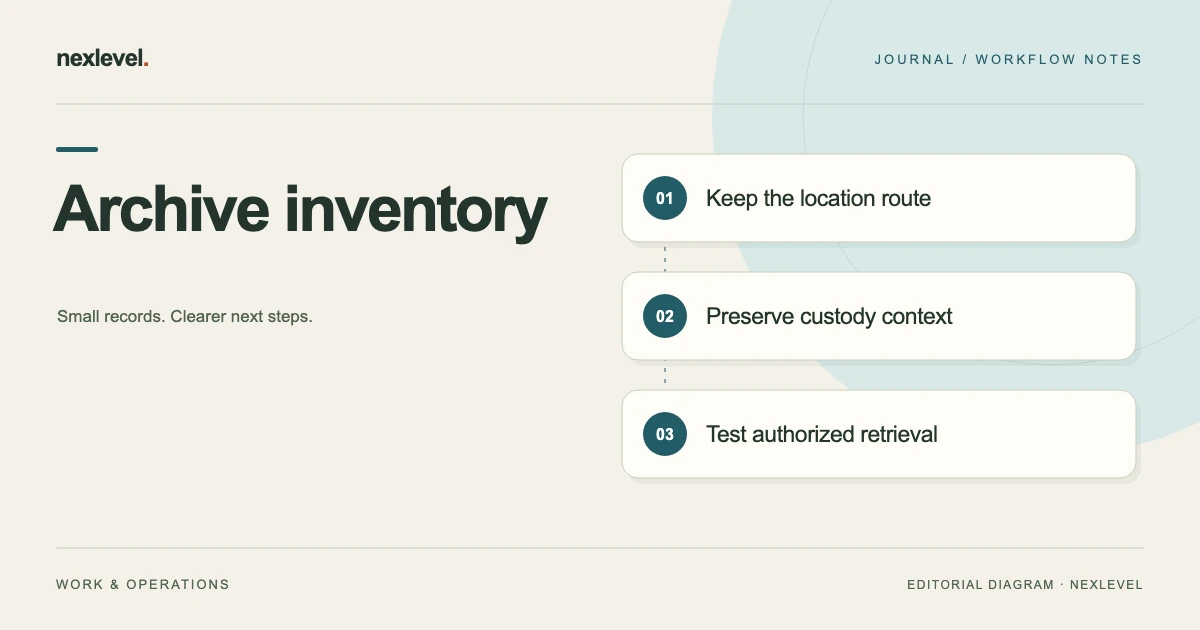
A freezer inventory archive should preserve which sample or aliquot was recorded at which full location and at what source cutoff. Identify the archive's purpose and keep custody events, a readable companion index and any encrypted restore archive in their own roles.
Retain the relationships that explain the archived position
- State the selected inventory boundary, cutoff and future retrieval task.
- Index the item identity, aliquot relationship, full location and relevant custody occasion.
- Identify the actual supported archive and the authorized recovery arrangement.
- Record the scope and outcome of any retrieval or restore check actually performed.
Working fields:
Cutoff | Item/aliquot | Full hierarchy | Custody source | Archive purpose | Retrieval dependency | Check result
Useful next steps: Define the sample record relationships, Resolve a conflicting move source, Prepare a current inventory handoff.
Choose the archive purpose
A retrieval copy, an encrypted backup, and a transfer packet can have different requirements. State which task the selected materials are intended to support before calling the packet complete.
Write the inventory scope, selected location hierarchy, source cutoff, preparation occasion, intended reader, and actual output. A packet about one box should not appear to represent the entire lab inventory or every later move.
Use the actual authorized arrangement for access and retention. An index can preserve relationships without putting private research details or archive secrets into a general shared folder.
Keep the complete location route
A box nickname alone may not distinguish two containers. Retain the freezer, rack, box, and selected position context that gives the record its meaning. A sample reference should not depend solely on the name displayed in a current search result.
FreezerGrid’s current description includes hierarchical visual maps, sample and aliquot records with positions, barcode lookup, custody history, and search across several entered contexts. Use the actual selected relationships rather than assuming an export automatically explains every abbreviation.
If the source cannot establish the selected position, preserve that question. Do not assign a plausible location merely to make the archive map look fully populated.
Use a location-and-custody archive index
One row can describe a selected sample or aliquot relationship. Other rows can preserve custody or output context where those sources answer different questions.
| Field | Context to preserve |
|---|---|
| Hierarchy | The selected freezer, rack, box, and position route |
| Identity | The actual sample or aliquot reference |
| Source occasion | Which retained inventory state is represented |
| Custody | The recorded check-out or return context |
| Output | The actual archive representation and purpose |
| Retrieval limit | The next source question or access dependency |
These are independent companion prompts. They do not establish a separate named archive-index module or guarantee that every explanatory field appears automatically in an exported file.
Work through a fictional location packet
Imagine freezer F2, rack R1, box B7, and position P6. Sample S11 and aliquot A2 have a selected recorded relationship. Custody event C4 and retained archive E3 concern their own source occasions.
The first index row preserves F2/R1/B7/P6 and its source cutoff. Another identifies S11/A2 without creating a second sample merely because the relationship appears in more than one representation.
The custody row identifies what C4 actually records. The archive row identifies E3’s purpose and the selected workflow used to prepare it. A separate question records whether a later move belongs to the cutoff or a subsequent working state.
No real material, quantity, condition, storage requirement, or movement is supplied. The fictional references demonstrate inventory relationships without creating genuine custody history.
Distinguish sample identity from location history
A sample can retain its identity while its recorded position changes. A historical location and a current working position need their own source occasions so the reader does not mistake one for a duplicate sample.
For an unclear move, use the box-move reconciliation guide. Preserve the actual result or source question in the packet rather than choosing whichever location looks more convenient.
An archive can explain what was recorded at its cutoff without claiming that the selected location remains physically current. A real retrieval task needs the appropriate current authorized source review.
Preserve the aliquot relationship
A sample reference and an aliquot reference can describe related but distinct records. Keep the actual parent-and-selected-record relationship understandable instead of flattening both into one ambiguous label.
For S11/A2, identify the source that establishes the relationship and the selected location context. Similar labels or adjacent positions should not be the only explanation a later reader receives.
This guide supplies no sample preparation or aliquoting instruction. The recordkeeping exercise concerns entered identifiers and locations, with scientific and handling decisions remaining in their appropriate procedures.
Keep custody actions in their actual role
The current FreezerGrid description includes check-out and return actions with durable custody history. A recorded event can explain the entered workflow without independently proving every physical action or condition.
For C4, preserve the selected source occasion and its relationship to S11/A2. A current location map should not silently replace the historical custody question the archive was prepared to answer.
If a return relationship remains unclear, name the precise missing source. Do not create a fictional return simply to make a retained packet look closed, or infer physical storage conditions from a completed-looking event label.
Choose the encrypted archive purpose deliberately
FreezerGrid Pro currently advertises encrypted archive export and restore. The listing describes authenticated encryption and password-based key derivation, with inventory remaining on the user’s device unless deliberately exported.
Check actual Pro access and use the supported workflow. Keep an archive secret within the actual authorized recovery arrangement, rather than writing it into the same broadly shared cover note as the archive route.
The existence of an encrypted file does not by itself demonstrate that the intended person can restore or interpret it. File preparation, authorized access, successful restoration, and useful retrieval are separate results.
Plan a bounded restore check
Define the test scope before interacting with the supported restore workflow. Preserve the active workspace and use a permitted separate test arrangement where available. Do not overwrite a real inventory merely to prove that an archive exists.
Identify the selected file, actual preparation occasion, intended reader, and expected reference relationships. The comparison can inspect F2/R1/B7/P6 and S11/A2 without using real research material.
The public description does not establish arbitrary spreadsheet import, every cross-version compatibility case, or automatic multiuser merging. Record only the behavior actually demonstrated by the selected supported workflow.
Prepare a cover note for E3
The cover note can identify the selected hierarchy, source cutoff, archive purpose, and authorized route to the retained representation. A separate line names S11/A2 and the custody question C4 addresses.
A contents line should distinguish the archive from any companion index or source explanation. Do not describe a short table as the complete encrypted app archive or imply that an archive automatically contains an independent scientific procedure.
Keep secrets out of the general note. A useful access line can state which authorized recovery arrangement is needed without exposing the secret itself.
Test retrieval from several starting points
Ask an authorized reader to start with A2 and locate its selected sample and position context. Then start with B7/P6 and locate the selected inventory relationship at the cutoff.
Finally, start with C4 and ask which record and source occasion it concerns. The reader should distinguish location, identity, custody, and prepared output rather than treating them as one current status.
If the intended copy loses a relationship preserved in the working record, repair the companion explanation. If the original source is uncertain, retain that limitation instead of manufacturing a complete route.
Separate a historical archive from a handoff
An archive may support later retrieval by the original user. Another researcher taking over the inventory adds questions about authorized access, current source state, unresolved locations, and responsibility for the next check.
For that task, use the freezer inventory handoff guide. A retained file does not itself establish authority to move materials or change a working register.
For a tool decision, use the freezer inventory tool comparison. Selecting a method and preparing one historical packet have related but distinct requirements.
Handle later clarification without rewriting the cutoff
A later source may clarify a location or custody relationship. Identify that source occasion and its relationship to E3. Do not make the retained packet appear to have known a later movement from the start.
A correction to an explanatory index is different from entering a new physical-event record. Keeping those tasks distinguishable helps prevent a documentation repair from silently becoming invented inventory history.
A concise receipt can name the sources inspected, relationships established, supported output checked, restore-test scope if actually performed, and next question. It documents an administrative review rather than validated laboratory compliance.
Complete the fictional archive contents register
The E3 cover note can use a compact register that separates identity, location, custody, and recovery dependencies. The example does not claim that every row is a native field inside the encrypted archive.
| Reference | Role in the selected packet | Question to test |
|---|---|---|
| F2/R1/B7/P6 | The selected hierarchy at the source cutoff | Can the reader reconstruct the full route? |
| S11/A2 | The selected sample and aliquot relationship | Does the retained context distinguish the records? |
| C4 | The recorded custody occasion | Which event and source does it represent? |
| E3 | The actual prepared archive representation | Which supported workflow created the copy? |
| Recovery arrangement | The authorized route to the needed secret | Can the intended reader use it without exposing it broadly? |
| Later movement | A separate working-state question | Does it belong inside or after the selected cutoff? |
For a real packet, place authorized source routes beside the short references. A reader who recognizes a box nickname still needs enough hierarchy context to distinguish another similarly labeled container.
Keep the recovery dependency distinct from general readability. A companion table may be understandable while the encrypted archive still requires an authorized secret. Conversely, possessing the file and secret does not by itself explain a confusing sample-to-position relationship.
Record what a restore check actually established
If a supported bounded restore test is performed, record its actual scope and observed result. Name the selected archive, test arrangement, relationships inspected, and remaining questions. Do not describe an unperformed test as successful because the file exists.
Suppose a permitted test representation makes S11/A2 visible but the source context for C4 remains unclear. Record those results separately. Successful access and unresolved custody meaning can coexist; one should not silently certify the other.
If a test cannot be performed without risking the active workspace, preserve that limitation and identify the next supported source check. This guide does not authorize destructive changes or invent an alternate restore mode the product does not advertise.
Finally, ask the intended reader to start from the restored or retained representation actually inspected and identify the hierarchy, record identity, source cutoff, and next question. The result should be bounded to what was demonstrated.
The reusable artifact is the relationship register and truthful test receipt. Keep fictional inventory identifiers outside real research records, and keep technical handling, sample suitability, and validated-system conclusions outside this administrative archive exercise.
Keep the actual source cutoff inside the packet as well as in any filename. A later reader should not infer inventory timing from a file modification date. If the selected copy omits an established location relationship, repair that copy; if the source itself remains uncertain, preserve the precise next question. Neither repair requires inventing a new sample or custody event.
Use FreezerGrid for understandable entered inventory
FreezerGrid connects entered hierarchy maps, sample and aliquot positions, custody records, and plan-dependent encrypted archives in a private local workspace.
Check the official FreezerGrid App Store listing for current capabilities and Pro access. Inventory organization does not establish storage suitability, diagnostic meaning, or a validated GLP/GxP information-management system.