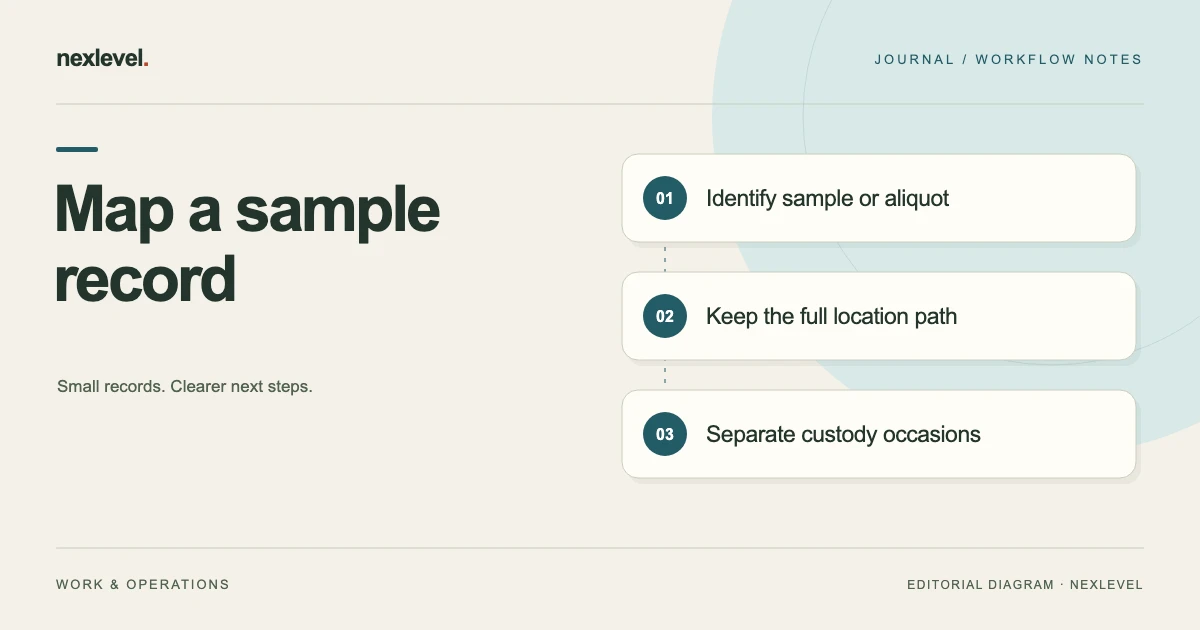
A freezer sample record needs a stable item reference, its sample or aliquot relationship, the complete recorded location and any relevant custody source. A position or readable barcode can help locate a record while still leaving an identity question open.
Fill one record without merging its different roles
- Name the record's purpose and select the item supported by the authorized source.
- Record sample/aliquot and barcode relationships without inferring them from similar names.
- Write the full location path and the custody event's own occasion.
- Keep unresolved fields and the retained copy's cutoff explicit.
Working fields:
Purpose | Item/aliquot | Barcode source | Freezer/rack/box/position | Custody source | Cutoff | Open question
Useful next steps: Set up the wider freezer inventory, Check the barcode lookup relationship, Review a checkout-return source set.
Choose the record’s actual task
Write whether the selected task is intake, lookup, a location review, custody review, or historical retrieval. A template can support several tasks while still needing one clear purpose for each selected copy.
For example, a lookup copy needs enough identity and location context to explain which record is selected. A custody review additionally needs the relevant action occasion and history relationship.
Do not treat a source worksheet as authorization to move or handle material. The exercise organizes entered information; actual laboratory work remains governed by its appropriate procedures and authorized decisions.
Set up a fictional sample record
Imagine S81 is a sample reference and A2 an aliquot reference. B3 identifies a barcode source. F4, R5, X6, and P7 identify the selected freezer, rack, box, and position. K8 is a custody-history reference, and C9 is the retained companion worksheet.
The selected question is whether C9 clearly represents the chosen item and its source relationships. The exercise does not establish the physical identity or condition of any real vial.
These teaching labels are not native identifiers or a prescribed FreezerGrid schema. They keep the template readable without inventing fields, automatic checks, or data-validation controls.
Use a copy-ready sample-role template
| Companion field | Fill from the selected authorized source | Keep distinct |
|---|---|---|
| Record purpose | The actual intake, lookup, custody, or retrieval question | A physical handling instruction |
| Selected identity | S81, A2, or the actual chosen item reference | A location label alone |
| Sample/aliquot relationship | The relationship the source establishes | An inferred parent-child association |
| Barcode context | B3 and its actual selected item relationship | A successful scan as identity proof |
| Location hierarchy | F4 / R5 / X6 / P7 at the selected occasion | Permanent item identity |
| Custody context | K8 and the action/history occasion reviewed | Physical condition or completion by assumption |
| Cutoff and limitation | Source occasion, actual correction, precise next question | The current state of every copy |
Use the fields as a manual companion index. The table does not promise custom native fields, an import layout, or automatic verification of each relationship.
Establish the selected item before assigning a position
Start with the item relationship the source actually supports. A familiar sample name, barcode fragment, or project label may be useful context without uniquely establishing the selected item.
Do not create another sample merely to represent a new location for an existing item. Likewise, do not merge distinct items because their visible labels resemble each other.
The freezer inventory organization guide covers the broader setup task. This template narrows the review to the relationships represented by one selected record.
Keep samples and aliquots in their actual roles
FreezerGrid’s current description supports sample and aliquot records. For S81 and A2, preserve the relationship established by the selected source rather than infer it from naming similarity or nearby positions.
A copied table should not imply that a sample and aliquot are interchangeable identifiers. If the relationship is unknown, keep that specific question visible beside the affected reference.
This exercise supplies no quantities, preparation procedure, sample content, or physical derivation. It concerns the administrative association in the entered records.
Write the full selected location hierarchy
A box coordinate alone can be ambiguous across several racks or freezers. Preserve enough hierarchy to identify the selected recorded location at its actual occasion.
In the fictional case, F4/R5/X6/P7 is a location reference chain. The labels do not claim a real storage design or prescribe where any material should be placed.
If a copied summary omits X6, restore the source context when established. Do not change an accurate item record merely because its companion index shortened the location too aggressively.
Separate a position from permanent identity
A recorded position can change while the item identity remains the same. Keep earlier and later location occasions distinguishable instead of making an old retained copy appear to describe a later move.
The box-move reconciliation guide addresses that narrower task. Preserve its actual source result rather than duplicate a sample to make two location notes look consistent.
A location relationship in a record is still entered information. It does not independently verify physical presence, temperature, integrity, or suitability for research use.
Inspect barcode context rather than scan success alone
FreezerGrid advertises barcode scanning for intake and lookup. A readable code can help retrieve a record while leaving the actual item association to be established through the appropriate source arrangement.
For B3, identify which selected source and item relationship the review concerns. Do not describe scanning as automatic verification of the material or of every label ever attached to it.
If the relationship remains uncertain, name the source question. This guide does not invent a duplicate-barcode detector, automatic merge, or label-certification feature.
Keep custody history separate from location
The current app supports check-out and return actions with durable custody history. A selected action and its occasion can explain a record relationship that a static location label alone does not explain.
For K8, identify the action/history source being inspected and its relationship to S81 or A2. Do not infer a return merely because a preferred storage position remains visible elsewhere.
The administrative record should not become a claim about physical condition, successful handling, or complete chain-of-custody compliance. Those conclusions need their appropriate actual sources and processes.
Work through a complete fictional row
In one branch, the authorized sources establish A2’s relationship to S81, B3’s selected item association, the F4/R5/X6/P7 recorded location, and K8’s relevant custody occasion.
C9 can retain those relationships as the selected administrative source set. The useful result is a clear record-role template entry, not a certification of the vial or the laboratory.
Keep the source cutoff in the row or companion note. A later move or custody action can be valid while making the current record differ from the retained C9 copy.
Work through an incomplete identity branch
In another branch, A2 and S81 have similar labels but their relationship is not established by the available source. Keep that question explicit instead of filling the template with a guessed parent reference.
The rest of the row can remain useful if its own source relationships are clear. Do not force every field into the same resolved status merely because one location reference is readable.
A next task can identify the authorized source needed to distinguish the relationship. It should not prescribe sample handling or create an unsupported aliquot record to make the worksheet look complete.
Work through a location-copy branch
In a third branch, the source has the correct F4/R5/X6/P7 hierarchy, but C9 accidentally refers to another box. Correct the companion copy using the established source.
That repair does not require a physical move or a change to accurate inventory history. Keep a documentation correction separate from a recorded location event.
If the original source itself is uncertain, retain that different limitation. A cleaner copied hierarchy cannot establish where an item physically is.
Use reminders as prompts rather than custody events
FreezerGrid advertises private on-device due-date reminders, with reminder automation among the Pro extras. The current listing governs access details for the selected workflow.
A reminder configuration should not be entered as another custody action or treated as proof that someone completed a task. Keep prompt, recorded action, and physical work in different roles.
This exercise chooses no due date and changes no reminder. Any actual laboratory schedule or handling decision remains outside the companion template.
Keep Watch actions within their advertised scope
The current description includes quick checkout actions on Apple Watch. It does not establish every synchronization, confirmation, or failure-recovery control.
If a selected source involves a Watch action, identify what the actual available record establishes rather than infer successful persistence from an attempted interaction alone.
This template exercise performs no Watch action. It should not borrow another app’s queueing behavior or claim undocumented automatic conflict resolution for FreezerGrid.
Choose the supported retention representation
FreezerGrid Pro advertises encrypted archive export and restore. The current description says exported archives use authenticated encryption and password-based key derivation. It does not establish universal CSV or PDF output.
A readable companion index and an encrypted restore archive have different roles. The former helps explain selected source relationships; the latter serves the advertised archive capability under its actual supported controls.
Do not put archive passwords or unnecessary research contents into a broad source index. Preserve actual retrieval dependencies through the authorized arrangement rather than claim a filename alone guarantees recovery.
Distinguish review from restoration
Inspecting C9 can establish whether its selected references are understandable. It does not prove an encrypted archive was restored or that every current record can be recovered from that archive.
Likewise, the existence of a backup does not establish the current physical location or custody state of the item. Keep those source questions separate.
The exercise performs no restore and does not recommend overwriting a working inventory to test a template. Record only the representation actually inspected and the result it supports.
Run a second-reader source test
Give another authorized reader C9 and the controlled source routes. Ask which sample or aliquot is selected, what B3 identifies, how the location hierarchy is scoped, and what K8 actually records.
Then introduce another box with the same position label. The reader should preserve the full source hierarchy rather than assign a location by coordinate alone.
Finally, ask what the packet does not establish. The expected limits include physical presence, material condition, procedural validation, diagnostic use, and the current state of every retained copy.
Write a concrete template-check result
A companion receipt can identify the selected item, sample/aliquot relationship, barcode context, location hierarchy, custody occasion, actual copy correction, cutoff, and precise remaining question.
For the fictional matched branch, C9 preserves the selected A2/S81 relationship and F4/R5/X6/P7 context while retaining K8’s own action occasion. No real storage condition, physical move, or laboratory result is supplied.
Read the receipt without its filename. A later reader should understand which relationships were reviewed and which source would establish an unresolved point.
Connect the template to handoff and archive work
For an administrative transition, use the freezer inventory handoff guide. For historical copies, use the location-context archive guide.
For method selection, use the freezer inventory tool comparison. Keep the template’s bounded purpose visible when deciding which representation serves a task.
A useful record can make the next source review specific while leaving physical laboratory conclusions outside the administrative scope.
If a later source changes one relationship, retain its own occasion. A new custody action need not change the item identity, and a corrected companion box label need not represent a physical move. Record the actual role changed so the next reader can distinguish source correction from inventory history.
Use FreezerGrid for local research inventory roles
FreezerGrid connects freezer, rack, box, sample, aliquot, position, barcode, and custody records in a local workspace without requiring an account.
Check the official FreezerGrid App Store listing for current capabilities and Pro access. Keep identity, location, custody, retention, and actual laboratory decisions distinguishable.