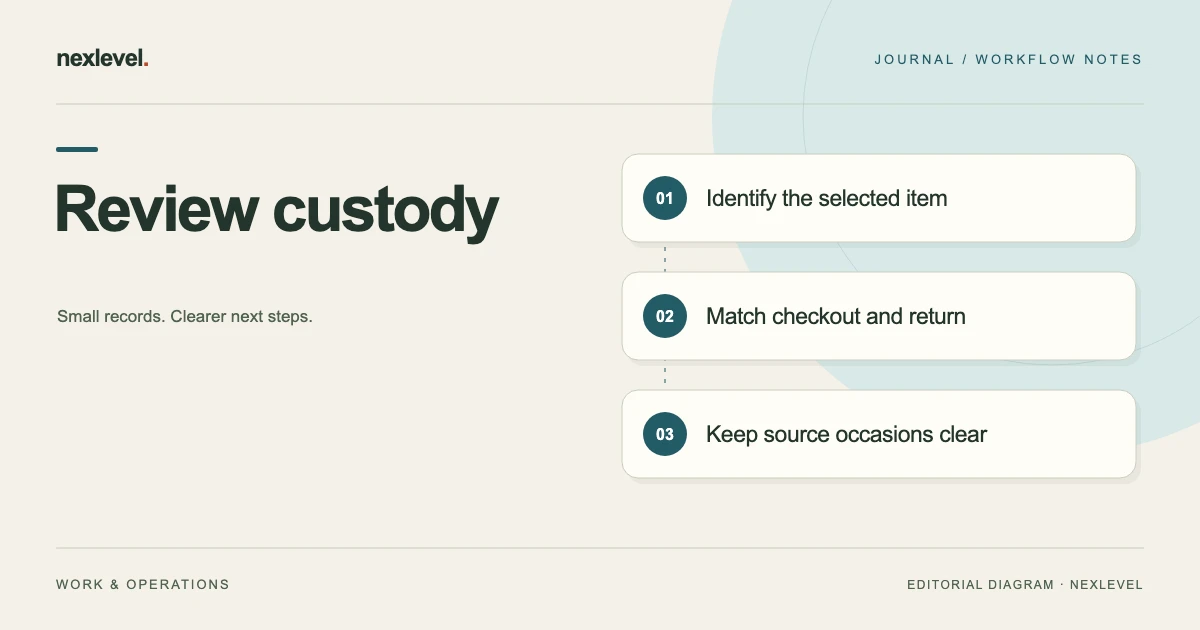
Review checkout and return history by matching each action to the selected sample or aliquot and its recorded occasion. A familiar box location or nearby return entry does not establish that the same item returned. Preserve the exact missing relationship for the next reviewer.
Match the return to the item checked out
- Choose one custody question and identify the selected sample or aliquot.
- Read the checkout and return sources for item identity and recorded occasion.
- Compare the location note and handoff cutoff without treating them as custody events.
- Correct a mistaken copied association or identify the source still needed.
Working fields:
Item | Checkout source/occasion | Return source/occasion | Location source | Handoff cutoff | Missing relationship
Useful next steps: Use the identity and location template, Reconcile a separate location move, Prepare the recipient's handoff packet.
Choose one custody-review question
Write the specific relationship the handoff needs to clarify. Examples include whether a selected return reference concerns the same item as an earlier checkout or which source occasion the retained location note represents.
Keep the task bounded to the actual available sources. A broad request to check the freezer forces the next reader to reconstruct the original concern and can blur administrative review with physical laboratory work.
No actual transfer of responsibility occurs in this exercise. Record the next task separately from proof that another person has accepted or completed it.
Set up a fictional history packet
Imagine S29 is the sample reference, A3 a selected aliquot reference, C4 a checkout-history source, R5 a return-history source, L6 a location note, and H8 the prepared handoff copy.
The selected question is whether R5 belongs to the same chosen item as C4 and what that relationship establishes at the reviewed occasion. The case does not assume the answer.
These labels are teaching references rather than native identifiers. They supply no actual sample material, project data, person, timestamp, physical move, or storage condition.
Build a custody-source review checklist
| Role | Question for the selected handoff | Keep separate |
|---|---|---|
| Item identity | Does the selected source concern S29 or A3? | A similar name or nearby position |
| Checkout reference | Which action occasion does C4 record? | A planned task or reminder |
| Return reference | Does R5 concern the same selected item? | A return for another sample |
| Location note | What occasion does L6 represent? | Current physical presence by assumption |
| Handoff copy | Which source set and cutoff does H8 contain? | Every later action or retained copy |
| Open question | Which source would distinguish the relationship? | A guessed physical result |
The checklist is a manual companion convention. It does not establish automatic custody reconciliation, native custom fields, or multi-user permission controls.
Establish sample and aliquot identity first
FreezerGrid supports samples and aliquots, so the selected item role matters. A checkout for S29 should not silently become a checkout for A3 merely because their names are related.
Use the actual authorized source arrangement to establish the relationship. If the selected sources do not settle it, keep that exact question visible.
The inventory organization guide covers the broader identity-and-location task. Its result can support this review without supplying the custody action’s facts.
Read the checkout at its recorded occasion
C4 is a selected action-history reference. Identify what it actually records and which item it concerns rather than summarize it more broadly as the sample is elsewhere.
A recorded action and a physical event can need different evidence. This administrative exercise does not independently verify handling, location, condition, or who physically performed work.
Preserve the source occasion in the companion note. A retained copy should not appear to include later history merely because it was reopened after another action occurred.
Match the return before treating the sequence as complete
R5 may be a relevant return source, a return for another item, or a relationship not established by the available evidence. Inspect that identity before using it to explain C4.
A familiar box or project label is not enough by itself. The selected sample or aliquot association must remain understandable.
If R5’s relationship is unresolved, retain the missing source question. Do not create a return event or move a record merely to make a handoff table look complete.
Keep location hierarchy separate from custody
FreezerGrid organizes freezer, rack, box, and precise position records. L6 should preserve enough hierarchy and source occasion to explain the location context selected for the handoff.
A preferred or retained location note does not independently establish that a return occurred. Likewise, a custody action does not automatically explain every current location reference.
The box-move reconciliation guide addresses a different selected question. Keep documentation corrections, entered location events, and physical moves distinguishable.
Separate a reminder from an action
The current app advertises private on-device due-date reminders, with reminder automation among Pro features. A prompt organizes attention without independently establishing a checkout or return.
Do not add a reminder as another custody event because it appears near an item in a working view. Keep the actual saved action source separate from configuration.
This review supplies no due date, changes no schedule, and recommends no laboratory handling action. It examines the recorded relationships relevant to H8.
Keep a Watch-origin action within verified scope
FreezerGrid’s current description includes quick checkout actions on Apple Watch. It does not establish every synchronization, confirmation, queueing, or recovery behavior.
If a selected source involves a Watch action, identify what the actual available inventory history establishes. Do not borrow another app’s save-confirmation model or claim a successful record from an attempted interaction alone.
The fictional exercise performs no Watch action. Any unresolved saved-source relationship remains a bounded documentation question.
Work through a matched checkout-return branch
In the first fictional branch, the authorized sources establish C4 and R5 as relevant action occasions for A3, with A3’s relationship to S29 also clear.
H8 can preserve that source set and explain L6’s actual location-note occasion. It should not expand the result into proof of physical condition or procedural compliance.
The handoff result is administrative: which recorded relationships were reviewed and how the selected history can be located. No actual material was handled or independently verified.
Work through a wrong-item return branch
In another branch, R5 concerns a different aliquot. The useful correction is to remove that unsupported association from the prepared explanation and identify the actual source relationship.
Do not rewrite accurate custody history to make the mistaken handoff copy appear consistent. Repair the representation that contains the error.
The next question can name which authorized source would establish the selected A3 return relationship. It should not infer a missing physical event from a mistaken copied reference.
Work through a later-source branch
In a third branch, H8 accurately reflects an earlier cutoff while a later source adds another action. The old copy can remain valid history without being the current inventory view.
Identify the later source’s own occasion before preparing an updated handoff note. Do not make the original H8 appear to contain later information.
A label such as latest should have an actual source basis. If that relationship is not established, use the specific selected occasion instead of a broad currency claim.
Keep a source gap separate from a physical conclusion
An unclear return relationship does not prove that material was lost, mishandled, or stored incorrectly. It establishes a limitation in the selected evidence available for the administrative review.
Likewise, a readable return source does not independently prove integrity, suitability, or compliance. The evidence boundary works in both directions.
State the precise missing relationship and the next authorized source question. Avoid turning incomplete documentation into an unsupported claim about laboratory events.
Choose a supported handoff representation
FreezerGrid Pro currently advertises encrypted archive export and restore. The listing does not establish universal CSV or PDF output. A companion source note can explain selected relationships without claiming a native report format.
Keep a human-readable index and an encrypted archive in different roles. The index can support the review question while the archive serves the advertised retention capability through actual supported controls.
Do not place archive passwords or unnecessary research contents in a broadly shared worksheet. Preserve retrieval dependencies through the authorized arrangement.
Do not claim a restoration from a reading check
Inspecting H8 can show whether its source references are understandable. It does not establish that an archive was restored or that every current record can be recovered.
Similarly, an archive’s existence does not settle the selected custody sequence or physical location. Those need their own actual source relationships.
This exercise performs no restoration and does not propose overwriting a working inventory to test a handoff note. Record only the representation actually inspected and the result it supports.
Write the next review task precisely
A useful next task identifies the selected item, source relationship, and evidence needed. “Establish whether R5 concerns A3 under the authorized source set” is more specific than check return.
Keep the recorded owner or reviewer arrangement accurate without claiming someone has accepted a task merely because their role is named in a worksheet.
The inventory handoff guide covers the broader transition. This custody review supplies a narrower evidence question for that process.
Run an independent handoff-reading test
Give another authorized reader only H8 and usable controlled source routes. Ask which item is selected, what C4 and R5 record, how L6 is scoped, and which relationship remains open.
Introduce another item with a similar label or an identical coordinate in another box. The reader should preserve actual identity and full location context rather than assign history by resemblance.
Record any manual explanation needed. It identifies missing context in the copy, not a reason to invent an event or force a final-looking state.
Use a copy-ready custody-review receipt
A companion receipt can name S29/A3, the selected C4/R5 source occasions, L6’s hierarchy and cutoff, actual representation inspected, copy correction if any, and the precise next question.
For the matched fictional branch, the receipt preserves the established action relationships without a physical condition or compliance claim. For the wrong-item branch, it identifies the mistaken association and leaves the selected return question open.
Keep the receipt beside H8 when appropriate. A future reader should understand the review without reconstructing the original conversation or assuming an old file updates with the live workspace.
Connect the review to retention and method choice
For historical packets, use the location-context archive guide. For selecting a working method, use the inventory tool comparison.
Keep identity, source sequence, current view, retained copy, and actual physical work in distinct roles. A readable index can make the next administrative task specific without claiming a validated laboratory information system.
The fictional labels remain teaching inputs. Reuse the source structure with authorized records and preserve the limits established by the actual source arrangement.
Distinguish displayed order from established occasion
A retained view’s visual order should not replace the actual source occasion. Identify what the selected history establishes before describing one action as following another. This guide does not claim a particular FreezerGrid sorting rule.
Likewise, the time a companion file was copied does not independently establish when an inventory action occurred. Keep the preparation occasion and selected action context in their separate roles.
If the available source does not settle the sequence needed for the question, name that limitation. Do not rearrange action references to make a convenient narrative or infer causation from proximity in a list. The handoff can preserve a useful source question while leaving the missing temporal relationship open.
Use FreezerGrid for clear entered custody context
FreezerGrid connects local sample and aliquot identity, location hierarchy, barcode lookup, and durable checkout/return history without requiring an account.
Check the official FreezerGrid App Store listing for current capabilities and access. Keep entered actions, selected location sources, handoff copies, archive functions, and laboratory conclusions distinguishable.