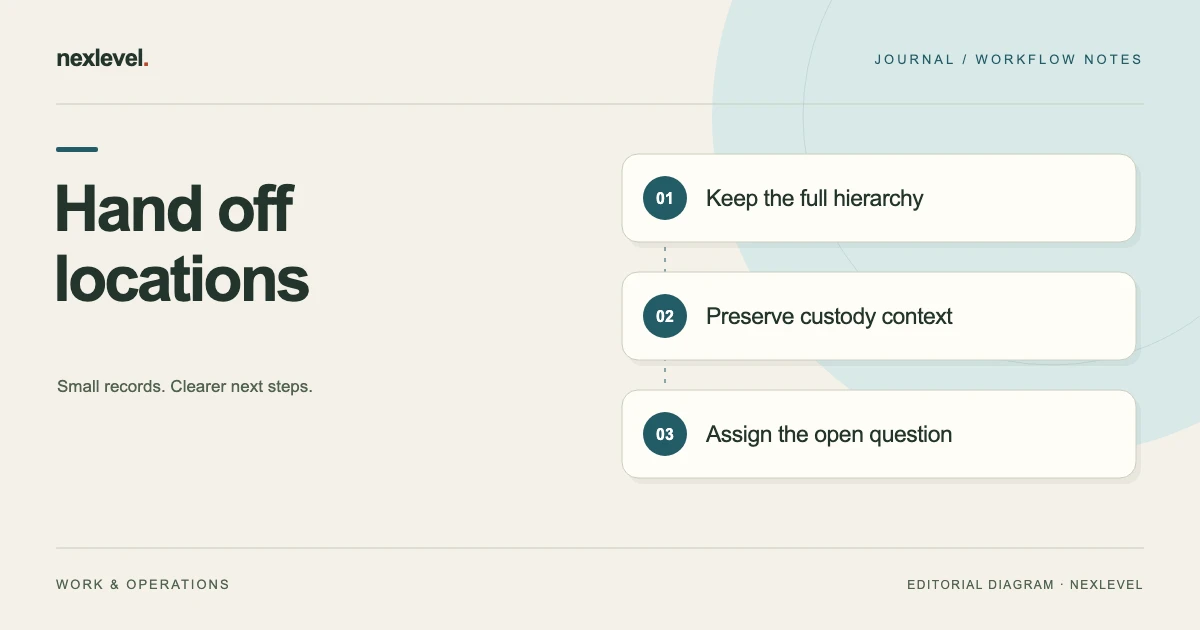
A freezer inventory handoff should let the next authorized reader find the selected item, reconstruct its full recorded location and understand what remains unresolved. Include the source cutoff and custody context, then identify the next source check rather than filling a gap with a guessed move.
Give the recipient a specific record question
- Define which freezer, boxes or selected items the handoff covers.
- Connect sample and aliquot references to their full hierarchy and relevant custody sources.
- Separate the readable question index from any supported encrypted recovery archive.
- Ask the recipient to reconstruct the selected question and record the next reviewer.
Working fields:
Scope/cutoff | Item | Full hierarchy | Custody source | Open relationship | Source needed | Next reviewer
Useful next steps: Check checkout and return history first, Check a barcode candidate against item identity, Prepare an archive with location context.
Define what is being handed over
A reviewer taking over location questions needs a different packet from someone testing recovery of a local inventory archive. Name the actual task before preparing a large copy.
Identify the selected freezer, rack, box, and record scope. A bounded handoff can be accurate without representing every inventory or later change.
FreezerGrid’s current listing describes a local research-inventory workspace. It does not advertise an automatic shared team database or a general credential-based ownership transfer. Use the actual responsible organizational arrangement.
Keep full hierarchy references
A position such as C5 can appear in several boxes. Preserve freezer, rack, box, and position together when the selected record needs that context.
Sample and aliquot identity should remain distinguishable where the actual source model separates them. A repeated name does not automatically establish a duplicate record.
The current app description supports visual hierarchy, sample and aliquot positions, barcode lookup, and search. Those features organize entered records; they do not independently verify the physical contents of a container.
Use a handoff index
Suggested fields are selected inventory scope, record reference, hierarchy source, custody context, open location question, next reviewer, portable-copy purpose, and actual verification result.
| Packet part | Question to preserve |
|---|---|
| Hierarchy | Which full recorded location applies? |
| Identity | Which sample or aliquot is selected? |
| Custody | Which entered check-out or return event is relevant? |
| Open question | What actual source is needed next? |
These are independent companion fields, not a claim that the app provides a formal team-handoff module.
Work through a fictional location question
Imagine sample S41 and aliquot A1, with a recorded position in box B12. Two racks use a similar box label, and an independent note mentions only C5.
The reviewer first matches the selected record and full hierarchy. They then identify whether the note describes current recorded location, an earlier custody occasion, or an unresolved proposed move.
Do not choose a location solely because its position code matches. If the actual source does not establish the relationship, retain the question and next responsible review rather than inventing a completed move.
Separate custody events from location summaries
A check-out or return action records a custody event through the supported workflow. A retained location summary may represent a different source moment.
FreezerGrid’s current listing describes durable custody history. Preserve the relevant source rather than replacing it with a vague “moved” note that loses the selected record identity.
For an actual discrepancy, use the separate box-move reconciliation guide. The handoff can preserve its result or limitation without creating another custody event merely to document the review.
Use lookup as a route, not independent validation
A barcode scan or search can help locate a record. Inspect the actual selected result and its hierarchy rather than treating a successful lookup as proof of every associated fact.
The handoff should retain a usable route for the intended authorized reader. A nickname familiar to the outgoing person may be insufficient for someone else.
This guide does not prescribe physical verification or specimen handling. The actual responsible laboratory process determines those actions and any applicable quality requirements.
Choose the appropriate portable form
FreezerGrid’s current Pro description includes encrypted archive export and restore. Its listing describes authenticated encryption and password-based key derivation, but not a generic PDF report or CSV export.
Do not design the handoff around an output the current source does not establish. A readable companion index and an encrypted restorable archive can serve different tasks.
Use the actual supported workflow and appropriate organizational process for archive access. The packet should identify its purpose without exposing credentials or unrelated research material.
Test recovery through the supported process
An archive file existing is not the same result as demonstrating the intended recovery task. Inspect the actual supported process within the authorized arrangement.
Check the selected identity, hierarchy, and relevant custody context after the intended test. Do not assume a file contains every relationship merely because it has a plausible name or extension.
This guide does not instruct deletion of existing records or invent an arbitrary import path. Preserve needed originals and use only the actual supported workflow and responsible process.
Keep reminders and device views separate
The current listing includes due-date reminders and Watch checkout actions, with expanded reminder automation under Pro. A prompt is not proof that an inventory check occurred.
A retained companion view can have another source context from the current working record. Inspect the actual selected result rather than entering another action simply to make two copies agree.
No synchronization timing or team-sharing guarantee is supplied here. If the relevant source is unavailable, preserve the specific next check.
Prepare a concise open-question register
A useful row names the sample or aliquot, full location context, unresolved relationship, source needed, and next reviewer. “Location issue” is too broad to preserve the reasoning.
Keep known context available while one field remains uncertain. A narrow unresolved question does not require declaring the entire inventory either fully verified or wholly unusable.
For tool-selection requirements, use the separate freezer inventory comparison guide. A handoff should not imply a new feature or capability was demonstrated just because a candidate was selected.
Correct the appropriate copy
If the working record is accurate but the index omits the rack, repair the index. Do not alter good custody history to match an incomplete summary.
If an actual record issue is established, use the supported workflow and inspect its result. Keep later clarification distinguishable from the earlier occasion.
A changed note does not automatically update every retained copy elsewhere. Identify the intended current packet through the actual private arrangement.
Run a recipient reconstruction test
Ask an authorized recipient to identify S41/A1, B12’s full hierarchy, the relevant custody context, and the unresolved C5 note. They should not need the outgoing person’s memory.
If they choose a rack from a position code alone, improve the reference. If they treat a planned move as completed custody, clarify the source role.
A short receipt can identify the selected scope, actual archive or index inspected, established result, and next owner. It does not validate specimen identity or certify GLP/GxP compliance.
Prepare the fictional inventory handoff rows
The scope row identifies the selected inventory and source cutoff. It should say whether the packet covers one freezer, selected boxes, or another bounded set. A narrow packet can be appropriate when the recipient’s task is specific, provided it does not claim to be a complete inventory of everything held elsewhere.
The identity row keeps S41 and A1 distinguishable according to the actual source model. If the same sample name appears in several records, preserve the reference that establishes which one the question concerns. A successful name search is only the beginning of that identity check.
The hierarchy row records freezer, rack, box B12, and position together. It should not rely on C5 alone. Repeated position codes are precisely why a hierarchy matters. The receiving person needs the selected source context, not a location guessed from the most familiar box label.
The custody row identifies the actual relevant check-out or return source. It should distinguish a saved event from an independent note about a proposed move. Reviewing the history is not another custody event and should not create a duplicate action merely to show the row was checked.
The question row identifies what remains unknown. For example, the C5 note may lack a rack reference or may concern an earlier occasion. Name that specific source relationship. A broad warning that “locations are wrong” would claim more than the selected review established.
The archive row identifies the actual supported portable form and its purpose. A companion index helps a person read the selected question; an encrypted archive supports a different recovery task. Do not call one a substitute for the other without actually demonstrating the intended process.
The access row belongs in the appropriate organizational arrangement. It can identify who will perform the next authorized check without exposing credentials in a broadly shared summary. The app’s local-first architecture does not decide a laboratory’s data-access policy or validate its quality system.
Check the recipient’s actual continuation task
If the recipient needs only to review S41/A1’s location question, test that task directly. They should be able to find the actual source and explain which hierarchy element is unresolved. There is no need to transfer unrelated inventory simply to make the packet larger.
If the recipient needs a supported recovery test, keep that scope explicit. Inspect the actual result for selected identities, hierarchy, and relevant history. A produced archive file does not establish recovery by itself. This guide does not direct deletion of existing records or an unsupported import.
For a hypothetical result where the source clarifies the full location, record that bounded relationship. It does not independently verify physical contents, specimen properties, or storage conditions. Those remain outside the administrative example and within the actual responsible laboratory process.
For a result where the source remains unclear, retain the next source needed and responsible reviewer. Do not create a completed move to make the summary consistent with an assumption. A precise open question is easier to continue than a false current location.
Keep retained copies distinct after clarification. An earlier exported index may still contain the old question. Identify the intended current packet through the actual arrangement rather than claiming every file elsewhere changed automatically when the working note was updated.
At the end, ask the recipient to explain what the handoff established and what it did not. They should identify the record relationship, supported archive or index purpose, and remaining limitation. They should not infer validation or physical handling from a documentation check.
A useful receipt can therefore name selected scope, actual sources inspected, demonstrated continuation task, intended copy, and next owner. The result is continuity of a bounded research-inventory question, not certification of the whole laboratory or a promise about every future record.
Check the selected plan’s capacity and export scope as part of the actual continuation task. FreezerGrid’s current listing distinguishes a bounded free workspace from Pro capacity and encrypted archive features. A handoff should not promise a capability that was not available in the workflow demonstrated.
Keep this separate from the scientific meaning of the inventory. A plan allowance is an app-access detail, not a reason to reinterpret sample identity or custody history. Preserve needed records and use the actual responsible process for retention and access decisions. The packet should state what was demonstrated, what source remains available, and what limitation affects the recipient’s next administrative step.
For a concise routing note, write the full hierarchy before the question: “S41 / A1; recorded freezer, rack, box and position; competing note: C5 only; next source: [identified record].” The recipient can then see exactly which missing relationship needs review without interpreting a short position code as a confirmed location.
Use FreezerGrid for the working inventory
FreezerGrid connects visual hierarchy, sample positions, lookup, custody history, and local records. Its current Pro description expands capacity, encrypted archive export and restore, and reminder automation.
Check the official FreezerGrid App Store listing for current features and plan details. Keep the handoff source-aware while leaving physical handling and organizational quality decisions with their actual responsible process.