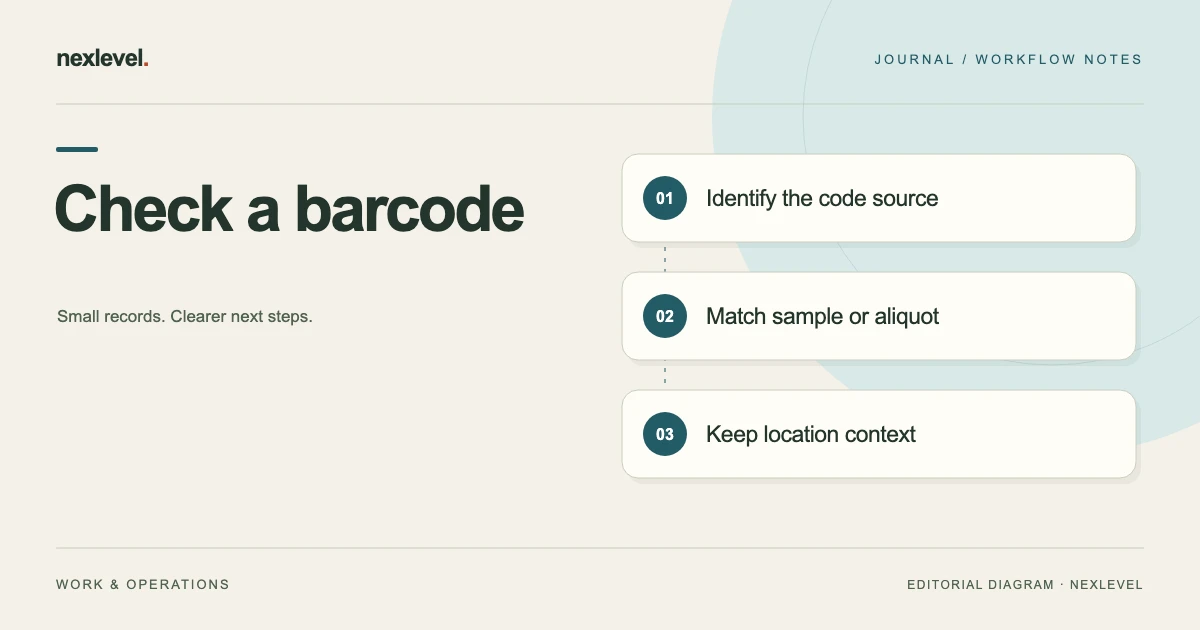
A barcode lookup retrieves an entered record; the next step is to establish whether that candidate represents the intended sample or aliquot. Compare the code source, item relationship and location occasion before using the result to explain a custody action or prepare a handoff.
Check the candidate record after the lookup
- State whether the task is intake, retrieval or review of an existing association.
- Match the candidate to the actual sample or aliquot source rather than a similar label.
- Keep the full location and its occasion separate from permanent item identity.
- Record a supported match, a copied-note correction or the precise source gap.
Working fields:
Lookup purpose | Code source | Candidate record | Item role | Location occasion | Match/source gap | Next check
Useful next steps: Fill the item identity template, Review the related custody history, Resolve a location discrepancy separately.
Choose the lookup question
Write whether the selected task is finding an existing record, reviewing an intake association, or checking a candidate before a custody-history review. Those tasks can involve the same code while needing different source relationships.
The bounded question is which selected item the available record actually represents. The exercise does not authorize a physical move or establish material condition.
A useful result can remain an explicit source question. Do not create a new sample merely to make an uncertain lookup appear resolved.
Set up a fictional barcode packet
Imagine B17 is the selected barcode-source reference, S40 a sample, A2 an aliquot, F3/R4/X5/P6 a recorded location chain, and L8 the candidate lookup result. C9 is the retained review note.
The selected question is whether B17/L8 establish the intended S40 or A2 relationship. The exercise does not assume a readable source automatically settles that identity.
These labels are teaching references rather than native identifiers or actual barcode contents. No real sample, container, label, project, person, or physical action is supplied.
Use a lookup-to-identity worksheet
| Role | Question to establish | Keep separate |
|---|---|---|
| Lookup purpose | Which actual record question is selected? | An instruction to handle material |
| Code source | What does B17 identify under the actual arrangement? | Readable text as physical identity proof |
| Candidate result | What record does L8 actually represent? | The intended item by assumption |
| Sample/aliquot role | Which S40/A2 relationship is established? | Interchangeable identifiers |
| Location context | Which occasion does F3/R4/X5/P6 represent? | Permanent item identity |
| Next action | What source question remains? | A custody action already performed |
| Retained copy | What cutoff does C9 represent? | Every later record change |
This is an independent companion worksheet. It does not establish native custom fields, a duplicate-code detector, or automatic source verification.
Separate scanning from establishing identity
FreezerGrid currently advertises barcode scanning for intake and lookup. That capability helps access entered records;the public description does not say it independently verifies a container’s contents.
For the selected B17 source, preserve the actual association the available record establishes. Do not broaden a successful retrieval into a physical or procedural conclusion.
If the relationship is unclear, keep the exact question beside the candidate result. A more confident caption cannot supply the missing source evidence.
Distinguish sample and aliquot roles
The current app supports both sample and aliquot records. S40 and A2 therefore need their actual selected relationship preserved rather than being treated as interchangeable references.
A similar naming pattern or nearby position does not independently establish a parent-child association. Use the authorized source arrangement needed for the real record question.
This exercise supplies no material quantity, preparation process, or physical derivation. It concerns entered identity roles only.
Keep the full location chain visible
A coordinate can recur in several boxes. Preserve enough freezer, rack, box, and position context to explain the location source selected for L8.
F3/R4/X5/P6 is a fictional reference chain, not a storage recommendation. It should not replace S40 or A2 as permanent item identity.
The inventory organization guide covers the broader identity-and-location task. Keep the lookup check bounded to the relationship actually under review.
Do not assign the nearest-looking candidate
Search or lookup results can contain familiar labels without establishing every intended association. Identify which candidate source actually matches the selected item context.
If another record has a similar name, project, or location label, preserve the difference until the relevant source relationship is established.
The public description does not establish a universal matching identifier or automatic merge workflow. Do not invent one to make the proposed method sound more decisive.
Keep intake separate from retrieval
Looking up an existing record and creating a new entered association have different roles. An uncertain result should not automatically become a reason to duplicate the item.
If the task is intake, preserve the actual source context needed for the selected record. If it is retrieval, identify what L8 represents before describing it as a new source.
The worksheet does not claim arbitrary external barcode-database import or an automatic label-authoring feature. Use actual supported controls and retain uncertainty where needed.
Work through a matched-identity branch
In the first fictional branch, the authorized sources establish B17/L8 as the selected A2 record, with A2’s relationship to S40 clear. The location chain retains its actual selected occasion.
C9 can preserve those relationships as an administrative lookup result. It should not claim physical presence, material integrity, or compliance.
The check also does not validate every other barcode or record. Keep its scope tied to the selected source set.
Work through a wrong-item branch
In another branch, L8 concerns another item with a similar label. Correct the candidate association in C9 or retain the precise source question.
Do not rewrite an accurate sample record merely to make the mistaken lookup explanation fit. The error may be in the selected companion note rather than the underlying history.
The exercise performs no relabeling, physical move, or material handling. It identifies the administrative relationship that needs review.
Work through an unavailable-scan branch
In a third branch, the selected scanning route is unavailable. FreezerGrid also advertises search across names, barcodes, projects, and locations;use the actual supported search context if it answers the selected record question.
An unavailable scan does not independently establish that an item is absent or that the inventory is empty. Keep availability and identity in different roles.
This guide supplies no undocumented permission flow, retry button, or device reset procedure. Preserve the actual limitation rather than invent a recovery control.
Keep repeated labels separate from duplicate records
Two retained notes containing B17 do not independently establish two samples. Identify the underlying source relationship before counting records from copied references.
Conversely, two similar-looking items are not automatically duplicates. They can represent distinct samples, aliquots, or source occasions.
The current listing does not establish automatic deduplication. Do not delete or merge accurate history by assumption to make a candidate list look simpler.
Separate location changes from lookup corrections
A copied box reference can be wrong while the underlying source remains accurate. Repair that explanation using the actual established hierarchy.
The box-move reconciliation guide addresses a related task. A documentation correction should not silently become a physical move or a new sample record.
If the original location source is unclear, retain that different question. A cleaner copied chain cannot establish where material physically is.
Keep custody actions separate from lookup
FreezerGrid advertises checkout and return actions with durable custody history. A retrieved identity record is not itself a checkout or return.
Use the checkout-and-return review guide when the selected history relationship needs checking.
This lookup exercise performs no custody action. Its result can make a later authorized administrative review specific without claiming that material was handled.
Keep reminders and Watch actions in their own roles
The current app includes private on-device due-date reminders and quick Watch checkout actions, with reminder automation among Pro capabilities. Those features should not be used as substitutes for the selected barcode identity source.
A prompt does not establish a saved custody event, and an attempted device interaction does not independently establish the selected record relationship.
The public description does not document every synchronization or confirmation rule. Do not borrow another app’s queueing behavior for this method.
Choose a supported retention representation
FreezerGrid Pro currently advertises encrypted archive export and restore. Its public description does not establish universal PDF or CSV output.
A human-readable companion note can preserve the lookup purpose and source relationships without becoming a native archive schema. Keep the two representation roles distinct.
This exercise performs no restore and does not verify recovery of the full inventory. It also does not place archive passwords or unnecessary research contents into a broadly shared source index.
Run an independent lookup-reading test
Give another authorized reader C9 and usable controlled source routes. Ask what B17 represents, which record L8 identifies, and how S40/A2 and the location chain are related.
Then introduce another box with the same coordinate or another item with a similar name. The reader should preserve the actual selected identity rather than assign the first familiar candidate.
Record any manual explanation needed. Repair a confusing copy when the source is accurate;retain a precise question when the source relationship remains unresolved.
Use a copy-ready lookup receipt
A companion receipt can identify the lookup purpose, B17/L8 source set, selected sample or aliquot, established location context, actual representation inspected, copy correction, cutoff, and next question.
For the matched fictional branch, it preserves A2/S40’s actual relationship without a physical condition claim. For the wrong-item branch, it identifies the mistaken association and leaves the intended source question open.
Read the receipt without its filename. A future reviewer should understand the administrative result without reconstructing the original bench conversation.
Connect the check to handoff and retention
For an administrative transition, use the inventory handoff guide. For historical copies, use the location-context archive guide.
For choosing a working method, use the inventory tool comparison. Keep the selected lookup question visible when deciding which representation serves a task.
A useful packet can make the next source review specific while leaving physical laboratory decisions and validated-system conclusions outside its administrative scope.
Make a candidate-selection note concrete
For the fictional matched branch, a companion note can identify B17 as the selected code-source reference, L8 as the reviewed candidate, and A2 as the item role established by the authorized source. It can separately identify S40’s relationship and the F3/R4/X5/P6 location occasion.
Suppose another candidate shares the project label but concerns S40 directly. The familiar project does not make it interchangeable with A2. Keep the actual sample-versus-aliquot relationship visible before using either candidate in another administrative review.
Suppose instead that L8’s identity is clear but its location differs from an older retained C9. Establish the source occasions before calling the lookup wrong. The older note may accurately represent an earlier location context.
If the source does not distinguish those relationships, record that precise limitation. A more confident label or a copied hierarchy cannot establish the missing item association.
For a final practical check, remove the original folder context and ask an authorized reader to identify the selected code source, candidate, item role, location occasion, and next question. They should not need actual barcode contents or unnecessary research details in a broad worksheet. Their answer should preserve what was established while keeping physical presence, material condition, and custody actions outside the lookup result.
Record the actual correction separately from its interpretation. Updating a companion candidate label does not create a native sample, change a barcode association, or move material. Keeping that distinction explicit lets the next reviewer continue from the established source result instead of guessing which action occurred.
Use FreezerGrid for clear entered lookup context
FreezerGrid connects local sample and aliquot records, barcode lookup, location hierarchy, and durable custody history without requiring an account.
Check the official FreezerGrid App Store listing for current capabilities and access. Keep code sources, candidate records, item identity, location, custody, and actual material condition distinguishable.