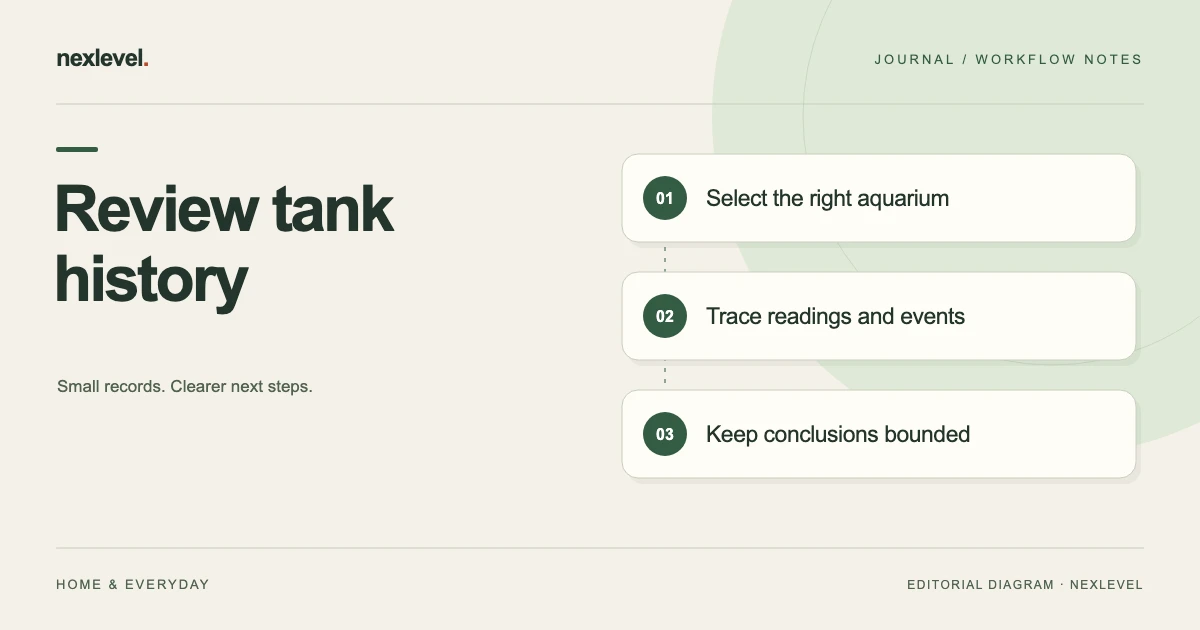
Before preparing an aquarium report, confirm the selected tank, reading units, source occasions and equipment-event context. Preserve what happened before and after each event without treating sequence as proof of cause, then inspect the actual PDF for the question it needs to answer.
Check the timeline-to-report relationship
- Define the report purpose, tank, intended reader and source cutoff.
- Match readings and equipment events to that tank and their actual occasions.
- Keep target bands and scheduled tasks separate from measured results and completion evidence.
- Inspect the whole selected report and companion note for missing context or unsupported conclusions.
Working fields:
Tank/purpose | Reading/unit/occasion | Equipment source/order | Band basis | Planned vs recorded | PDF inspected | Gap | Cutoff/stage
Useful next steps: Check reading and tank association, Keep band comparisons separate from health claims, Prepare the recipient handoff.
Define the report question first
Write a bounded purpose: “Review the selected aquarium timeline before preparing a representation of the supplied readings and equipment context.” Identify the tank, source occasion, intended reader, cutoff, and next task. This is narrower than evaluating the aquarium’s condition.
A report for a historical equipment discussion may need different context from a report for checking a copied reading. Keep the actual purpose visible rather than assume one output answers every question.
Preparation is also separate from sharing. A report can be ready for inspection without having been delivered or interpreted by another person.
Keep the selected tank identity clear
TankLedger advertises independent tank volume, parameters, schedules, and history across different setups. A familiar room label or similar photograph should not substitute for the actual selected aquarium relationship.
Compare the tank context behind the relevant readings and events before considering trends. Correct values from another aquarium would still be unsuitable for the selected report question.
If the association is unprovided, retain that exact question. Do not choose the most familiar tank merely to make the report packet complete.
Create a controlled fictional timeline
For this exercise, T47 identifies the selected tank. R2 is an earlier reading role, E3 a recorded equipment-event role, and R4 a later reading role. P5 identifies the candidate report and N6 the companion review note.
The references establish no actual parameter value, target band, device model, operating method, animal condition, or maintenance result. Another tank, U7, appears only in a look-alike branch.
These labels are independent worksheet references, not native field names, a promised report schema, or evidence that a test or equipment action occurred.
Review exact readings at their own occasions
The app advertises exact values, notes, and timestamps, with several parameters logged in one session. Keep each selected reading tied to its tank, parameter identity, unit, and actual source occasion.
A number without its unit or parameter context is not enough for a meaningful record comparison. A similarly named parameter should not silently become another measurement because its value looks familiar.
This exercise supplies no actual reading. For the broader matching task, use the tank-reading association guide.
Read equipment events as recorded context
TankLedger advertises equipment events in the chronological timeline. Identify what E3 actually represents when a relevant source is supplied: a note, recorded change, or another supported event role.
A planned equipment action and a recorded event are different stages. A photograph can provide context without establishing every operating fact about a device.
Do not invent automatic equipment recognition, technical inspection, or a causal analysis feature. The administrative task is to preserve the relationship between the selected record and its report representation.
Separate sequence from cause
The fictional sequence places R2 before E3 and R4 after it. That chronological relationship alone does not establish that the equipment event caused any reading difference.
Keep the actual source occasions visible while leaving causal interpretation outside what this packet proves. A report can accurately show before-and-after context without supplying an experimental conclusion.
The guide performs no test, equipment action, or scientific analysis. Do not turn an understandable timeline into a diagnosis or treatment recommendation.
Keep keeper-defined bands in their actual role
The listing advertises comparison with keeper-defined target bands. Those are selected organizational preferences in the record, not universal safety limits for every aquarium.
If a band is actually supplied, retain its basis and selected tank relationship in any companion explanation. If the basis is unprovided, keep that limitation rather than attribute it to a professional or standard.
A reading appearing inside a selected band does not by itself establish an animal’s health. This exercise supplies no band or biological interpretation.
Keep scheduled maintenance separate from events
The app advertises recurring maintenance tasks and due or overdue work. A scheduled reminder is not proof that the physical maintenance occurred.
When a report question concerns actual events, identify the relevant entered source rather than treat every due task as completed history. Preserve any unprovided relationship explicitly.
This guide recommends no maintenance interval, dose, water-change amount, or care procedure. Substantive aquarium decisions require their actual relevant research and professional review.
Use a copy-ready pre-report worksheet
A practical companion worksheet asks for selected tank, report purpose, reading references and units, relevant notes/timestamps, equipment-event sources, chronological relationships, keeper-defined band context, and scheduled-work distinctions.
Add actual representation inspected, cutoff, missing associations, corrections, next source task, and sharing stage. Keep any biological or technical conclusion outside the evidence supplied by this exercise.
These prompts form an administrative structure. They do not assert native required fields, an automated report validator, or an import-ready template.
Fill the source-clear branch
In the first fictional branch, R2/E3/R4 clearly belong to T47 at their stated occasions. N6 can preserve their order and selected roles without claiming a parameter value, causal relationship, or animal outcome.
P5 remains a candidate representation until an actual supported report is prepared and inspected. A clear packet does not establish that the app exported every possible record or attachment.
The preparation task can therefore finish with a bounded source explanation while substantive aquarium interpretation remains outside its scope.
Fill a mixed-tank branch separately
In another branch, E3 belongs to U7 rather than T47. Keep that source relationship instead of attaching the event to the selected tank because a device label looks familiar.
The next task is to identify the relevant T47 equipment context, not to invent a missing event. If the association is unknown rather than established as U7, record an unprovided relationship instead of a proven mismatch.
For initial setup context, use the tank and equipment source guide. This report review does not alter a native record.
Inspect the actual supported PDF
TankLedger advertises polished PDF reports through Pro. Inspect the actual selected output rather than assume every timeline field, note, photo, or attachment appears in every representation.
A missing detail in a PDF should first be read as an output-scope question. It does not automatically establish that the source record was deleted or lost.
The public description does not document every filter or layout choice. Use the supported representation that answers the real task instead of inventing an export schema.
Compare a report with later timeline material
Suppose actual later reading R8 becomes available after N6’s cutoff. Give it its own source occasion before preparing another representation.
P5 can remain accurate history of the selected earlier context. Do not make it appear to contain a reading or equipment event that had not yet been supplied.
If only a companion heading calls the old report current, correct that explanation. A copied-label correction and a new timeline event are different administrative outcomes.
Preserve local work and optional sync
TankLedger works locally without an account. Optional Pro iCloud synchronization uses the user’s private iCloud database. Keep that advertised option separate from a mandatory backend or invented household-sharing service.
A record existing on one device does not establish that another person received the PDF. Choose an actual authorized sharing task and preserve its stage separately.
This exercise makes no network request and shares no aquarium data. Supply only material needed for the selected real review.
Keep portable output distinct from restoration
The listing advertises CSV export alongside supported reports. A portable copy can help review selected records without necessarily containing every editable relationship or attachment.
Do not describe CSV or PDF as arbitrary import or guaranteed complete workspace restoration without supporting documentation. This exercise imports nothing, restores nothing, and deletes no records.
For retention, use the equipment-context archive guide. Preserve which representation and source occasion each copy describes.
State current access accurately
The advertised free tier supports one aquarium, five parameters, three recurring tasks, basic history, and local storage. Pro expands aquariums and panels and includes advanced trends, PDF reports, widgets, and optional private iCloud sync.
Monthly, annual, and lifetime access are advertised. The monthly seven-day trial depends on Apple’s eligibility result; do not infer the same offer for every plan.
Expanded access cannot establish a missing tank association, biological suitability, or causation. Keep entitlement and evidence review separate.
Run a timeline-to-report reading test
Give an authorized reviewer the fictional references and N6 without the original folder context. Ask which tank is selected, what R2/E3/R4 represent, what their order establishes, and what remains unprovided.
Then introduce U7 and a later R8 separately. The reader should preserve tank identity and source occasions rather than attach the most familiar event.
Record any explanation still needed. A useful result can specify the next source question without giving animal-care advice or claiming the whole aquarium was independently assessed.
Write a bounded report-review receipt
A compact fictional note can state: “T47 is selected. R2/E3/R4 have their supplied reading/event roles and order. The packet supplies no parameter values, target bands, causal finding, or biological result. P5 is a candidate report; actual output scope and sharing stage require their own inspection.”
Add actual source references and corrections only when they exist. Keep accurate historical records intact while repairing a companion explanation that used the wrong tank or occasion.
TankLedger is recordkeeping, not animal diagnosis, treatment, or a replacement for species research, product instructions, or qualified veterinary advice.
Fill the selected-role review before interpreting a trend
For tank identity, N6 can name T47 and the actual source establishing that association. If the source is missing, the next task concerns identity rather than water interpretation.
For R2 and R4, retain their reading roles and occasions without inserting values the fictional packet does not supply. For E3, retain the recorded equipment context without claiming that every physical operating fact was observed.
For a keeper-defined band, state whether its source is supplied. For P5, identify the candidate representation and what actual output was inspected, if any. This role-by-role check avoids letting one clear relationship stand in for the entire report.
Separate a correct report from an unsupported conclusion
A PDF can accurately represent selected records while a companion explanation overstates their meaning. For example, an explanation might call the after-event reading proof that equipment fixed a problem. The chronological source set alone does not establish that claim.
Correct the unsupported explanation at its own level while preserving accurate records. Do not alter the timeline to make the stronger conclusion appear true.
Likewise, an absent field in a selected output does not prove the underlying record never existed. Identify the actual scope question and next source task. A careful administrative review can make the report easier to use without becoming an assessment of the aquarium, its equipment, or its animals.
Use TankLedger for contextual aquarium reports
Retain the selected tank, representation inspected, and cutoff beside the review result. That lets another reader identify exactly which source context was considered without treating an administrative report check as a new aquarium event.
TankLedger connects selected panels, exact readings, keeper-defined bands, tasks, equipment events, notes, photos, and chronological history.
Check the official TankLedger App Store listing for current capabilities and access. Keep source records, report copies, scheduled work, and biological outcomes distinguishable.