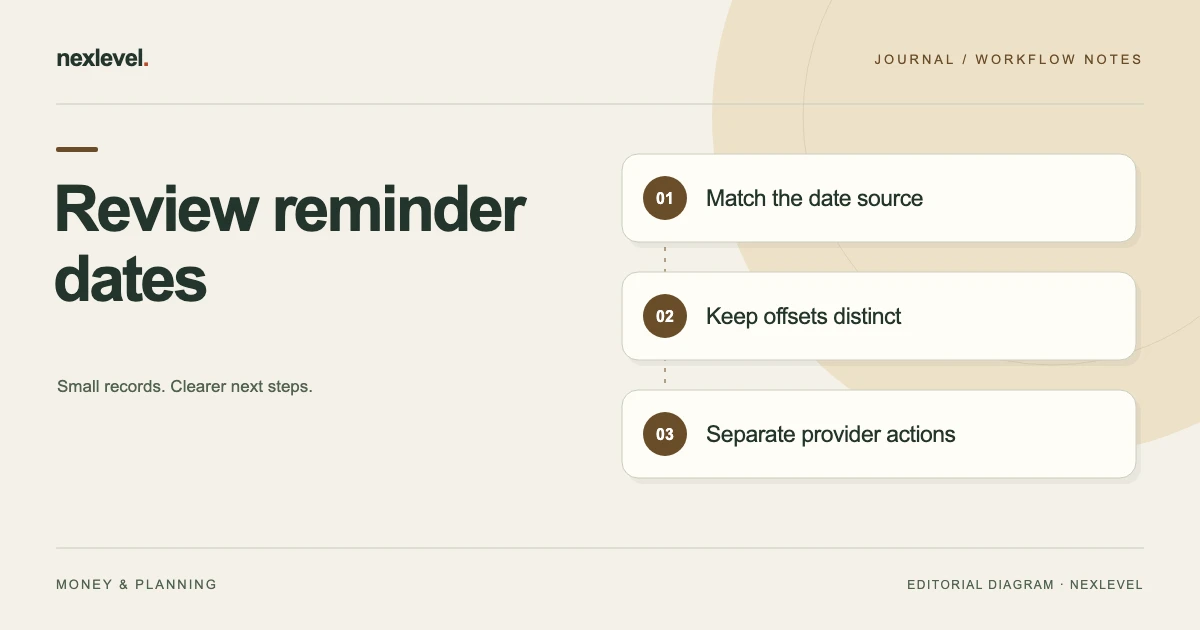
When a renewal-date source changes, establish whether the later date concerns the same service, plan and event before updating the reminder basis. Then inspect the actual local date and offset. A reminder preference does not establish a provider deadline or prove notification delivery.
Check that the new date describes the same event
- Compare earlier and later sources for service, plan and event identity.
- Distinguish renewal dates from purchase, trial or access events.
- Review the selected entered date and chosen reminder offset in the actual local representation.
- Keep the source change, copied-note correction and provider action as separate results.
Working fields:
Service/event | Earlier source/date | Later source/date | Applicability | Entered date/offset | View inspected | Next check
Useful next steps: Check the original billing-source record, Review upcoming decisions monthly, Retain earlier source occasions.
Define the changed-date question
Write a bounded purpose: “Review the selected reminder after later source material establishes a different renewal-date context.” Identify service/plan, earlier source, later source, entered-date role, offset, cutoff, and next task.
A different date is not automatically evidence of a provider change. It may describe another plan, a different event, or a corrected companion explanation.
Keep the actual relationship visible before calculating any reminder reference or declaring the local record current.
Keep manual entry within its advertised role
DueNudge advertises manually adding services, selecting cycles and next dates, and choosing reminders. Do not describe a later source as automatically synchronized from a bank, email account, or provider system.
The official description requires no account or bank connection. A local record can be useful without independently verifying every provider term or event.
For initial preparation, use the billing-source setup guide. This review focuses on the later date relationship.
Create a controlled fictional source set
For this exercise, S28 identifies the selected service/plan context. D2 is an earlier source role associated with July 22, 2032; D3 is later material associated with July 24, 2032.
E4 identifies the entered-date role, O5 a hypothetical five-calendar-day reminder preference, V6 a selected reminder view, and N7 the companion note.
No real provider, subscription, account, deadline, charge, cancellation term, or notification is supplied. These labels are independent references, not native field names or an import schema.
Check service and event identity before date arithmetic
Confirm what actual relationship connects D2 and D3 to S28. A familiar service name does not establish the same plan, account context, billing stage, or event type.
A purchase date, trial date, and next renewal date have different roles. Do not choose the later number merely because it looks more current.
If applicability is unprovided, retain that precise source question rather than treat the difference as an error or complete the reminder model with an assumption.
Read the earlier reminder reference
Under the explicit fictional teaching assumptions, July 22, 2032 minus five calendar days gives July 17, 2032. That is an independent date reference based on the selected earlier input.
It is not an observed native alert, a real deadline, or a recommendation about how much time a provider requires. No time-zone, daylight-saving, or holiday rule is supplied.
Keep the selected date and offset beside the reference so a later reader can reproduce the limited arithmetic without inferring provider terms.
Read the later reminder reference separately
If D3 actually establishes July 24 for the same selected next-date context, the same independent five-day preference gives July 19, 2032.
The source dates differ by two calendar days. That difference establishes the teaching model’s changed reference, not a charge adjustment or successful cancellation.
This exercise performs no native edit or reminder scheduling. It does not claim that DueNudge automatically reads the later material.
Keep a preference separate from a provider requirement
O5 is a chosen organizational offset. It does not establish the provider’s cancellation window, billing policy, or a guaranteed opportunity to act.
A companion sentence saying “you have five days to cancel” would exceed what this preference alone establishes. Correct the wording rather than invent a provider term to support it.
The example supplies no actual cancellation advice or financial recommendation. It reviews the meaning of selected source and calendar roles.
Use a copy-ready changed-date worksheet
A practical companion worksheet asks for service/plan context, earlier source/date role, later source/date role, applicability evidence, selected entered date, reminder offset, and independent reference basis.
Add actual view inspected, source occasions, cutoff, missing relationships, correction source, next task, and any provider-action evidence supplied separately.
These prompts are an administrative structure, not native required fields, an automatic billing checker, or an import-ready template.
Fill the source-change branch
In the first fictional branch, D3 clearly concerns the same selected next-date role at a later occasion. N7 can preserve both source occasions and the independent shift from July 17 to July 19.
It should not make the earlier note appear to contain later information. Nor should it state that a provider changed a charge unless a relevant actual source establishes that separate event.
The administrative result is a clearer date basis. No subscription is created, renewed, paid, or canceled by this exercise.
Fill a different-event branch separately
In another branch, D3 describes a purchase or trial event rather than the selected next renewal. Keep that actual role instead of substituting it into E4 by appearance.
The next task concerns the relevant renewal source, not a generic instruction to use the newest date. A mathematically correct subtraction with the wrong event basis would not answer the selected question.
If the source relationship is unknown, retain an unprovided question rather than a proven mismatch. The guide establishes no native app defect.
Inspect the actual local reminder representation
DueNudge advertises local reminders at configurable day offsets, plus upcoming renewals in dashboard and calendar views. Inspect the actual selected context rather than infer it from an old copied date.
A scheduled prompt is not proof that somebody saw it. An absent source in this packet also does not prove that no notification or provider event exists elsewhere.
This example guarantees no alert delivery and supplies no native notification algorithm. It preserves what an actual review would need to establish.
Keep billing cycles and amount roles distinct
The app advertises weekly, monthly, quarterly, annual, and custom cycles. A changed date source does not automatically establish a changed cycle or price.
Likewise, a monthly amount and an annualized total are modeled roles, not bank transactions. The official description keeps totals for different currencies separate.
This review supplies no amount, exchange rate, financial forecast, or spending recommendation. Keep any later cost question tied to its actual source.
Keep cancellation information separate from action
DueNudge advertises saved cancellation links, contact details, and notes. Those records do not establish that a request was submitted or completed.
The app cannot cancel third-party subscriptions for the user. For that source distinction, use the cancellation request and outcome guide.
This exercise opens no link, contacts no provider, sends no message, and performs no cancellation.
Preserve source updates and copy corrections separately
If actual later material changes the selected date basis, give it its own source occasion. If only a companion note copied the wrong date, correct that explanation at its actual level.
Do not invent a provider event to make an inaccurate copied label appear true. The original source can remain accurate history of the context it represented.
For retention, use the renewal-source archive guide. Do not claim a native versioned-audit feature the public description does not establish.
Preserve local work and portable-copy limits
The advertised workflow requires no account or bank connection, and records stay on device unless explicitly exported. Locally supported review should not acquire a new mandatory server or financial-login requirement.
Pro includes CSV export. A readable copy is useful for selected review without automatically being arbitrary import or guaranteed complete workspace restoration.
This exercise exports nothing, imports nothing, restores nothing, and deletes no records. Supply only authorized material needed for an actual task.
State current purchase options accurately
DueNudge Pro advertises unlimited active subscriptions and CSV export through monthly access or a one-time lifetime unlock. Apple processes purchases, and restoration is available from the Pro screen.
Do not confuse an annual service billing cycle with an annual Pro option. The selected current description does not advertise that purchase option or an introductory trial.
Do not invent numerical free quotas or localized prices. Expanded access cannot validate a date source or complete a third-party action.
Run a changed-date reading test
Give an authorized reviewer N7 and the fictional references without the original folder context. Ask what D2/D3 represent, what O5 establishes, and why the independent reminder references differ by two days.
Then introduce another event type and a cancellation note separately. The reader should preserve their actual roles rather than treat every date as interchangeable.
Record any explanation still needed. A useful result identifies the next source task without giving financial advice or claiming a provider outcome.
Write a bounded review receipt
A compact fictional note can state: “S28 uses selected D2/D3 date contexts. Under the hypothetical five-calendar-day preference, July 22 gives July 17 and July 24 gives July 19, 2032. O5 is a reminder preference, not a cancellation requirement. Actual alert receipt and provider actions remain unprovided.”
Add actual later sources and corrections only when they exist, with their own occasions. Keep accurate source material intact while repairing an unsupported companion explanation.
For a reusable structure, use the renewal tracker template. Preserve the selected changed-date purpose when adapting it.
Fill the changed-date note
N7 can preserve D2 and D3 as separate source occasions, identify which next-date relationship each actually establishes, and keep O5 as the selected preference.
The independent reminder references should stay beside their input dates and offset. A reader should not have to infer whether a displayed prompt came from the old source, later source, or another event.
If the selected service association is unprovided, retain that source question before doing more arithmetic. A familiar name is not enough to establish the relevant plan or billing stage.
Keep a corrected explanation separate from provider activity
If only the companion note copied the wrong date, correct that explanation against the actual source. Do not invent a renewed service, billing change, or accepted cancellation to make the copied label appear true.
If a later actual provider statement supplies another date basis, give it its own occasion. The older review can remain accurate history of the material available at its cutoff.
The selected local reminder representation still needs its own inspection. A source existing does not establish that every relevant local record or prompt was changed.
Keep the packet’s limitations precise
An unprovided alert-receipt source does not prove no notification was seen. An unprovided provider-action source does not prove a service was unchanged everywhere. State what this packet lacks instead of making a universal negative claim.
Similarly, a five-day preference does not establish a provider’s required action period. The worksheet’s calendar exercise supplies no real deadline or advice about how to satisfy a term.
A future reader should be able to identify the service context, date roles, selected preference, actual representation, and next source question without reconstructing the original billing conversation. That is a useful administrative result while charges, eligibility, cancellation, and financial decisions remain separate.
No link is opened and no message is sent merely to complete this review.
Use DueNudge for clear reminder sources
Keep the selected service, date-source occasions, offset preference, and cutoff beside the result. Another reader should be able to identify what was inspected without treating the note as a current provider rule or proof of notification receipt.
DueNudge connects manually entered service details, cycles, next dates, local reminders, separate-currency totals, cancellation information, and supported export.
Check the official DueNudge App Store listing for current capabilities and access. Keep source dates, local prompts, modeled representations, and actual provider actions distinguishable.