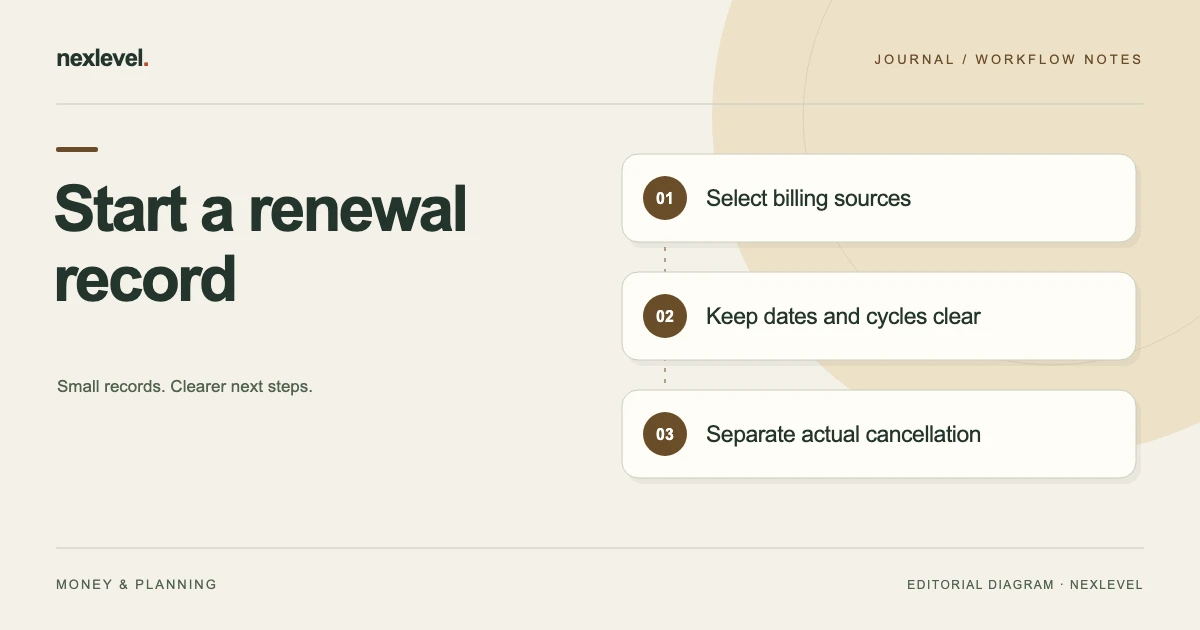
Start a renewal record with the source that identifies the selected service and plan, recurring billing basis, amount/currency and next relevant date. A receipt may establish a purchase without establishing recurrence or renewal. Keep trial, reminder and cancellation details in their own roles.
Establish recurrence and the next date before modeling totals
- Match the selected service and plan to the actual billing source.
- Verify that the amount is recurring and retain its billing period and currency.
- Record the next renewal or trial-event date from its own source.
- Choose local reminder preferences and retain any missing-source question explicitly.
Working fields:
Service/plan | Billing source | Recurrence/amount/currency | Next-date source | Trial role | Reminder preference | Open question
Useful next steps: Use the complete renewal template, Review a later date-source change, Check currency and period models.
Choose one subscription and one source question
Write a bounded purpose: “Prepare the selected renewal record from the supplied service and billing material.” Identify the subscription context, relevant source occasions, currency, intended record use, and next task.
A familiar service name does not establish which plan, account context, billing cycle, or date is selected. Keep the source relationship visible before copying a number into a recurring record.
The task can finish with a precise missing-source question instead of invented certainty about every field.
Use the advertised manual-entry workflow
DueNudge advertises manually adding a service, choosing its billing cycle and next renewal date, selecting reminders, and keeping cancellation links, contact details, and notes.
Do not invent automatic bank reconciliation, email scanning, provider-policy discovery, or an account connection. The listing explicitly requires no bank connection and no DueNudge account.
A companion worksheet can preserve source references without claiming the app ingests every invoice, document, or screenshot as a native attachment.
Create a controlled fictional record
For this exercise, S12 identifies a hypothetical service. P2 is the selected plan-context source, B3 the billing-source role, D4 a next-renewal-date role, and T5 any relevant trial context.
C6 identifies a cancellation-detail source, R7 a reminder preference, and N8 the independent setup note. No real provider, user account, subscription, link, invoice, charge, or term is supplied.
The references demonstrate companion source roles, not native field names, an import schema, or evidence that a service was purchased or canceled.
Keep dates in their actual roles
A source describing when a subscription was purchased does not automatically establish the next renewal date. A trial’s start or end context also needs its own relevant source.
If D4 is unprovided, retain that exact gap rather than calculate a date from an unrelated receipt by habit. The public description does not establish every provider’s date rule.
This exercise supplies no real deadline or cancellation policy. It prepares an understandable source basis for actual supported manual entry.
Choose billing cycles from the selected source
The app advertises weekly, monthly, quarterly, annual, and custom billing cycles. Keep the selected actual cycle separate from a generic interval guessed from the next visible date.
A monthly cycle should not automatically be described as thirty days. A custom cycle should not silently become annual because a note mentions a yearly budget.
The worksheet does not reconstruct a native recurrence algorithm or prescribe provider behavior. It records what the relevant source actually establishes.
Keep the amount and currency together
For an independent teaching model, assume the selected source states 12 per month in one currency. The example excludes all tax, fees, discounts, promotions, exchange changes, and other adjustments.
The amount is fictional bookkeeping input, not a current price or advice about whether to keep a subscription. Preserve what period the amount covers before comparing it with another record.
If the source basis is unprovided, identify the question rather than copy a familiar number into an annual or monthly total.
Distinguish annualized modeling from actual charges
Under the explicit teaching assumption of twelve unchanged monthly periods, 12 multiplied by 12 gives 144. That is an independent annualized model, not an actual annual invoice or promise that a provider will charge exactly that amount.
DueNudge advertises monthly and annualized totals. Keep a modeled representation separate from bank transactions, eligibility, future pricing, or a decision to cancel.
The exercise makes no payment, accesses no financial account, and supplies no recommendation about spending.
Keep different currencies separate
The official description says totals for different currencies stay separate. A currency label therefore matters to understanding a record rather than being decorative text.
This fictional setup uses one currency and performs no conversion. Do not invent a live exchange feed or add unrelated currency amounts into a single financial result.
Likewise, a category grouping does not establish that two services have the same billing basis. Preserve each selected source relationship before interpreting a total.
Use a copy-ready initial-renewal worksheet
A practical companion worksheet asks for service/plan context, billing source and occasion, amount/currency basis, selected cycle, next-date source, trial role, cancellation-detail source, and reminder preference.
Add actual representation inspected, cutoff, missing associations, later-source references, next task, and any chosen export stage.
These prompts form an administrative structure. They are not native required fields, an automated financial checker, or an import-ready template.
Fill the source-clear branch
In the first fictional branch, P2/B3/D4 clearly concern S12 at their supplied occasions. N8 can preserve those roles and the limited amount/cycle model without asserting a real charge.
T5 and C6 retain only the trial and cancellation relationships actually supplied. A saved link is not an action, and a trial label does not establish a provider’s full terms.
The setup task can be clear while the actual service relationship remains outside this exercise. No native renewal record is created here.
Fill a conflicting-date branch separately
In another branch, two supplied sources describe different date roles or occasions. Identify whether they actually concern the same next-renewal relationship before treating the difference as an error.
A later provider statement may be new source context; a purchase receipt may describe another event. Keep those roles explicit instead of choosing the most familiar date.
If the relationship is unknown, retain an unprovided source question rather than a proven mismatch. The guide establishes no native app defect or actual provider mistake.
Review reminders as local calendar prompts
DueNudge advertises local reminders at configurable day offsets. A selected offset is a preference applied to the entered renewal context, not a provider confirmation or cancellation action.
For independent date arithmetic, a hypothetical May 20, 2032 renewal with a five-calendar-day offset gives May 15, 2032. These are fictional dates, not a native notification test or real deadline.
The example specifies no time-zone or daylight-saving algorithm and guarantees no alert delivery. Inspect the actual supported reminder state in a real task.
Keep cancellation details separate from cancellation
The app advertises saved cancellation links, contact details, and notes. Keeping that information close does not establish that a cancellation request was submitted or completed.
DueNudge cannot cancel third-party subscriptions for the user. For the later source-tracking task, use the cancellation request and outcome guide.
This exercise opens no link, sends no message, contacts no provider, and performs no cancellation.
Keep later billing sources at their own occasions
If an actual later source changes an amount, cycle, or next date, identify its relationship before preparing another explanation. The earlier note can remain accurate history of what was supplied at its cutoff.
If only a companion label calls a monthly amount annual, correct that explanation rather than invent a provider change to make the copy appear true.
For retention, use the renewal-source archive guide. Keep source updates, copy corrections, and actual provider actions distinguishable.
Preserve local work and portable-copy limits
The advertised workflow requires no account or bank connection, and subscription records stay on device unless explicitly exported. Locally supported review should not acquire a mandatory server or financial-login requirement.
Pro includes CSV export. A readable copy can support selected record review without automatically being arbitrary import or guaranteed complete restoration of every relationship.
This worksheet exports nothing, imports nothing, restores nothing, and deletes no subscription data. Supply only authorized material needed for an actual chosen task.
State current purchase options accurately
DueNudge Pro advertises unlimited active subscriptions and CSV export through monthly access or a one-time lifetime unlock. Purchases are processed by Apple and can be restored from the Pro screen.
Do not confuse an annual billing cycle recorded for a service with an annual DueNudge Pro purchase option. The selected current description does not advertise that option or an introductory trial.
Do not invent numerical free quotas or localized prices. Expanded access cannot establish a missing provider date, validate a charge, or complete a cancellation.
Run an initial-record reading test
Give an authorized reviewer N8 and the fictional source references without the original folder context. Ask which plan is selected, what B3 covers, what D4 establishes, and why 144 is modeled rather than an actual charge.
Then introduce a different date role and another currency separately. The reader should preserve the selected basis instead of combining familiar numbers.
Record any explanation still required. A useful result can identify the next billing-source task without giving financial advice.
Write a bounded setup receipt
A compact fictional note can state: “S12 uses selected P2/B3/D4 source roles. The independent 12-per-month model annualizes to 144 only under twelve unchanged periods and stated exclusions. R7 is a local reminder preference; C6 is cancellation information, not a completed provider action.”
Add actual later sources and corrections only when they exist. For a reusable structure, use the renewal tracker template.
The result is an understandable administrative record basis. It establishes no future charge, service eligibility, alert receipt, or cancellation outcome.
Check that the source establishes recurrence
A document showing an amount of 12 does not by itself establish a monthly recurring charge. The teaching model explicitly supplies that basis; a real packet may not.
Identify what actual material connects the amount, service, cycle, and next date. If that relationship is unprovided, retain the exact question rather than annualize an unrelated one-time amount.
The source check is separate from arithmetic. Twelve multiplied by twelve can be mathematically correct while failing to describe the selected service when the billing basis is wrong.
Keep trial context within its actual scope
A free-trial label can be useful while leaving the next charge, renewal date, or cancellation relationship unprovided. Do not infer all terms from the fact that the record is marked as a trial.
If actual provider material establishes a later paid stage, give that source its own occasion. A reminder preference is not evidence that the provider changed or accepted anything.
This exercise supplies no trial duration or cancellation window. Its hypothetical five-day offset illustrates calendar arithmetic only, not a recommended deadline or a method for satisfying a provider requirement.
Close the setup task without inventing a provider outcome
N8 can finish with clear plan, billing, date, and reminder roles while leaving the relevant missing-source question explicit. The absence of a source in this packet does not prove that no charge, response, or action exists elsewhere.
A local record change is also different from a third-party service action. Keep actual cancellation or payment facts tied to their relevant provider sources instead of inferring them from how the local record looks.
A future reader should be able to identify what was entered or modeled, what was merely planned, and what the packet cannot establish. That is an understandable administrative result without advice to buy, keep, or cancel a real service.
Use DueNudge for explicit renewal sources
DueNudge connects manually entered service details, billing cycles, next dates, local reminders, separate-currency totals, cancellation information, and supported export.
Check the official DueNudge App Store listing for current capabilities and access. Keep source records, modeled totals, calendar prompts, and actual provider actions distinguishable.