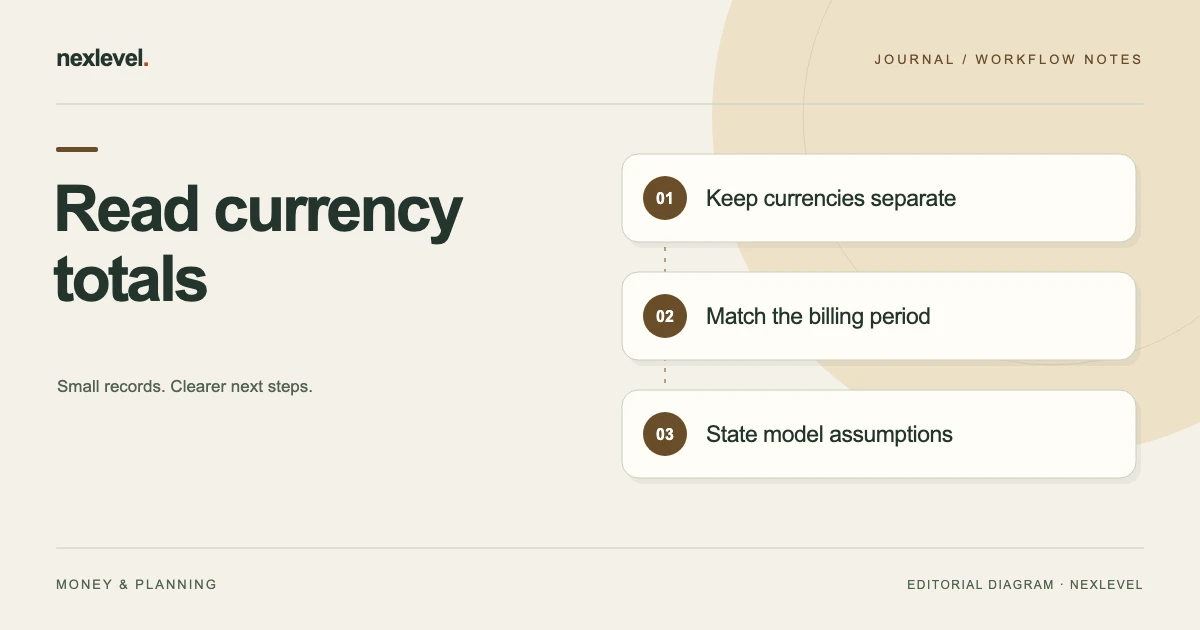
Check subscription totals by matching each amount to its source currency, billing period and occasion. Monthly and annualized models describe entered records; category grouping does not convert currencies. Retain separate totals unless an independently defined comparison supplies a relevant basis.
Preserve the currency and period beside every amount
- Identify the selected services, source occasions and representation being reviewed.
- Keep each amount attached to its actual currency and billing period.
- State any annualization assumptions and retain separate currency results.
- Correct missing labels or identify the source still needed without inventing a conversion.
Working fields:
Service/source | Amount/currency | Billing period | Model assumptions | Separate result | Output/cutoff | Missing basis
Useful next steps: Verify the billing basis at setup, Include totals in a bounded monthly review, Archive models with their source assumptions.
Define the total being reviewed
Write a bounded purpose: “Check whether the selected representation preserves currency and billing-period roles for the supplied renewal sources.” Identify service/plan context, source occasions, actual output inspected, cutoff, and next task.
A readable amount is not enough. The same number can describe another currency, billing interval, or source occasion.
Keep those relationships explicit instead of treating a favorable-looking aggregate as proof that every subscription or charge was verified.
Use the advertised separate-currency boundary
DueNudge advertises monthly and annualized totals, with totals for different currencies kept separate. It also advertises grouping recurring costs by category.
A category is an organizational grouping, not an exchange-rate source. Do not invent automatic conversion or a financial-reconciliation feature absent from the selected description.
The app requires no bank connection. A local management view is not automatically a bank statement or proof of actual payments.
Create a controlled fictional source set
For this exercise, A1 is a service-source role with a hypothetical USD 12 monthly amount. B2 is another source role with BRL 15 monthly. These currency codes belong to the independent teaching worksheet, not an observed native output.
N3 identifies the companion review note, C4 a category role, and E5 a candidate representation. The model excludes all taxes, fees, discounts, promotions, exchange changes, and other adjustments.
No actual service, provider, account, price, invoice, rate, or charge is supplied. The references are not native field names or an import schema.
Keep the source currency beside each amount
A1’s 12 is expressed in USD, while B2’s 15 is expressed in BRL. Their shared monthly basis does not establish a single directly additive monetary total.
If a companion explanation drops the labels, identify that representation problem before doing further arithmetic. Do not assume one source should inherit another’s currency.
The review can be useful without converting either value. The next task may simply be to preserve the selected source labels and their separate totals.
Annualize each teaching amount separately
Under the explicit assumption of twelve unchanged monthly periods, A1’s independent annualized model is USD 144. B2’s is BRL 180.
Those are separate conditional models, not actual annual invoices or guaranteed future charges. Omitted costs are excluded from the exercise, not asserted to be zero in real services.
Keep currency, selected period, and unchanged-input assumption beside each result. The exercise provides no spending or exchange recommendation.
Do not turn category grouping into conversion
C4 can group the sources organizationally while their monetary roles remain separate. A common category does not establish that USD and BRL became the same basis.
A single unlabeled aggregate would not be justified by the supplied source set. Correct the explanation rather than invent a rate or claim the app performed a conversion.
This fictional mismatch belongs to a companion note, not an observed DueNudge defect.
Use a copy-ready currency/period worksheet
A practical companion worksheet asks for service/plan, source occasion, amount, currency role, actual billing period, selected modeling basis, category context, and independent annualization assumptions.
Add representation inspected, cutoff, unprovided relationships, correction source, next task, and actual export/sharing stage.
These prompts are an administrative structure, not native required fields, automatic validation, an exchange engine, or an import-ready format.
Fill the source-clear branch
In the first fictional branch, A1/B2 clearly establish their monthly currency roles. N3 can preserve USD 12 and BRL 15 separately, alongside the independent USD 144 and BRL 180 annualized models.
The result should not imply an actual charge, confirmed future price, or completed payment. It describes the selected source basis only.
No record is created in the app, no bank is accessed, and no service is bought or canceled by the exercise.
Fill a missing-currency branch separately
In another branch, a copied amount lacks an established currency relationship. The next task is to identify the relevant source, not to choose a familiar label.
An unprovided label in this packet does not prove the underlying record has none. Keep the conclusion within the actual representation inspected.
If only a companion heading used the wrong currency, correct that explanation. Do not invent a provider change to make the copy appear true.
Check billing periods before comparing models
An amount already expressed for a year should not be treated as monthly merely because another record uses a monthly cycle. Preserve the actual selected source basis before annualizing.
The app advertises weekly, monthly, quarterly, annual, and custom cycles. This worksheet does not reconstruct a native conversion formula for every cycle or duration.
For initial setup, use the billing-source record guide. Keep each actual period relationship explicit.
Keep price changes at their own occasions
If later actual material changes an amount or currency basis, give it its own source reference before preparing another comparison. An older model can remain accurate history of its selected assumptions.
A corrected copied label is different from a new provider source. Do not silently replace the earlier occasion while retaining a conclusion written about another representation.
For retention, use the renewal-source archive guide. The exercise claims no native immutable-audit feature.
Keep reminder dates separate from amount verification
DueNudge advertises local reminders at configurable day offsets and upcoming dashboard/calendar views. A prompt does not verify a charge or establish that somebody saw the alert.
Likewise, a matching next date does not establish a missing amount or currency basis. These source roles need their actual relevant material.
For date changes, use the changed-date reminder guide. This article schedules no alert.
Keep cancellation information separate from action
The app advertises saved cancellation links, contact details, and notes. Keeping that information does not establish a submitted or completed cancellation.
DueNudge cannot cancel third-party subscriptions for the user. A reduced local total also does not prove provider charges stopped.
For that distinction, use the cancellation request and outcome guide. This exercise opens no link and sends no message.
Inspect the actual portable representation
Pro advertises CSV export. Read the actual supported output before stating which amount, cycle, currency, category, or source context a recipient receives.
A readable file can support a selected review while needing N3 for a missing relationship. The public description does not establish every column or filter.
Do not promise arbitrary import or complete restoration. This worksheet exports nothing, imports nothing, restores nothing, and deletes no data.
Preserve local work and deliberate sharing
The advertised workflow requires no account or bank connection, and subscription records stay on device unless explicitly exported. Locally supported review should not acquire a mandatory server or financial-login requirement.
A copy being prepared is separate from recipient receipt. Supply only authorized material needed for the selected task, not unrelated subscription history.
The fictional packet contains no personal billing records and makes no remote request.
State current purchase options accurately
DueNudge Pro advertises unlimited active subscriptions and CSV export through monthly access or a one-time lifetime unlock. Apple processes purchases, with restoration from the Pro screen.
An annual service cycle is not an annual Pro purchase option. The selected current description does not advertise that option or an introductory trial.
Do not invent numerical free quotas or localized prices. Expanded access cannot validate a currency source or establish a financial outcome.
Run a separate-currency reading test
Give an authorized reviewer N3 and the fictional source roles without the original folder context. Ask why the monthly amounts remain separate and which assumptions produce their independent annualized models.
Then introduce a missing label and an annual-period source separately. The reader should preserve currency and period roles rather than combine familiar numbers.
Record any explanation still needed. A useful result identifies the next source task without recommending spending or exchange activity.
Write a bounded total-review result
A compact fictional note can state: “A1 is USD 12 monthly and B2 BRL 15 monthly under the selected teaching sources. Twelve unchanged periods model USD 144 and BRL 180 separately. C4 is category context, not conversion. E5’s actual scope needs inspection; no real charge or exchange rate is supplied.”
Add actual later sources and corrections only when available, with their own occasions. Preserve accurate source material while repairing an unsupported combined-total explanation.
The result is an administrative source comparison, not a bank reconciliation, financial forecast, actual payment, or advice to keep or cancel a service.
Fill the currency-preserving note
N3 can identify A1 and B2 as separate source roles with their own currencies and monthly bases. Keep those labels beside every conditional annualized result, not only in a remote heading the next reader might miss.
If E5 clearly preserves the selected roles, record the actual scope inspected. That does not establish every subscription, charge, or currency relationship in a whole dataset.
If an output lacks a label the task needs, retain that representation question. Do not infer a native conversion or provider change merely because a combined-looking number appears in a companion explanation.
Keep source gaps distinct from financial findings
An unprovided currency source does not prove the service has no currency or no actual charge. It means the selected packet lacks that relationship. A missing period source likewise differs from a proven incorrect amount.
The next task should identify the relevant source rather than choose a familiar label. More arithmetic cannot establish the missing input basis.
This review supplies no exchange rate or method for making a financial decision. It preserves administrative clarity while actual spending, eligibility, and provider terms remain outside the exercise.
Keep a corrected total explanation at its actual level
If the source records are accurate but N3 combines unlike currencies, correct the explanation. Do not alter correct source values to make the unsupported aggregate appear meaningful.
If actual later material changes an amount, currency, or period, give that source its own occasion. A provider update and a copied-label correction are different administrative events.
The older note can remain accurate history of what was available at its cutoff. It should not appear to contain a later exchange, charge, or service action automatically.
Retain the next reader’s exact question
A useful result identifies which currency, period, or source association remains unresolved. It does not require a preferred spending choice, a cancellation recommendation, or a claim that every charge was verified.
A recipient can understand separate conditional totals without adopting an invented conversion. Keep actual sharing and receipt stages distinct from preparation of the copy.
This makes the record reproducible outside the original billing conversation while preserving the difference between a category, a currency, a modeled period, and a real financial event.
Use DueNudge for clear currency roles
Retain each selected currency, period, and source occasion beside the result. A later reader should be able to identify what was modeled without treating the packet as a current provider statement, bank record, or complete financial review.
If another actual source arrives, inspect its relationship before reusing an older conclusion. A readable new amount does not establish every missing currency or billing-stage association.
DueNudge connects manually entered services, cycles, next dates, local reminders, separate-currency totals, cancellation information, and supported export.
Check the official DueNudge App Store listing for current capabilities and access. Keep source amounts, conditional models, portable copies, and actual provider actions distinguishable.