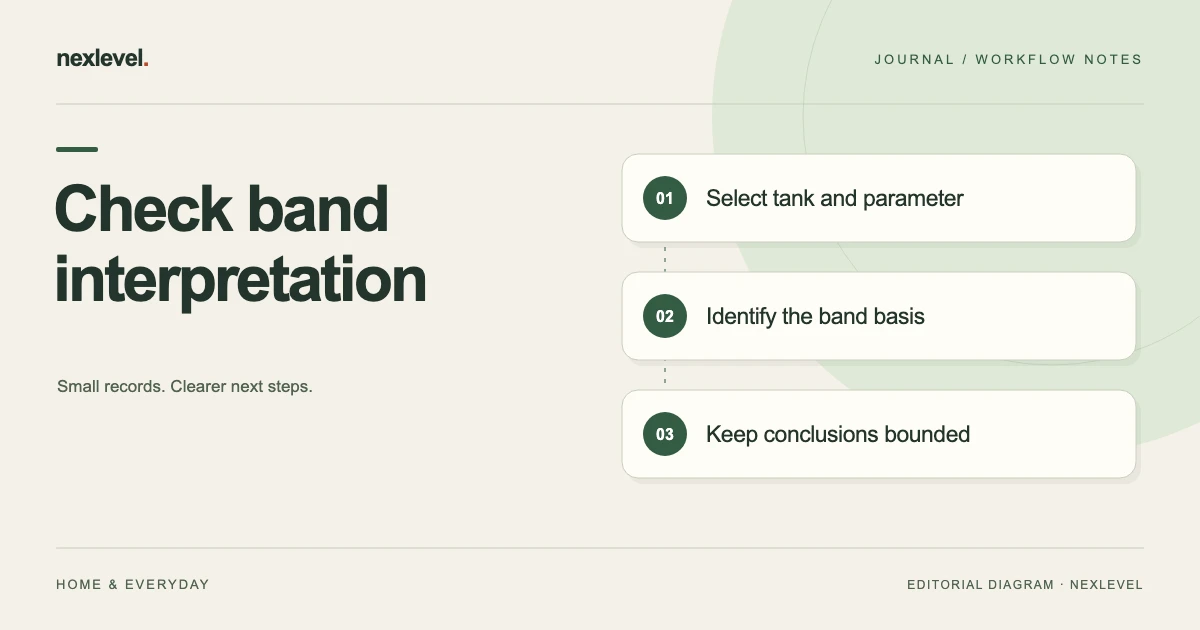
A reading inside or outside a keeper-defined target band describes its relationship to that selected band. It does not alone establish animal health, aquarium safety or the effect of maintenance. Keep the tank, parameter, unit and band basis beside any explanation.
State the comparison the record actually supports
- Identify the tank, reading, parameter/unit and selected band source.
- State the supplied inside/outside comparison without adding a health label.
- Keep a missing band basis or changed unit as its own source question.
- Correct an overstated companion explanation while preserving accurate readings and later source occasions.
Working fields:
Tank/parameter/unit | Reading/occasion | Band/source | Comparison supported | Proposed wording | Unsupported expansion | Gap/next source
Useful next steps: Check tank, parameter and unit identity, Review the comparison in a PDF report.
Define the interpretation question
Start with a bounded purpose: “Check whether the companion explanation stays within what the selected reading and band establish.” Identify the aquarium, parameter, unit, reading occasion, selected band context, and next review task.
That question is narrower than evaluating the aquarium. A clear record can support an administrative comparison while leaving substantive animal care outside its scope.
Do not begin with an assumed health result and select the most reassuring display to support it. Preserve what the actual source relationships establish before interpreting a label.
Use the app’s advertised band role
TankLedger advertises exact readings compared with keeper-defined target bands. The word keeper-defined matters: the selected preference is not automatically a universal standard or professional recommendation.
Keep its basis clear in a companion note when actual source material is supplied. If the basis is unprovided, retain that relationship as unknown rather than attribute it to a veterinarian, manufacturer, or species reference.
The official listing describes recordkeeping, not diagnosis, prescribed treatment, or a replacement for species research, product instructions, or qualified veterinary advice.
Create a controlled fictional source set
For this exercise, T36 identifies the selected tank and P2 a neutral parameter role. B3 is the selected keeper-band context, R4 a saved-reading role, and N5 a companion explanation.
N5 describes the reading as “healthy” merely because its supplied comparison role is inside B3. No actual parameter, numeric range, unit, species, animal, reading, or biological finding is supplied.
C6 identifies a later band-source role if one becomes available. These labels demonstrate independent worksheet relationships, not native field names, band-versioning features, or an import schema.
Read the exact comparison before the stronger label
In the fictional packet, the supported relationship is R4 to selected B3. The companion explanation’s broader health conclusion is not established by that relationship alone.
A correction can preserve the bounded comparison without inventing a diagnosis. It need not claim the animal is unhealthy either; the supplied source set establishes neither biological conclusion.
This exercise identifies an overstatement in an independent note. It does not establish that TankLedger displayed an incorrect medical judgment or performed an actual native calculation.
Keep tank identity and parameter units visible
A band and reading need their actual tank, parameter, and unit context for a meaningful administrative comparison. Similar names or familiar values do not establish the same basis.
If R4 belongs to another aquarium, preserve that actual association instead of comparing it with T36’s preference by appearance. If the relationship is unprovided, record an unknown rather than a proven mismatch.
For the broader matching task, use the tank-reading association guide. Do not invent a cross-unit or cross-tank validation rule.
Distinguish four useful review outcomes
A reading described as inside a supplied selected band supports that bounded comparison. A reading described as outside it supports a different comparison. Neither alone supplies an animal-health conclusion.
An unprovided band basis leaves a source question. A changed parameter or unit leaves a comparability question. Those outcomes should not all be compressed into a label such as “normal” or “problem.”
Keep the actual relationship beside the conclusion. This makes the next administrative task clearer without recommending any care action or interpreting a real measurement.
Use a copy-ready band-interpretation worksheet
A practical companion worksheet asks for selected tank, parameter/unit, reading reference and occasion, band-source role, supplied comparison relationship, proposed explanation, and what that explanation does not establish.
Add later-source context, representation inspected, cutoff, missing associations, correction source, and next review task. Keep actual biological or technical findings under their own relevant sources if supplied.
These prompts are an independent structure, not native required fields, an automated clinical checker, or an import-ready format.
Fill the overstatement branch
In the first fictional branch, N5 turns an inside-band relationship into “healthy.” The worksheet can identify that unsupported expansion and preserve the original selected comparison.
Correct the explanation at its actual level. Do not alter an accurate source reading or band merely to make the stronger wording appear true.
The next task may be to obtain the relevant substantive source for a different question. This guide supplies none and makes no recommendation about a real aquarium or animal.
Fill a missing-band-source branch separately
In another branch, the packet supplies R4 but not the basis or applicable context of B3. Retain that exact source limitation instead of assuming a familiar target applies.
A missing relationship in this packet does not prove that no relevant band or reference exists elsewhere. Keep the conclusion within the scope actually reviewed.
The useful next task is to identify the selected basis, not to invent a safe range or fill an empty field from memory.
Keep later preference context at its own occasion
Suppose actual later material C6 describes a changed keeper preference. Preserve its source occasion before preparing another comparison or explanation.
The public description does not establish a native historical-band versioning algorithm. Do not claim that the app automatically preserves every earlier band or recalculates all prior interpretations in a particular way.
The independent worksheet can retain which actual source context its note used. If that relationship is unprovided, leave the question explicit rather than invent a historical state.
Read timeline events without claiming cause
TankLedger advertises chronological context for water changes, dosing, observations, equipment events, photos, and notes. A reading after an event does not by itself establish that the event caused the result.
Preserve actual timestamps and relationships while keeping causal conclusions outside what the packet proves. An understandable before-and-after sequence is not an experiment or treatment assessment.
For initial context, use the tank and equipment source guide. No equipment or care action occurs here.
Keep due tasks separate from completed work
The app advertises recurring maintenance tasks and due or overdue work. A scheduled reminder is a planning role, not evidence that physical maintenance happened.
Do not combine a due task and an inside-band comparison into a claim that a maintenance procedure succeeded. Each actual event and substantive interpretation needs its relevant source.
This exercise supplies no maintenance instruction, interval, dose, or method. It reviews the meaning of a companion explanation only.
Inspect the representation the reader actually has
The official description advertises CSV export and Pro PDF reports. Inspect the actual selected output before stating which tank, reading, note, or preference context a recipient can see.
A polished report can accurately represent selected records while a separate explanation overstates them. A detail absent from one output does not automatically prove that its source record was deleted.
For the report task, use the timeline-to-PDF review guide. Do not invent a universal export schema.
Preserve local work and optional synchronization
TankLedger works locally without an account. Optional Pro iCloud synchronization uses the user’s private iCloud database. Keep that option separate from a mandatory backend or invented household-sharing service.
A local record existing on one device does not establish that another person received a report or interpreted a comparison. Keep preparation, chosen sharing, and actual receipt in their respective stages.
This exercise sends no aquarium data and makes no network request. Supply only authorized material needed for an actual selected task.
Keep portable copies distinct from restoration
A readable CSV or PDF can support a bounded review without containing every editable relationship or attachment. The public description does not establish arbitrary import or guaranteed complete workspace restoration.
This worksheet exports nothing, imports nothing, restores nothing, and deletes no records. Keep original source relationships intact while preparing another explanation.
For retention, use the equipment-context archive guide. A source copy and a biological finding remain different things.
State current access accurately
The advertised free tier supports one aquarium, five parameters, three recurring tasks, basic history, and local storage. Pro expands aquariums and panels and includes advanced trends, PDF reports, widgets, and optional private iCloud sync.
Monthly, annual, and lifetime access are advertised. The monthly seven-day trial depends on Apple’s eligibility result; do not infer the same offer for every plan.
A purchase cannot establish a missing band basis, animal condition, causation, or safety conclusion. Keep entitlement and evidence review separate.
Run a band-reading test
Give an authorized reviewer N5 and the fictional controlled references without the original folder context. Ask which tank and parameter are selected, what B3/R4 establish, and which part of “healthy” is unsupported.
Then introduce an outside-band branch and a missing-basis branch separately. The reader should preserve their different source questions without turning either into a diagnosis.
Record any explanation still needed. A useful result identifies the next administrative source task without advising a care action.
Write a bounded interpretation receipt
A compact fictional note can state: “T36/P2 uses selected B3/R4 comparison context. N5’s health wording exceeds what that relationship establishes. The packet supplies no parameter value, biological finding, causal result, or treatment basis. The explanation needs a bounded correction.”
Add actual sources and later clarifications only when they exist, with their own occasions. Preserve accurate records while repairing an unsupported companion statement.
The task can finish with a clearer interpretation boundary. It does not certify the aquarium, its equipment, its records, or its animals.
Fill the selected comparison note
N5 can identify T36/P2 as selected, B3 as the keeper-defined comparison basis, and R4 as the reading role. Keep those references together rather than replace them with an unexplained positive label.
If the supplied relationship is inside B3, state that bounded comparison. If it is outside B3, preserve that different relationship. Neither statement needs an invented diagnosis to be administratively useful.
If the band source is missing, identify the missing basis beside the affected statement. A reader should not have to infer whether the comparison was made against an actual selected preference or a familiar range from elsewhere.
Keep missing evidence separate from an opposite conclusion
The absence of a biological source in this packet does not prove the aquarium is unhealthy. The packet simply does not establish a health conclusion. Keeping that scope clear avoids replacing one unsupported claim with its opposite.
Likewise, an unprovided parameter unit does not establish that no unit exists in the actual record. It identifies a source relationship the selected review still needs.
This method makes the next task precise without prescribing a test, selecting a range, or treating a tidy interface as proof that a living system was assessed.
Retain the interpretation correction
If the selected record is accurate but N5 overstates its meaning, repair the explanation. Do not change correct readings merely to make the stronger wording appear supported.
If later substantive evidence becomes available, give it its own source and occasion before preparing another note. The earlier review can remain accurate history of what its packet established.
A future reader should be able to identify the selected tank, comparison basis, observed relationship, unsupported expansion, and next source task without reconstructing the original conversation. That is a completed administrative explanation, not certification of the aquarium, equipment, animals, or care.
Use TankLedger for clear recording context
TankLedger connects selected panels, exact readings, keeper-defined bands, tasks, equipment events, notes, photos, and chronological history.
Check the official TankLedger App Store listing for current capabilities and access. Keep preferences, recorded comparisons, administrative explanations, and biological conclusions distinguishable.