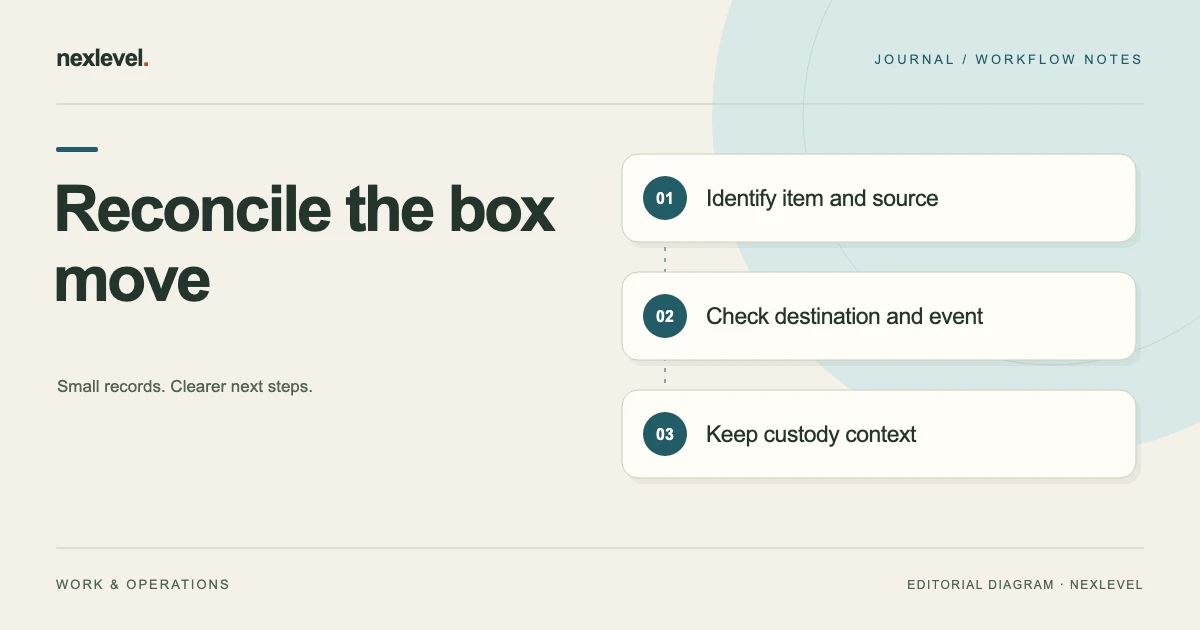
Reconcile a freezer move by identifying the item, the complete source and destination, and the event the sources actually establish. Moving a box changes its location relationship; it does not create a second set of samples. Keep a planned move separate from a recorded action.
Identify what moved before changing the inventory
- Identify whether the question concerns a whole box, one sample, an aliquot or a checkout.
- Compare the full source and destination paths at the relevant cutoff.
- Check whether apparently repeated items are copies, duplicates or distinct related records.
- Update only the supported relationship and test retrieval from the corrected record.
Working fields:
Item/event | Move type | Source path | Destination path | Supporting source | Copy or record issue | Next check
Useful next steps: Define the inventory hierarchy, Review checkout and return relationships, Hand off an unresolved location question.
Define the move being reconciled
Record whether the event concerns a whole box, an individual sample, an aliquot, a temporary checkout, or another supported inventory operation. These events can affect different parts of the hierarchy.
Identify the person responsible for reconciling the record and the relevant cutoff. Later return events should remain distinguishable from the original move rather than appearing to have occurred simultaneously.
Use the actual lab procedure and tool workflow. An administrative worksheet should not invent a handling method or bypass a required source check merely to make the map look tidy.
Identify the physical item and record
Use the lab’s actual identifiers and the inventory’s corresponding reference. Similar labels, project names, or positions can be useful context without uniquely establishing sample identity.
Keep real sensitive identifiers within the appropriate access arrangement. Fictional examples can use neutral references such as S8 and A1 without exposing actual research or clinical information.
If identity remains uncertain, preserve that question before changing locations. A precise destination entered for the wrong record creates a more convincing error, not a resolved move.
Capture the full source location
Record freezer, rack, box, and position as applicable to the actual system. A coordinate such as A1 is meaningful only within its relevant container and hierarchy.
Keep the source location as it was recorded at the relevant event. Do not rely only on the current map if it has already been edited.
If the physical check and stored position differ, identify both observations and their sources. The reconciliation needs to explain that difference rather than silently choose whichever is easier to use.
Capture the intended destination
Identify the destination on the same hierarchy basis. A box label reused in two racks should not be treated as a unique full address without its surrounding context.
Check the actual destination state through the authorized process. A position that appears free in an old export may have changed before the move.
Keep intended destination and observed destination distinguishable when they differ. A plan to move an item does not establish that the physical event occurred.
Use a move-reconciliation worksheet
Useful fields include event ID, item reference, event type, source location, intended destination, actual source observations, relevant custody records, cutoff, discrepancy, responsible person, and result.
Keep the actual inventory entry or event reference beside the worksheet. It should support the main record rather than create a competing location system that nobody maintains.
Record which parts were checked and which remain open. A complete administrative note can accurately describe an unresolved identity or location question.
Work through a fictional box relocation
Imagine box B12 recorded in freezer F1, rack R2, with samples identified by positions within that box. An authorized move places the box in rack R4 of the same freezer, but a convenience sheet still lists R2.
The reviewer identifies the box and its hierarchical relationships before editing. A whole-box location change should not automatically create a second set of sample identities in the destination map.
The reconciliation records the source, destination, event reference, and actual result through the supported workflow. It preserves enough history to explain why the earlier R2 reference exists.
Distinguish a duplicate from a related aliquot
Two similar names can represent the same physical item entered twice, or separate related aliquots. Establish the actual identity relationship before merging or removing anything.
Keep parent and aliquot references according to the tool’s supported model and the lab’s process. A naming resemblance alone should not decide whether two records describe one object.
If the relationship is unclear, assign a specific source check. Do not erase a legitimate separate record merely to reduce an apparent duplicate count.
Keep checkout and return events readable
A temporary checkout can be different from a permanent location change. Record the event type and relevant custody context through the actual workflow.
If the return location differs, identify that result rather than assuming the original position was restored. Keep the return source and time context with the event.
The worksheet does not determine sample condition or authorized handling. Its purpose is to keep the recorded movement understandable for the next inventory lookup.
Check occupied-position conflicts
If two records claim the same destination, preserve the conflicting entries and source context. Use the authorized reconciliation process to establish what each record represents.
A barcode lookup can help locate a record, but the actual relationship still needs checking. Do not treat a successful scan as proof that every stored location is current.
Record the specific result and next action. A generic “inventory fixed” note gives little help when a similar conflict appears in a later search.
Keep current and historical copies distinguishable
A map export, printed sheet, or retained archive may describe an earlier cutoff. Label its role rather than treating every matching filename as the current inventory.
If a bench convenience list or working note is maintained separately, reconcile it deliberately with the chosen current record. One tool edit does not update unrelated copies automatically.
Preserve the main source and the lab’s access controls. A convenient share copy should not become an uncontrolled archive of sensitive information.
Test retrieval after the correction
Start from the item reference and locate its current recorded hierarchy. Then check the relevant move or custody context through the supported record.
For B12, the reviewer should distinguish the current R4 relationship from the older R2 convenience sheet. If both still look current, improve the labels or source references.
This is an administrative retrieval check, not validation of every sample, storage condition, or chain-of-custody requirement.
Inspect an archive or restore operation accurately
If an encrypted archive is part of the authorized process, use the tool’s actual export and restore workflow. Keep the archive’s scope and cutoff identifiable.
Opening a summary is not the same as restoring a workspace. Describe any test according to the operation actually performed rather than calling every portable file a complete backup.
Keep access secrets outside a general inventory sheet. Use the lab’s appropriate arrangements for controlled copies and authorized recovery.
Check a whole-box case in detail
In the fictional B12 move, suppose three sample records have positions inside the same box. The administrative question is whether the box’s parent location changed or three new physical items were created. The move description establishes the former, while the actual authorized inventory workflow must preserve the relevant identity relationships.
The reviewer records B12’s earlier F1-R2 relationship, its intended F1-R4 destination, and the source event used to establish the current record. They also check that the retained position references still identify the same samples within B12. A rack label alone does not explain that hierarchy.
If an old sheet shows the three records under R2 and the current view shows them under R4, count copies and identities separately. The two views can describe one set of three items at different cutoffs. Adding both lists together and announcing six items would describe a different physical inventory.
Keep the resulting note specific: box identity checked, parent location reconciled, sample-position relationships inspected, old sheet labeled as historical, and remaining question assigned if any. The note does not claim that every sample was tested or that the administrative correction validates storage conditions.
Check a single-position case
A second fictional event concerns record S8 moving from B12-A1 to B20-C3 within the authorized location structure. The worksheet names both boxes and their parents so the coordinates can be interpreted unambiguously.
Before closing the administrative reconciliation, inspect the actual supported record and relevant source observations. An intended destination should not replace the actual event if the physical work or identity relationship remains uncertain. Preserve the difference with a next action.
If two current-looking entries now show S8 in both positions, establish whether they are duplicate records, historical views, or distinct related items. Do not resolve the ambiguity by deleting whichever row appears older without checking what it represents.
Record the actual resolution through the lab’s permitted method. The useful outcome is a current location relationship with an understandable source trail. A successful barcode lookup can help find S8, but the lookup alone does not prove that the record reflects the current physical position.
Check checkout and aliquot labels together
A third fictional example contains parent sample S8 and a separate aliquot reference S8-A1. The suffix resembles a position label in another context. Keep the identifier’s role visible so the worksheet does not confuse the aliquot name with the parent sample’s box coordinate.
If an authorized checkout concerns S8-A1, identify that actual record and event. Do not infer that the parent sample or every related aliquot was checked out as well. The source should establish the scope of the recorded action.
When a return is recorded, inspect which item and destination the event concerns. A generic note saying “S8 returned” may be too broad to reconstruct the aliquot history. Use the actual supported fields and lab process to clarify it.
The handoff summary can name the item, source event, current recorded relationship, and unresolved issue. This makes the administrative history retrievable while leaving technical handling, sample condition, and regulatory questions with the responsible process.
Keep a filled reconciliation receipt
A compact fictional entry can say: “B12 moved within F1 from R2 to R4 under event M12. Three existing sample identities retained within the box; source references inspected; earlier R2 sheet labeled as an older cutoff. S8’s separate position question remains assigned to the inventory coordinator.”
Add the actual source locations and cutoff to the real record. If an operation was only planned, say so. If a source could not be opened, retain that limitation rather than describing a completed evidence check.
Ask the next authorized reader to reconstruct one item from the current view and locate the event behind its location. Their answer should identify the same physical-item relationship without depending on the original person’s memory. Record the question found, correct the relevant label or source reference, and keep the current state distinguishable from retained history.
Before closing the review, compare the selected inventory boundary with the source task. Confirm which box, sample, or aliquot identities were checked, which event was established, and which question remains assigned. A completed reconciliation can accurately leave a source question open when its owner and next action are explicit. Keep the current location view and retained history accessible through the actual authorized arrangement. The administrative record should explain the movement that was checked without suggesting that every specimen, handling condition, or regulatory requirement has been validated by the worksheet.
Use FreezerGrid for connected locations and custody
FreezerGrid connects freezers, racks, boxes, sample and aliquot positions, barcode lookup, and checkout or return history. Its current listing describes Pro encrypted archive export and restore.
Use the lab’s authorized process for physical work and record reconciliation. Check current capabilities and plan details in the official FreezerGrid App Store listing, and keep identity, movement, and source evidence clear.