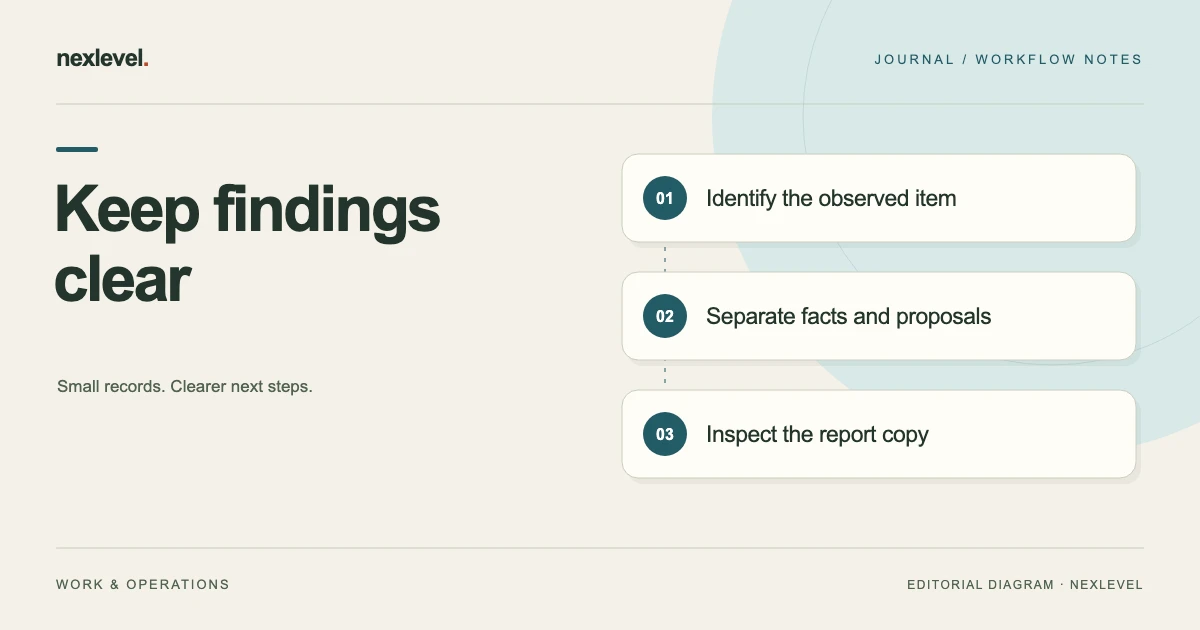
An inspection report can become misleading when a visible observation, an interpretation, and a proposed repair are written as though they were the same fact. The reader needs to understand what the inspector recorded, which evidence supports it, and where professional judgment enters the explanation.
Keep those roles distinct. Connect each finding to the inspected item and actual source evidence, retain limitations, and label recommendations as recommendations. A polished sentence should not claim more than the underlying record establishes.
This guide provides a clearly fictional documentation exercise and an independent review worksheet. It does not inspect a property, diagnose a defect, specify a repair, or determine compliance. For the underlying evidence structure, see the property inspection evidence log template.
Give every statement a clear role
An observation describes what the inspector actually recorded. An interpretation explains the meaning the inspector assigns to that observation. A recommendation proposes a next action. A limitation states what the inspection or evidence did not establish.
These roles can belong in one finding while remaining distinguishable. The problem is not that professional judgment appears in a report. The problem is that a reader cannot tell where the recorded evidence ends and an interpretation begins.
Use labels or sentence structure that make the relationship clear. Avoid presenting a proposed future check as though it already occurred. Equally, do not describe an inferred cause as something visible in a photograph unless the source genuinely establishes it.
These are documentation practices for an independent worksheet. They do not claim that every tool provides four dedicated fields or that a particular wording meets every professional reporting requirement.
Start with item identity and scope
Identify the actual property, inspection occasion, room or area, and checklist item. A finding called “wall issue” can be hard to match when several areas have similar descriptions.
Use references consistently across the working record and recipient copy. If an independent worksheet calls an item R3-I8, retain enough context for an authorized reader to locate that item. The reference itself should not reveal unnecessary private information in a broadly shared summary.
Keep the inspected scope readable. A statement about one selected item should not silently become a statement about every similar item in the property. A report can be concise without expanding the source’s coverage.
Where access was limited, preserve that limitation with the affected finding. The guide to documenting inaccessible areas addresses that separate recordkeeping task.
Use a four-part review worksheet
For each selected finding, an independent worksheet can hold the item reference, recorded observation, evidence reference, inspector interpretation, proposed next action, limitation, and next review owner. Keep the original source wording available during review.
| Statement role | Question to ask |
|---|---|
| Observation | What was actually recorded at this occasion? |
| Interpretation | Which part is the inspector’s judgment? |
| Recommendation | What future action is proposed? |
| Limitation | What does the evidence leave unresolved? |
Do not fill an empty field with a plausible guess. If the original source does not establish a measurement or cause, retain that boundary. A completed-looking worksheet is not a substitute for an actual inspection source.
The worksheet explains the review. It should not become a second authoritative inspection record that quietly contradicts the working report.
Work through a fictional finding
Imagine a fictional inspection record for area R3 and item I8. The inspector selected a photograph and entered a note describing a visible mark on a surface. A separate draft sentence attributes the mark to a particular cause, although the source photo alone does not establish that cause.
The reviewer first matches the photo and note to I8. They then separate the recorded visible observation from the inspector’s interpretation. If the cause remains unestablished, the report should not describe it as a directly observed fact.
A proposed further check belongs in the recommendation role and needs the inspector’s actual professional judgment. This example supplies no technical diagnosis, testing procedure, or repair specification. It illustrates how the record can preserve the distinction.
The reader should be able to identify the observation source and understand which question remains open. That is more useful than a smooth paragraph that hides uncertainty behind confident wording.
Review photographs for what they actually show
A selected photo can support the location or appearance of an item at a particular occasion. It does not automatically establish an unseen cause, a measurement, or the condition of an inaccessible area.
Open the actual image rather than relying only on its filename. Check whether it belongs to the selected item and whether the detail referenced in the finding is visible. A similar-looking image from another room is not interchangeable evidence.
Keep any relevant source context available in the intended report. Do not assume that adding an image means every recipient understands which item or occasion it represents. A concise item reference can prevent an otherwise useful picture from becoming detached from its meaning.
Inspecova’s current listing describes inspector-selected evidence photos. It does not claim automatic defect detection or independent measurement from images. Recommendations and conclusions remain the inspector’s responsibility.
Keep entered readings distinct from conclusions
A reading should preserve the actual parameter, unit, source occasion, and inspector-entered value where established. A number without that context can be copied accurately and still be difficult to interpret.
Do not invent a missing unit or imply that the app measured the property. Inspecova’s listing describes entered readings and explicitly leaves measurements and conclusions with the inspector.
If a reading is cited in an interpretation, the relationship should be clear enough for the reader to trace it back. The interpretation should not replace the original reading with a broad condition label that hides the source value.
This guide supplies no technical threshold or judgment about a particular measurement. The documentation review checks identity and source relationships; the actual inspection method and appropriate professional standards belong to their proper sources.
Review severity and acknowledgment separately
The current product describes Monitor, Attention, and Critical finding states, along with explicit critical-finding acknowledgment before report completion. Those are recorded workflow states.
Do not treat acknowledgment as evidence that a physical repair was completed or that a risk no longer exists. It establishes the supported acknowledgment action in the record. Any later work requires its own actual source.
Similarly, a severity label is an inspector-entered judgment, not an automatic certification from the software. Review whether its explanation and evidence remain attached to the finding.
When preparing the independent worksheet, keep “finding reviewed,” “acknowledged,” and “proposed work completed” distinct. Collapsing them into a single checked box can make the final report claim more than the working record establishes.
Keep sentence cleanup from changing the facts
Inspecova’s current description limits local sentence cleanup to spacing, initial capitalization, and ending punctuation. Suggestions remain advisory and editable, with changes accepted under inspector control.
That feature should not be described as diagnosis, factual rewriting, or a professional review of the finding. A tidier sentence can still contain an unsupported cause or a misplaced recommendation.
Read the meaning before and after any accepted cleanup. Check item identity, the observation’s scope, and words expressing uncertainty. The review should not transform “not established” into a completed conclusion.
For fictional I8, the inspector can improve punctuation without changing which part is observed and which remains an interpretation. Editing presentation does not create new inspection evidence.
Inspect the completed report snapshot
The listing describes freezing completed work into an immutable report snapshot, producing a uniquely numbered PDF, and retaining page and SHA-256 traceability details. These features help identify the prepared report.
They do not independently prove that the underlying inspection conclusions are correct. A content hash concerns the identified content; it is not a property safety certificate or professional endorsement.
Open the actual intended report and trace I8 from the finding to its selected evidence. Check that observation, interpretation, recommendation, and limitation remain readable in the copy the recipient will see.
Do not assume a draft edit changes a previously completed immutable snapshot. Use the actual supported workflow and identify the intended report version without inventing a revision feature the current listing does not describe.
Prepare a recipient explanation that is proportionate
The recipient may need a short source index rather than a copy of every working note. Include enough context to locate the selected finding and understand its limitations through the authorized sharing arrangement.
Inspecova shares through Apple’s system share sheet when the user chooses. Preparing a report, opening a share interface, and actual recipient delivery are separate events. Do not describe the report as received merely because it was generated.
Check current plan access before promising outputs. The listing distinguishes watermarked free reports from Pro evidence, reading, recommendation, and unwatermarked export capabilities. Inspect the actual prepared artifact instead of assuming every plan has identical content.
Keep private property details appropriate to the actual task. A useful source explanation does not require distributing unrelated access information.
Test one finding with a second reader
Ask an authorized reader to reconstruct fictional I8 from the report. They should identify what the inspector recorded, where its evidence appears, which statement is an interpretation, and what future action is only proposed.
If the reader assumes the app detected the issue automatically, clarify the tool’s role. If acknowledgment looks like repair completion, improve the state explanation. If a photo is ambiguous, improve the source relationship.
Record the actual review result and any remaining question. A short receipt can identify the selected report and finding, established evidence relationship, and unresolved source owner. Avoid a broad assurance that every aspect of the property was verified.
The test evaluates the document’s clarity. It does not replace inspection work or establish regulatory compliance.
Compare a vague draft with a source-based explanation
For fictional I8, a vague draft might read: “Cause identified; repair required; checked.” The problem is not simply brevity. The sentence fails to identify what was observed, whether the cause was established, what action is proposed, and what “checked” refers to.
An independent review note can instead use labeled placeholders: “Observed: inspector’s actual recorded description. Evidence: selected I8 photograph and source note. Interpretation: inspector’s explanation, with uncertainty retained. Recommendation: inspector’s proposed next action. Limitation: cause not established by the photograph alone.” The placeholders must be replaced with actual source-backed content before using the note in a real report.
This structure helps the inspector see where another source is needed. It does not supply missing facts, dictate a diagnosis, or tell the recipient how to repair a property. A longer sentence with invented certainty would be worse than an honestly limited observation.
Now consider a different fictional outcome: the original finding and evidence are already clear, but a short cover summary merges all four roles. The repair belongs in the cover summary. There is no reason to alter accurate underlying evidence merely to make the old summary look consistent.
After revising the appropriate copy, repeat the reader test. Can the reader point to the observation and identify the proposed future action separately? If so, the administrative problem has a concrete resolution. If not, identify the exact source or wording question that remains. Keep that question attached to I8 rather than issuing a vague warning about the entire inspection.
Use Inspecova for structured field documentation
Inspecova brings checklists, inspector-entered findings, selected evidence, acknowledgments, and completed report snapshots into a local-first workflow. Its current listing describes device-specific field views and plan-dependent PDF and CSV outputs.
Check the official Inspecova App Store listing for current features and plan details. Use the tool to preserve traceable documentation while keeping inspection judgments, recommendations, and limitations explicitly connected to their actual sources.