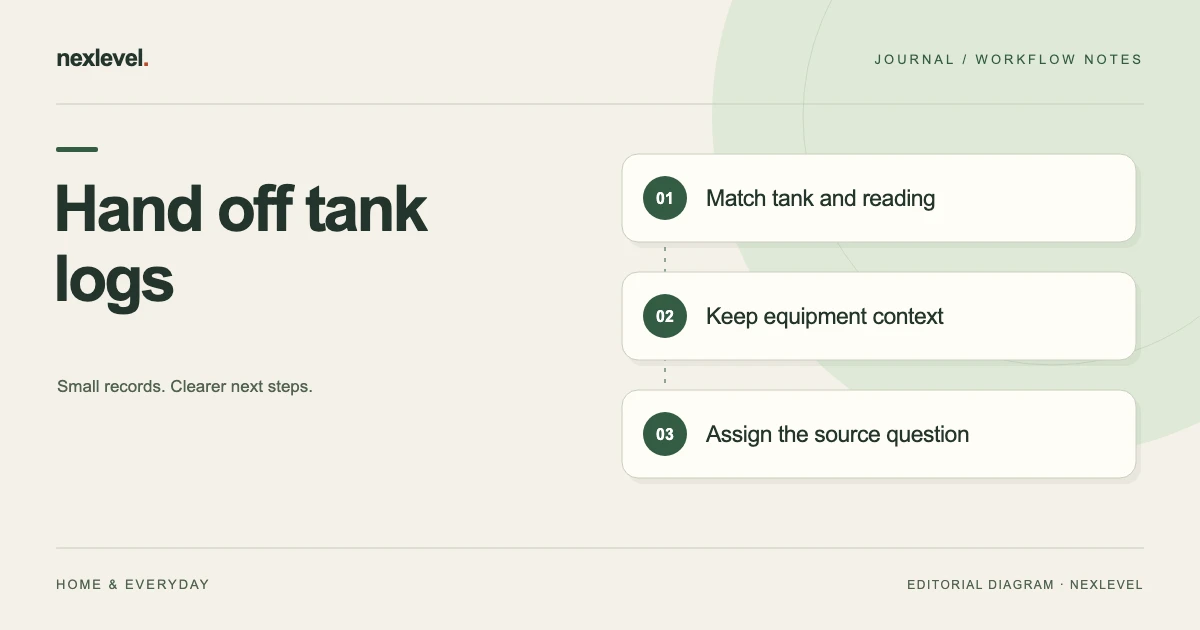
An aquarium record handoff should let the next authorized reader locate the tank, reconstruct selected readings and understand the equipment or source question still open. Keep historical observations, keeper-defined bands, recurring tasks and actual care instructions distinguishable.
Give the next reader the record and the question
- Define the recipient’s record-review task, tank and selected period.
- Preserve reading parameters, units and observation occasions.
- Identify equipment-event sources and keep planned tasks separate from completion evidence.
- Inspect the chosen packet and ask the recipient to locate the next question and responsible reviewer.
Working fields:
Reader/task | Tank/period | Reading/unit/time | Equipment/event source | Band context | Planned work | Copy/cutoff | Question/owner
Useful next steps: Resolve a reading-to-tank relationship, Retrieve older equipment-event evidence, Check a timeline report before handoff.
Name the recipient’s task
Reviewing historical readings, maintaining the working log, and deciding an animal-care response are different responsibilities. Identify the actual task before preparing an export. A recipient can help reconstruct records without being authorized or qualified to make every operational decision.
Write the selected aquarium, source period, intended reader, and next question. A handoff can accurately concern one tank and still leave other aquariums outside scope. Avoid a general “all tank records” label when the selected copy covers only a bounded period.
Keep appropriate actual instructions and responsible professional advice in their own role. The record packet should explain what was entered and what remains uncertain. It should not fill a missing instruction by borrowing a target or treatment from another setup.
Confirm aquarium identity before comparing readings
Two tanks can share a parameter name or a similar nickname while having separate histories. Match the selected aquarium and its actual context before preparing a trend summary. A repeated test label does not establish one common measurement series.
TankLedger’s current listing supports separate setups, independent volumes, panels, schedules, and histories. It also supports freshwater, planted, reef, quarantine, and other setup categories. Those organizing capabilities do not verify entered identity or determine which care requirements apply.
If an equipment note or reading appears assigned to the wrong tank, preserve the exact source question. Use the tank-reading identity guide rather than combining histories solely because their dates or names look similar.
Build a handoff index
The index should route the recipient to the selected sources and identify the next review. It need not duplicate every reading, image, or private note. Keep one question per row when different sources are needed.
| Field | What the recipient needs |
|---|---|
| Aquarium | The selected record and relevant setup context |
| Reading | Parameter, entered value, unit, and observation occasion |
| Event | The related maintenance or equipment source |
| Target context | Which user-defined comparison basis is being shown |
| Copy | The intended output and source cutoff |
| Question | The next specific source check and responsible person |
These are independent worksheet prompts, not a named multiuser handoff feature. The current product description does not establish an automatically shared team database or a generic assignment service.
Keep reading roles and units explicit
A value without a parameter, unit, or source occasion may be difficult to interpret later. Preserve the exact entered basis. Do not choose a familiar unit merely because it makes a graph look plausible, and do not transfer a value from another tank to close a blank.
The current app supports several parameters in a test session, exact values, notes, timestamps, and keeper-defined target bands. A target band is entered comparison context. It should not be presented as an independently validated requirement for every animal or setup.
Distinguish an observation occasion from the time a record was entered or a report was prepared. A later administrative correction does not mean the water was tested again. The handoff should preserve that difference where it affects a reader’s understanding.
Work through a fictional equipment-context packet
Imagine aquarium T8, reading session R12, and equipment event E3. The packet concerns the relationship between these records, not whether any real parameter is acceptable. No test value, target, species, or intervention is supplied in this example.
The first row identifies T8 and the selected source period. The second points to R12 with its actual parameter labels, units, and observation context. A similarly named session in T9 remains outside this packet unless its relationship is separately established.
The third row identifies E3 and asks whether it belongs before or after the selected reading occasion. If the source only establishes when the note was entered, retain that limitation. Do not invent an event time to produce a cleaner sequence.
The fourth row identifies the current keeper-defined target context as separate from the historical observation. The fifth names the intended copy and the next source check. The recipient should be able to explain the record relationship without treating the article as an instruction to alter the aquarium.
Separate equipment events from explanations of cause
A timeline can show that an equipment event and a reading are near each other. That relationship does not independently establish why a value changed. Keep a source-established event separate from an interpretation or proposed follow-up question.
TankLedger’s current description includes equipment events, observations, dosing logs, water changes, photos, and chronological history. These recorded categories help preserve context. They do not diagnose an animal or prove the physical effect of a particular action.
For an older equipment packet, use the equipment-change archive guide. The handoff can reference that source without turning a retained event note into an operational prescription.
Keep recurring tasks and completion evidence distinct
A recurring task identifies planned maintenance context. A due or overdue label reflects the entered schedule and actual app workflow. It does not prove that work occurred, that a physical condition is acceptable, or that another person received the same reminder.
When preparing the packet, distinguish the next planned task from an actual recorded event. If work was reported outside the log, identify the source question rather than creating a completion merely to make the queue look settled.
This guide recommends no maintenance interval. The responsible keeper’s actual requirements, product instructions, species research, and qualified advice determine operational choices. A careful administrative handoff should make those boundaries easier to see.
Review photos as source context
A tank photo can help identify an occasion or equipment arrangement. Preserve which aquarium and event it describes. A cropped image with an ambiguous filename should not become the sole basis for a current condition claim.
The current product supports photos and notes in the timeline. Its listing does not establish that every portable output includes every image or that a static image can reconstruct the complete working history. Inspect the actual intended copy.
If a photo’s source occasion remains unclear, retain that question separately from the reading unit or equipment identity. Different limitations may require different sources; a single “check tank” note would make the next person’s task harder.
Choose the actual output and access arrangement
TankLedger currently describes portable CSV data, with PDF reports and optional private iCloud sync under Pro. Free supports one aquarium, five parameters, three recurring tasks, basic history, and local storage. Check the actual plan and selected workflow before promising an output.
Private iCloud synchronization should not be described as automatic multiuser team collaboration. A PDF or CSV can support a bounded review without giving the recipient a live editable workspace or creating identical reminders on another device.
Open the intended copy and inspect aquarium identity, selected reading context, units, event references, and limitations. A companion index may need to explain a relationship not represented automatically in the export. Preparing the copy is separate from delivery and understanding.
Test the recipient’s reconstruction
Ask the recipient to identify T8/R12/E3, distinguish an observation time from an entry time, and name the unresolved equipment-source question. They should be able to find the selected sources without relying on the original writer’s memory.
Then ask what the packet does not establish. It does not diagnose animals, verify a target band, demonstrate an intervention’s effect, or certify the physical condition of the aquarium. If the recipient infers those outcomes, improve the explanation.
A read-through can pass while one source question remains open. The useful handoff identifies that question and the next responsible reviewer. It should not invent a completed source check simply to give every row the same status.
Handle later corrections in the appropriate layer
If a later source establishes E3’s actual occasion, preserve that clarification with its own review context. Do not make an earlier packet appear to have contained the information from the start. Identify which intended copy now carries the clarification.
If the working log is accurate but the companion summary swaps T8 and T9, repair the summary. If an actual entered issue is established, use the supported workflow and inspect its result separately. A correction does not create a new physical observation.
A concise receipt names the aquarium scope, sources reviewed, output inspected, actual limitation, and next question. It documents the administrative task rather than a care outcome.
Write a continuation note for the equipment question
For the fictional T8/R12/E3 packet, the continuation note can begin with the exact uncertainty: the selected source does not yet establish whether E3 occurred before or after R12. That is a record-order question, not a claim that the equipment caused a change in water conditions.
Identify the actual source route the next reviewer should inspect. A maintenance note, photo context, or other record may help establish the event occasion, but the packet should not promise an answer that has not been found. Keep the question separate from any proposed care action.
The reading row should preserve its actual parameter, unit, and observation context. If the intended report omits a unit that the working source includes, correct the report. If the source itself is unclear, retain that uncertainty rather than inferring a unit from a keeper-defined target band.
Give the recurring task its own line. The task’s next due context can remain useful without explaining E3’s historical occasion. The recipient should not mark another task complete solely to make the equipment timeline look continuous.
Now review a photo that appears near the event in a retained packet. Its position in the folder does not establish chronological order. Use the actual source relationship or preserve the limitation. A cropped image should not acquire a new event date merely because it was exported today.
The recipient’s return note can name which sources were inspected and which relationship became established. If the answer remains unavailable, record the next specific source question. This gives the handoff a useful outcome without inventing a physical observation.
Keep any later clarification attached to the intended current explanation. An earlier static PDF can remain historical while the working record is clearer. The packet should identify that difference so a reader does not treat every retained copy as equally current.
A successful continuation test is modest: another reader can locate T8, identify R12’s role, explain E3’s question, and distinguish a target, reminder, and observation. That improves record continuity without diagnosing animals or prescribing a response to the aquarium’s physical condition.
The reusable method is this source-question structure. Substitute actual authorized references in real work, while keeping the fictional T8/R12/E3 scenario out of genuine care history. An illustrative worksheet should never become an invented observation simply because its labels look like real records.
Use TankLedger for connected local records
TankLedger connects aquarium readings, keeper-defined comparison context, maintenance tasks, and chronological events in a local workspace. Check the official TankLedger App Store listing for current capabilities and plan details.
Keep the handoff focused on source meaning and responsibility. A recipient should understand which aquarium, reading, event, and question are involved while leaving animal-care decisions with their appropriate instructions and qualified sources.