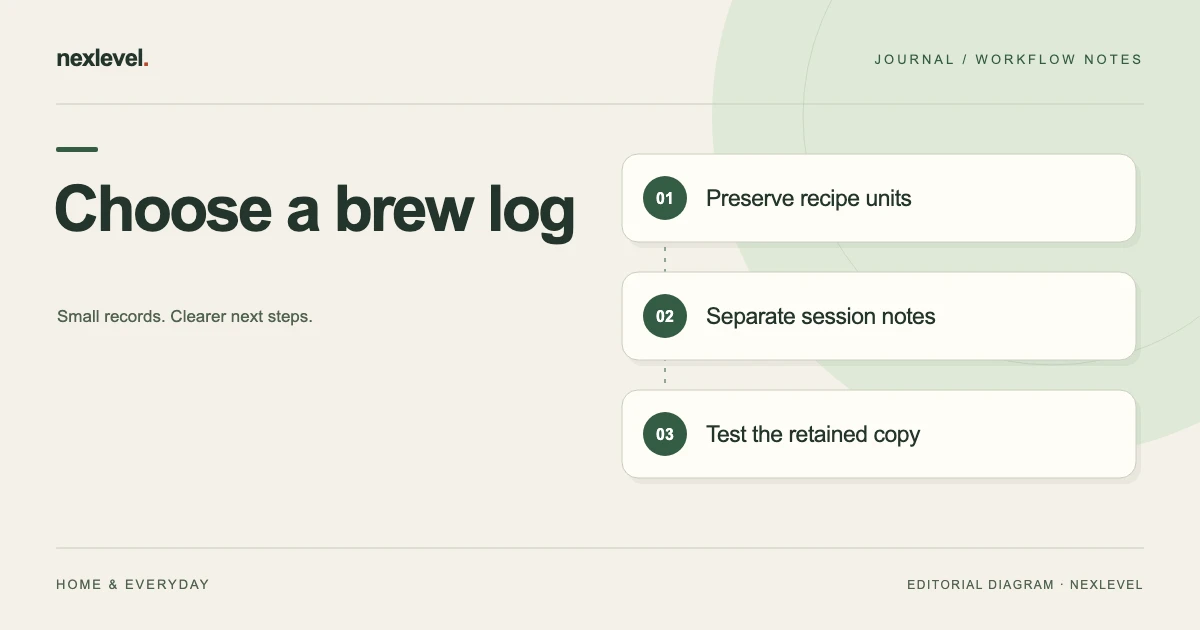
Choose a brew log by checking whether it preserves a recipe, separate sessions and personal observations in a form you can retrieve later. Run the same fictional record through each option, including a missing-unit correction, and count maintained formulas or cross-references as part of the work.
Test the same recipe and two sessions
- Set up one fictional recipe, two sessions and a note tied to the second session.
- Demonstrate quantities and units, then check how recipes and session rows stay distinct.
- Correct a copied unit label and verify the observation still belongs to its source session.
- Open the intended output and compare device needs, feature access and manual upkeep.
Working fields:
Method | Recipe/session model | Unit handling | Correction | Output/device | Manual convention | Plan access | Remaining question
Useful next steps: Define the brew-log fields you need, Review unit and ratio meaning, Test archive retrieval.
Define the record task
A quick calculator, a reusable recipe library, and a session history serve different needs. List the actual requirements before comparing visual design or the number of available features. A tool should be evaluated against the task the person intends to maintain.
Keep recipe identity, selected units, entered amounts, phase structure where relevant, session reference, and observation context distinguishable. A familiar recipe name should not be the only route to understanding what a retained number means.
Use fictional records during evaluation. There is no need to transfer an entire personal library into several tools merely to compare retrieval. A bounded, repeatable exercise makes manual assumptions and actual limitations easier to see.
Use one comparison worksheet
For each method, record demonstrated behavior, manual convention, intended output, and remaining question. A maintained formula is a dependency of the actual spreadsheet, not an automatic capability of every sheet.
| Task | What to demonstrate |
|---|---|
| Identify | Retrieve the selected recipe and source occasion |
| Calculate | Explain quantities using matching stated units |
| Record | Separate a planned recipe from a completed session |
| Observe | Keep ratings and tasting notes in their personal source role |
| Correct | Repair an established entry or summary error |
| Retrieve | Understand the intended portable copy |
These are independent worksheet prompts. They do not establish a common screen, field, or import mechanism across all candidate methods.
Set up a fictional recipe and two sessions
Imagine recipe R8 with an entered coffee mass of twenty grams and water mass of 320 grams. On that explicit mass basis, water divided by coffee is sixteen. These invented values demonstrate arithmetic only; they are not a recommended recipe.
Sessions S1 and S2 reference R8 but have separate observations. A personal note N4 belongs to S2. The candidate method should preserve those relationships without replacing the reusable recipe whenever a new observation is added.
A companion summary omits the word grams from the water quantity. The underlying source remains explicit. The evaluation includes correcting that summary rather than guessing a volume unit or changing accurate source information.
Test a paper recipe book
Paper can use a recipe heading, a quantity-and-unit block, and separate session rows. Demonstrate that a reader can find R8, identify its stated mass basis, and distinguish S1 from S2 without the original writer’s memory.
Keep a planned phase or recipe note separate from a completed-session observation. A check mark or a rating needs a clear convention. A blank row should not become a claim that a brew never occurred outside the selected record.
Inspect a retained photo or scan of the page. If it loses the unit heading or recipe reference, the copied numbers may become ambiguous. Record that actual output limitation rather than concluding that paper can never support a usable log.
Test the spreadsheet’s row model
Decide whether a row represents a recipe, phase, session, or observation. Mixing these roles can make filters and totals difficult to interpret. Repeated recipe references across session rows do not automatically establish duplicate recipes to delete.
For the fictional mass example, demonstrate that 320 divided by twenty equals sixteen on the stated basis. Then inspect how the sheet preserves units. A correct displayed result cannot establish whether an unlabeled water number represents mass or volume.
Sort or filter the selected table and open a retained copy. R8, S1/S2, and N4 should remain connected. A spreadsheet can be useful while depending on someone maintaining references, formulas, and the meaning of copied summaries.
Test BrewRatio against the current description
The verified current BrewRatio 2.1 listing describes calculating coffee, water, or ratio from two inputs, method presets, guided phases, completed-session details, ratings, and notes. Use those advertised capabilities as the source for a task-specific evaluation.
Pro currently expands recipes, beans, history, custom phase choreography, grinder profiles, on-device coaching, trends, and JSON/CSV output. Check actual feature access rather than borrowing a Pro capability to describe every free workflow.
The app’s calculator and session tools organize entered information. They do not independently measure the physical coffee, verify a personal tasting note, or establish that the same inputs will produce an identical cup in every situation.
Preserve units before interpreting a ratio
A mass-based comparison and a volume-based comparison need their actual unit meanings. Do not silently treat a volume as an equal mass or assume every cup or ounce label means the same dimension.
BrewRatio currently supports several mass and volume units. For the narrower source check, use the coffee unit and scaling guide. The tool comparison supplies no general density conversion or recommended ratio.
If the original R8 source is clear while the summary is not, restore the missing unit in the summary. If the source itself is unclear, retain that question. A precise-looking result should not create missing source certainty.
Keep phase plans separate from session actions
A reusable phase structure describes a plan. A timer or recorded completion concerns a selected session. Their relationship can support later review without making them the same event.
The current BrewRatio description includes phase-aware timing and early completion without losing session details. The evaluation should inspect the actual selected workflow rather than inventing a universal rule about which fields copy into every new session.
A personal note about S2 should not make R8 appear to have predicted that observation from the start. Use the session-versus-recipe comparison guide when the relationship needs closer review.
Keep tasting notes in their actual role
A rating or flavor note records a person’s entered observation under the selected context. It should not be presented as a verified customer result, scientific measurement, or guarantee that another person will experience the same outcome.
For N4, preserve which session it describes and what was actually entered. A note copied into a current review can remain historical context without becoming a newly observed fact.
This guide recommends no extraction target or sensory adjustment. Its task is to test whether the chosen method preserves recipe, session, and observation meaning without conflating them.
Inspect device and portability requirements separately
BrewRatio currently describes device-specific capabilities, including Watch calculation and Pro active-brew controls, as well as iPad choreography tools. A chosen workflow should identify which capability and device were actually demonstrated.
Pro currently includes JSON or CSV export. Open the intended output and inspect recipe identity, selected units, session references, and relevant limitations. Do not assume every independent worksheet field appears automatically.
A portable representation is not necessarily the whole editable app, an arbitrary spreadsheet import, or a live shared library. The public listing does not establish every possible restore or collaboration arrangement. Keep the comparison within the actual supported workflow.
Run the correction exercise
Start with the fictional cover summary that omitted the water unit. Ask each candidate to identify R8’s actual source and repair the summary. The correction should not change the entered coffee mass or reclassify the source as a different quantity dimension.
Next, verify that N4 remains associated with S2. If a retained table incorrectly places it beside S1, repair the selected representation according to the actual source. Do not move an accurate observation merely to match a shortened cover note.
Finally, inspect an older copy. It can remain an earlier representation without updating itself. The intended current explanation should identify which source and correction it contains rather than implying an automatic version merge.
Make a conditional tool choice
Paper may fit a compact recipe-and-session convention. A spreadsheet may fit a maintained row model and transparent calculations. BrewRatio may fit when its calculator, phase structure, history, and plan-dependent tools match the demonstrated needs.
Write the choice with its assumptions: selected recipe scope, units, device, actual plan, manual conventions, output requirement, and remaining question. A useful conclusion explains the fit rather than inventing a numerical winner.
For another person receiving a recipe, use the repeatable recipe sharing guide. Tool choice and one selected transfer have related but different requirements.
Test the result without the original writer
Ask a reader to reconstruct R8, S1/S2, the mass basis, the stated ratio, and N4’s source relationship. They should also identify the missing-unit correction and the scope of the retained copy.
If they infer a volume-to-mass conversion from an unlabeled number, improve the labels. If they treat a personal rating as an objective result, clarify its role. A successful retrieval test can leave a bounded source question open.
A concise comparison receipt records actual capabilities demonstrated, manual assumptions, intended output inspected, and next question. It should not claim improved coffee quality or a health benefit from the fictional inputs.
Use a second fictional batch to test source meaning
For a separate arithmetic branch, suppose a source explicitly states coffee mass of 25 grams and water mass of 400 grams. Water divided by coffee is again sixteen. This is a different batch with the same stated mass ratio, not another observation about R8’s actual session.
Now hold the water mass at 320 grams while changing coffee mass to 25 grams in an independent scenario. The stated ratio becomes 12.8. These invented values demonstrate input relationships only; neither branch recommends a recipe or predicts a cup’s quality.
Ask each candidate to identify which inputs changed and which result was derived. A sheet with three independently typed numbers can look precise while containing inconsistent assumptions. A calculator should still preserve the user’s selected unit basis and actual source context.
Keep the two branches separate from S1 and S2. A planning calculation does not establish that either brew happened. Likewise, N4 remains a personal observation attached to its actual session, not evidence that a later arithmetic variant produced the same result.
Use the exercise to inspect copied summaries too. If one summary drops the word grams, restore the source-established unit. If another source actually lacks a unit, retain that uncertainty rather than borrowing the mass basis from this fictional worksheet.
A useful comparison note can therefore name the selected recipe, independent branch, changed input, derived value, manual convention, and intended copy. The reader should reproduce the arithmetic without treating a matching ratio as proof that two batches or sessions are identical.
The reusable part is the record test. Replace its references only with actual authorized information in real work, and keep the invented quantities out of genuine brewing history. The comparison should improve explanation rather than create a falsely continuous story about past cups.
Before choosing a method, write down which part of the test required manual maintenance. For paper, that may be a cross-reference between a recipe page and session rows. For a spreadsheet, it may be a maintained unit column. For the app, it may be a companion explanation of the selected portable output. Compare the demonstrated work rather than assuming the simplest-looking screen eliminates it.
Use BrewRatio for a clear brewing record
BrewRatio connects quantity calculations, method-aware phases, session observations, and a local recipe history. Keep reusable plans separate from what was recorded during a particular brew.
Check the official BrewRatio App Store listing for current features and Pro access. Evaluate the method from the record tasks you actually need while preserving units, session identity, and the limits of personal observations.