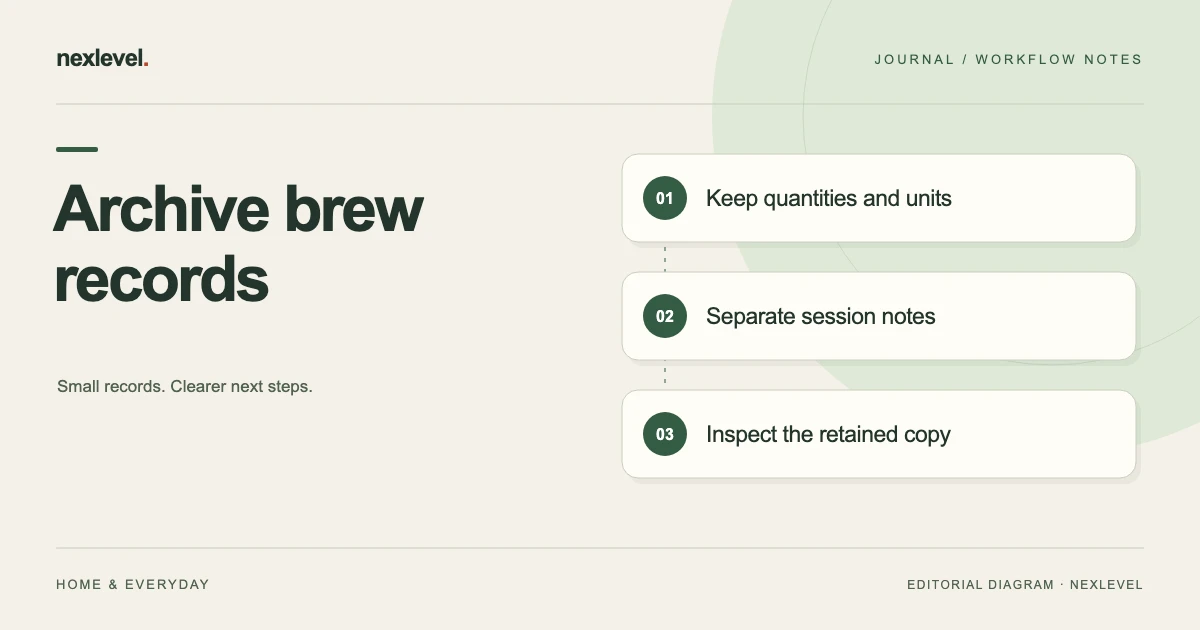
Archive a coffee recipe with its source quantities and units, then identify the sessions and observations you intend to retain. Inspect the actual exported copy and add a small index when it omits context. A portable file should be described by the records it contains and the cutoff it represents.
Keep the recipe and its history readable
- Choose the recipe, session scope and question the archive must answer.
- Index the recipe plan, each selected session and the source of personal notes.
- Open the output and verify units, references, phase context and cutoff.
- Test retrieval from an observation back to its session and recipe, then repair any lost relationship.
Working fields:
Recipe/source | Quantities/units | Phase source | Session | Observation owner/context | Output/cutoff | Limitation | Retrieval result
Useful next steps: Keep recipe revisions separate from completed sessions, Prepare a recipe for another brewer.
Choose the archive’s actual question
A reader may want to reconstruct one saved recipe, compare two sessions, or understand a personal note from an earlier occasion. Choose the selected task before deciding what files to retain.
Write the recipe reference, source cutoff, session scope, preparation occasion, and intended reader. A packet about one recipe should not appear to describe the entire library or every later revision.
Keep the selected material proportional to the task. A small source index can preserve the meaning of a portable copy without including unrelated notes or pretending that an export represents everything the app can display.
Separate recipe, phase, session, and observation
A reusable recipe describes a plan. A phase can be part of that plan. A completed session concerns a selected occasion. A rating or tasting note belongs to the person and context that produced it.
These records can reference one another without being interchangeable. A later session note should not overwrite the reusable recipe merely because both use the same familiar name.
BrewRatio’s current description includes calculations, method presets, phase-aware timing, session completion details, ratings, and notes. Use the actual supported relationships rather than inventing a universal automatic link among every retained field.
Use a recipe archive worksheet
One row can identify the source role of a selected record. A companion worksheet can remain useful when the portable output does not represent every explanatory relationship automatically.
| Record | Context to retain |
|---|---|
| Recipe | Selected identity, source occasion, quantities, and units |
| Phase plan | Which reusable plan the packet describes |
| Session | The selected completion occasion and entered details |
| Observation | The personal note or rating and its session context |
| Output | The actual retained representation and cutoff |
| Question | What the selected sources do not establish |
These are independent document prompts, not a claim that BrewRatio provides a dedicated archive module with those exact fields.
Work through a fictional recipe packet
Imagine recipe R12 with coffee mass of eighteen grams and water mass of 288 grams. On that explicit mass basis, water divided by coffee is sixteen. These are invented calculation inputs, not a recommended brew.
Sessions S4 and S5 reference R12. Observation N2 belongs to S5, while retained copy J3 represents a selected source cutoff. A later working recipe has another source occasion.
The first worksheet row identifies R12 and its stated units. Separate rows preserve S4, S5, and N2. The output row identifies J3 and what it actually contains. A limitation row asks whether a shortened phase label in the copy can be traced to the selected plan.
No real cup, taste result, or physical measurement is supplied. The exercise demonstrates source relationships and arithmetic without claiming that identical entered values guarantee identical coffee.
Keep units beside the quantities
A number copied without its unit can become ambiguous. A water value may describe mass or volume, and similarly named units can represent different dimensions. Preserve the actual source meaning rather than inferring it from a ratio.
For R12, 288 grams divided by eighteen grams gives sixteen on the stated mass basis. That calculation does not establish a general density conversion or justify relabeling the water quantity as milliliters.
Use the unit and scaling review guide if the original source is unclear. A precise result should not create certainty that the source does not supply.
Preserve phase-plan context without inventing timing
A phase plan can help explain the intended sequence, while a session records what was entered for an occasion. Keep the selected plan and completion context distinguishable in the packet.
The verified current BrewRatio 2.1 listing includes guided phases and early completion without losing completion details. Pro includes Recipe Studio with custom phase choreography. Check actual access rather than assuming every free record has the same editable phase tools.
This archive guide supplies no phase duration or preparation instruction. If the intended copy abbreviates a phase, identify the actual source route or retain the limitation instead of reconstructing a plausible instruction.
Keep a personal note attached to its session
N2 should identify S5 and its source occasion. A personal observation can be useful history without being a scientific measurement, a verified customer result, or a prediction about someone else’s experience.
For an ambiguous note, establish the actual session relationship before summarizing it as a characteristic of R12. Similar recipe names or adjacent rows are not enough to prove the link.
Use the session-versus-recipe comparison guide for that narrower review. Preserve its actual result without silently upgrading a personal note into a universal recipe property.
Inspect the intended JSON or CSV output
BrewRatio Pro currently advertises JSON or CSV export, along with expanded recipes, beans, history, grinder profiles, trends, and other plan-dependent tools. Open the selected output and check its actual contents.
Inspect recipe identity, units, session references, observation context, and the selected source cutoff. An exported table may need a companion note to explain a relationship that remains clear in the working view.
The public description does not establish arbitrary file import, a universal restoration workflow, or an automatically shared library. A portable copy can support a bounded retrieval task without being described as the complete editable app.
Prepare a cover note for J3
The cover note can identify R12, the selected source occasion, and J3’s purpose. List S4 and S5 separately, with N2 explicitly tied to S5 where the actual source establishes that relationship.
Keep the stated mass basis beside the calculation. A short line can explain that the ratio derives from the entered eighteen and 288 gram values. It does not independently measure the ingredients used in a physical session.
A contents line should name only what the packet includes. If the phase explanation remains in a separate source, identify the authorized route or open question. A filename called complete does not establish actual completeness.
Test retrieval without the original writer
Ask a reader to start with N2 and identify its session and recipe context. Then start with J3 and find the stated quantity units. The reader should not need the original writer to explain what the numbers mean.
Introduce another fictional recipe R13 with a similar display name. Its existence should not change R12’s source relationship. The reader should use the actual selected reference rather than the first search result.
If J3 loses a relationship preserved in the working record, repair the companion copy. If the source itself is uncertain, state that question. Do not change accurate session information to match an abbreviated summary.
Handle later revisions as later information
A later recipe version may use different quantities or phases. Identify its source occasion and relationship to the retained packet. Do not make J3 appear to have contained the later plan from the start.
Likewise, a later personal note belongs to its actual occasion. It should not silently replace N2 or turn S4 and S5 into duplicate sessions simply because their recipe reference is shared.
A concise archive receipt can name the sources inspected, established relationships, output opened, and next question. It documents a bounded administrative review rather than a brewing result or quality guarantee.
Distinguish a historical packet from a sharing task
An archive may be prepared for the original user’s later retrieval. Sharing a recipe with another person adds questions about which quantities, units, and source explanations the recipient actually receives.
For that task, use the recipe sharing guide. A historical export does not automatically transfer an editable library or establish the recipient’s interpretation of every field.
For method selection, use the coffee log comparison. Tool choice and a selected archive have related but different requirements.
Finish with an archive contents check
Check R12’s identity, explicit units, selected phase source, S4/S5 distinctions, N2’s relationship, and J3’s cutoff. Each required relationship should have an actual source route or a precise limitation.
Keep those explanations inside the packet as well as in any filename. Filenames can change during copying, and a later reader should not have to infer source meaning from a file’s modification date.
The reusable method is the source index. Keep the invented recipe and session references out of genuine brew history, and use actual authorized records when preparing a real packet.
Complete a second calculation-only archive test
Suppose the independent companion worksheet also includes a deliberately separate planning branch: twenty-seven grams of coffee and 432 grams of water. Dividing 432 by twenty-seven gives sixteen on that stated mass basis. This is another invented arithmetic case, not a brew recommendation or a record of a completed cup.
The branch should have its own source label. It must not silently replace R12’s eighteen and 288 gram inputs or become an additional completed session. The archive should identify whether the number belongs to a reusable plan, a session entry, or an independent worksheet.
| Fictional source | What it establishes | What it does not establish |
|---|---|---|
| R12 quantities | Eighteen and 288 grams imply a mass ratio of sixteen | A measured physical brew or recommended recipe |
| Separate branch | Twenty-seven and 432 grams imply the same stated ratio | An automatic change to R12 or session history |
| S4 and S5 | Distinct entered session contexts | Identical physical conditions or outcomes |
| N2 | A selected personal observation related to S5 | A universal quality property of the recipe |
| J3 | The chosen retained representation at its cutoff | Every later working change |
Ask the reader to reproduce both calculations and then identify their source roles. Correct division is only one part of successful retrieval. A reader who treats the separate branch as a completed session has lost the distinction the packet was intended to preserve.
Repair the copy at the point of the discrepancy
Imagine J3 retains the numeric water amount but loses its unit label. If the source still establishes grams, restore that meaning in the companion explanation. If the source itself is ambiguous, retain the question rather than choosing a unit that makes the arithmetic convenient.
Now imagine N2 is copied beside S4 even though the actual source ties it to S5. Repair the selected observation relationship. There is no need to change accurate recipe inputs or create another session to make the shortened copy look consistent.
The archive receipt can name the actual representation inspected, the relationship corrected, and the source that supported the correction. Keep any later clarification at its own occasion so the historical packet remains understandable.
This focused repair approach makes the next task bounded: locate the missing unit source or correct the observation reference. It avoids turning one copy problem into a speculative reconstruction of the whole brew library.
A retrieval label can use the selected recipe reference and actual preparation occasion. Keep units, source cutoff, and session distinctions inside the packet too, since a filename may be shortened and should not be the only place those relationships survive.
Use BrewRatio for clear recipe and session context
BrewRatio brings entered calculations, recipe plans, phase-aware timing, and personal session records into a local workspace without an account requirement.
Check the official BrewRatio App Store listing for current capabilities and Pro export access. Retain what was actually entered while keeping personal observations, calculation assumptions, and physical brewing outcomes distinguishable.