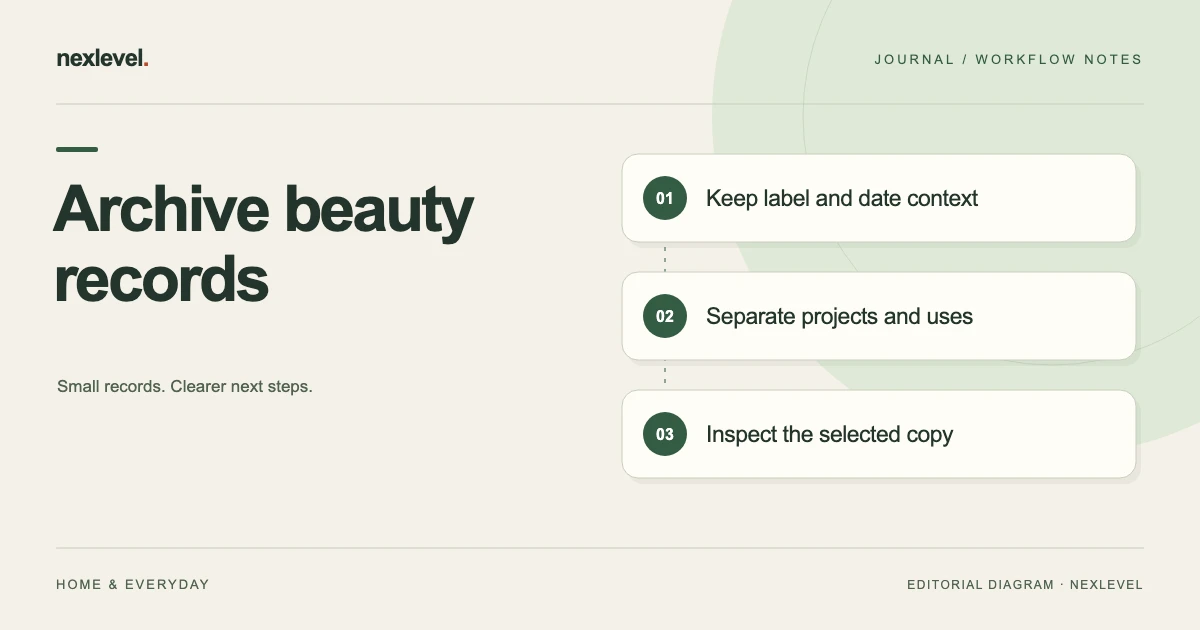
Archive a beauty inventory around a selected product or project question, preserving identity, entered date roles, saved uses and status at a clear cutoff. A shelf image or project summary may not preserve those relationships; identify the actual contents and source routes in the retained packet.
Keep each archived record tied to its own occasion
- Define the product/project scope and historical question.
- Index opening and label sources separately from goals, uses and status.
- Open the actual supported output and note any companion sources it needs.
- Test retrieval from a use or status reference and keep later changes visibly later.
Working fields:
Product/project | Opening/label source | Use/status occasion | Output/cutoff | Source route | Retrieval limit
Useful next steps: Define the product record, Review the current project separately, Prepare an intentional project handoff.
Choose the historical question
A later reader may need to identify one product, reconstruct a selected project membership, or understand what a recorded use/status represented at a cutoff. Those questions can need different sources.
Write the product/project scope, source period, preparation occasion, intended reader, and actual output. A packet about one period should not appear to represent every later routine or product change.
Keep the material proportional and private. A companion index can preserve selected relationships without copying unrelated shelf photos or personal notes into a broad shared folder.
Preserve product identity and source roles
A product name or shade label may recur across purchases. Retain enough actual identifying context to distinguish the selected record and its source relationships.
Panmoire’s current description includes name, brand, category, opened date, period-after-opening guidance, price, remaining amount, optional photo, project context, uses, and active/empty/decluttered states.
The archive should identify the actual selected representation. A familiar label alone should not be the sole basis for assigning a photo or use record.
Use a product-and-project archive index
One row can identify each selected source role. Keep product identity, entered dates, project, use events, status, output, and limitation separate where their sources differ.
| Field | What to preserve |
|---|---|
| Product | The selected identifying context |
| Label and dates | The actual guidance source and entered date roles |
| Project | The selected membership, goal, and source occasion |
| Use and status | The recorded event/status context |
| Output | The retained representation and cutoff |
| Limitation | The next source question |
These are independent companion prompts, not a dedicated archive module or a guarantee that every explanatory field appears automatically in a CSV.
Work through a fictional shelf packet
Imagine product alias P58, label source L2, entered opening note D3, Project Pan reference J4, saved use U5, and status note S6.
Retained copy C8 represents the selected cutoff. A later project change belongs to its own occasion and should not silently replace what C8 represented.
The first rows identify P58/L2/D3. Separate rows preserve J4/U5/S6. A limitation row asks which source establishes a shortened photo or project reference.
No real product, date, price, use, condition, routine, or safety outcome is supplied. The references demonstrate administrative relationships without creating genuine collection history.
Keep label guidance and entered dates distinct
A label’s period-after-opening guidance, an entered opened date, a review date, and export preparation can have different roles. Preserve their actual source meanings.
The current app presents those dates as organizational guidance rather than an authoritative expiry or safety verdict. A queue position should not be expanded into a conclusion about a real product’s condition.
This guide supplies no duration, sensory assessment method, or medical interpretation. Actual labels and appropriate professional advice remain separate sources when safety is uncertain.
Preserve project membership and targets
A Project Pan goal is an entered planning context. It should not silently become a record that every planned use occurred or that a product was finished.
Panmoire currently describes projects with selected products, targets, and finish dates. Check actual Free/Pro access rather than assuming every workflow has unlimited projects or deeper insights.
For J4, identify the selected product relationship and source occasion. A later membership change can coexist with the historical packet without making its earlier context wrong.
Keep saved uses separate from physical measurement
A saved use records entered activity. It does not independently measure the amount consumed, prove a physical application, or establish product performance.
For U5, preserve the actual source role and relationship to P58/J4. A reminder, goal, or visual progress indicator should not count as another use event.
If the relationship is unclear, retain the question rather than reconstructing a plausible routine from a completed-looking project.
Preserve status and remaining-amount context
An active, empty, or decluttered record and an entered remaining amount can answer different administrative questions. Keep their actual source occasions readable.
Use the duplicate-record reconciliation guide for that narrower task. Preserve its actual result or precise limitation.
A status correction is different from a new physical event. Do not create a fictional use or discard to make the archive agree with an explanatory summary.
Give value and cost-per-use summaries their stated role
The current app describes recorded value used and cost-per-use insights. Those organizing figures depend on entered records and the selected model.
A retained summary should preserve its source occasion and scope rather than become actual savings, verified consumption, or a recommendation to use a product.
No real price, spending result, product value, or financial recommendation is supplied here. If a cover note broadens a source’s meaning, repair the explanation rather than changing accurate history.
Inspect the actual CSV representation
The current listing describes CSV collection export and places export among Pro capabilities. Check actual access and the supported workflow rather than promising a particular Free export entitlement.
Open the selected output and inspect product identity, date roles, project context, saved-use/status relationships, source cutoff, and limitations. A companion note may be needed where the actual table omits explanatory context.
The public description does not establish arbitrary CSV import or universal full-collection restoration. A portable representation can support bounded retrieval without being the complete editable app.
Prepare a cover note for C8
The first line can identify P58 and the selected project/period, cutoff, and purpose. Label/date lines name L2/D3 and their actual roles.
Separate project, use, and status lines identify J4/U5/S6. A limitation line names the exact source relationship still open.
A contents line should name only what was retained. A CSV, selected label/photo representation, project context, and companion index can serve different purposes. A filename called complete does not establish their presence.
Test retrieval from the use and status
Ask a reader to begin with U5 and locate its selected product/project context. Then begin with S6 and identify the actual occasion and role.
Introduce another fictional product P59 with a similar display name. The reader should use actual references rather than assign U5 or a photo to the closest-looking record.
If the retained copy loses a relationship preserved in the working source, repair that copy. If the original source remains uncertain, retain the precise question rather than inventing a use or product condition.
Keep later clarification visibly later
A later source may clarify a label, photo, or project relationship. Retain its own occasion and connection to C8 rather than making the historical packet appear to have known it earlier.
A correction to the companion explanation is different from changing a project, entering another use, or recording a new status. Keeping those purposes distinguishable prevents archive repair from creating collection history.
A concise receipt can name sources inspected, representation opened, relationships established, and next question. It documents an administrative review without a product-performance, financial, or safety outcome claim.
Keep the packet proportional and usable
A small selected packet can be easier to retrieve than a broad folder of unrelated collection material. Include what the intended question needs and identify where relevant sources remain elsewhere.
Keep identity, date roles, project/use distinctions, and cutoff inside the packet as well as in filenames. A copied or renamed table should retain the context needed for the selected reader.
Do not delete working collection history merely because a file exists. Output preparation and reliable retrieval are separate results, and this guide does not prescribe a retention period.
Separate retention from current review and tool selection
For current record maintenance, use the Project Pan review guide. A historical packet can support that work without becoming the current queue.
For method selection, use the Project Pan tool comparison. Choosing a system and preparing one archive have different requirements.
The fictional references remain teaching inputs. Reuse the source-index structure with actual authorized records while leaving product-use and safety decisions with actual labels and appropriate advice.
Complete the product-and-project cover sheet
The C8 cover note can separate product identity, label/date context, project, saved use, status, and output. This is an independent explanatory worksheet rather than a guarantee that every line appears automatically in a CSV.
| Reference | Role in the packet | Question to test |
|---|---|---|
| P58 and L2 | The product and selected label source | What distinguishes another similar record? |
| D3 | The entered opening/date context | What source role does the date represent? |
| J4 | The selected Project Pan relationship | What is a plan rather than a saved event? |
| U5 | The selected recorded use | Which product/project context is established? |
| S6 | The selected status note | What occasion does the record represent? |
| C8 | The retained representation | Which cutoff and contents were inspected? |
Ask the reader to begin with U5 and identify P58/J4, then begin with S6 and locate the actual source occasion. The routes should converge where actual records establish the relationship.
Compare two possible retained collection packets
Imagine packet A contains only a shelf image. Packet B contains the selected supported output and a companion source/project index. Neither is automatically sufficient; compare each with the intended historical question.
If the task is to locate one selected image, packet A may supply a useful route once identity and occasion are established. If the task is to explain D3/J4/U5/S6, the additional source relationships in packet B matter.
Now suppose packet B treats a project target as though every planned use occurred. Its extra detail does not make it accurate. Repair the explanation rather than adding invented uses to the working collection.
A bounded continuation question can ask which authorized source establishes a shortened photo or project reference. This is more useful than reconstructing a whole personal routine when one link remains uncertain.
Keep product identity, date roles, project/use distinction, status context, and cutoff inside the packet as well as in filenames. A copied file can lose its original folder context.
If later clarification becomes available, identify its own occasion and connection to C8. Do not make the historical representation appear to have known a later opening-date or status correction earlier.
The completion receipt can name sources inspected, representation opened, relationships established, and next question. It documents an administrative review without a claim about product performance, actual consumption, spending saved, or safety.
The fictional references remain teaching inputs. Reuse the source-role structure with actual authorized collection records while leaving product-use and safety judgments with labels and appropriate advice.
For a final check, give the reader only C8 and its companion index. Ask them to identify product identity, label/date context, project membership, saved use, status, and cutoff. Record any manual explanation needed and the most specific remaining source question. The packet can support a bounded administrative review without treating a project target as a completed routine or an entered date as a product-safety verdict.
Use Panmoire for understandable entered collection history
Panmoire connects product identity, entered date guidance, projects, saved uses, statuses, and supported CSV output in a private local collection workspace.
Check the official Panmoire App Store listing for current capabilities and Pro access. Preserve what was recorded without treating the archive as physical measurement or a product-safety verdict.