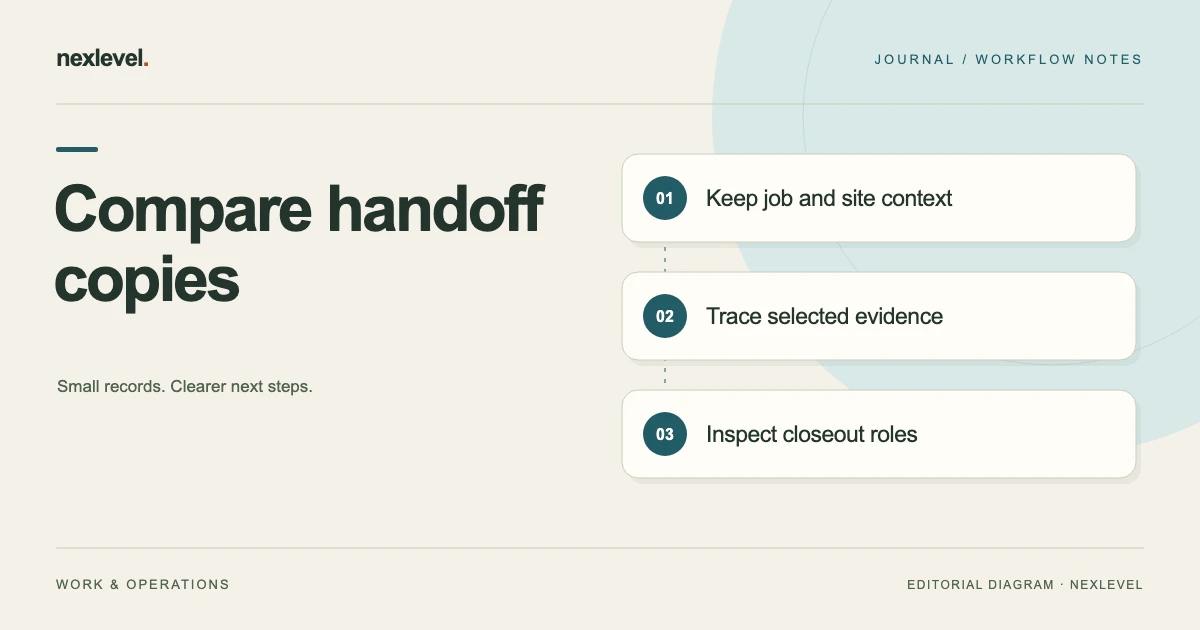
A maintained photo folder can suit an image-reference handoff; a structured job report can bring recorded work and closeout context together. Compare both using the same visit and recipient questions. Check the source relationships, usable copy and maintenance each approach needs before choosing the method.
Choose the handoff that answers the recipient's questions
- Define what the recipient needs to find or continue from the visit.
- Prepare the same fictional job, photo, material, exception and recommendation references in each method.
- Test retrieval from a photo to its work item and from the work item back to its evidence.
- Inspect the actual recipient copy and record missing context, manual upkeep and the selected method's limits.
Working fields:
Recipient question | Folder result | Report result | Manual dependency | Missing source | Selected method
Useful next steps: Define the service report contents, Build useful photo labels, Check open closeout evidence gaps.
Define what the recipient needs to reconstruct
Choose the actual handoff question. The recipient may need to identify a selected work area, locate a photo’s source, understand an exception, or continue a recommendation. Those tasks do not necessarily use the same representation.
Write the job/customer/site scope, source cutoff, intended reader, selected output, and next action. A packet about one visit should not appear to represent every later service occasion.
Use fictional material for the comparison. There is no need to handle a real site, photograph a customer property, or share private client records merely to test the documentation structure.
Distinguish photo context and completion context
A source photo can show selected visual information without independently establishing every action performed. A before/after label needs its actual job, area, and occasion.
A completed-work entry, exception note, recommendation, and customer acknowledgement have different roles. A folder or report should preserve those distinctions instead of letting a finished-looking image stand in for all of them.
The method choice should therefore test source relationships, not just file appearance. More photos do not automatically make a packet more understandable or its claims better supported.
Use one fictional visit for both methods
Imagine job J82, site reference S3, work item W4, selected photos P1/P2, material note M5, exception X6, and recommendation N7.
Customer acknowledgement A8 and retained report R9 concern separate roles. One question remains about which source establishes P2’s actual work-item relationship.
No real customer, site, service action, material use, physical result, signature, or payment is supplied. The references test how a recipient reconstructs entered records without creating genuine service history.
Build a folder-based handoff trial
A controlled folder can use a job cover note, selected labeled photos, a work/source index, and a separate closeout explanation. Demonstrate J82/S3/W4 before asking the recipient to interpret P1/P2.
The cover note should identify the actual source cutoff and role of each file. A filename called after should not be the only explanation of what the image concerns.
Keep the work, material, exception, and recommendation notes distinguishable. A smaller folder can be sufficient for a selected task if its source relationships are maintained clearly.
Identify the folder’s manual dependencies
The folder method may depend on someone maintaining labels, file routes, item references, and the cover note. Include those steps in the comparison rather than treating them as invisible work.
Open the actual recipient copy. A shared link, copied directory, and downloaded archive can have different contents or access dependencies under the real arrangement.
If P2 loses its job/item reference during copying, repair that selected representation. The limitation belongs to the actual implementation rather than every possible photo-folder method.
Evaluate ProofLedger against its current listing
The verified current ProofLedger description includes scheduled/ad hoc jobs, customer/site context, captured or imported labeled before-and-after evidence, completed-work records, materials, exceptions, recommendations, and closeout notes.
It describes typed-name/drawn acknowledgement, versioned completion report preview, PDF sharing, and a local archive of draft/completed jobs. The core workflow remains available without a network connection.
Check actual access. Free has a bounded monthly watermarked-report allowance; Pro expands reports and removes the watermark. The app does not provide invoicing, payment processing, dispatch optimization, or employee monitoring.
Build the report-based handoff trial
Use the same fictional J82 packet. Inspect the selected job, site, work item, photo labels, material note, exception, recommendation, and acknowledgement context in the actual supported representation.
A report can connect entered information without independently establishing physical workmanship or a customer’s understanding. Keep its source cutoff and version identifiable.
The current description does not establish arbitrary spreadsheet import or a universal full-workspace restore process. Do not invent those capabilities to make every candidate method appear equivalent.
Compare the information roles directly
| Recipient question | Folder trial | Report trial |
|---|---|---|
| Which job/site? | Inspect maintained cover/index context | Inspect selected job/site fields |
| Which photo relationship? | Inspect labels and source routes | Inspect selected evidence references |
| What was entered as done? | Locate the separate work note | Inspect the completed-work record |
| What remains open? | Locate exception/follow-up notes | Inspect exceptions/recommendations |
| What copy is this? | Identify contents and cutoff | Identify report version and cutoff |
These are independent comparison prompts, not a claim that every folder or every report automatically contains all the needed information.
Keep acknowledgement within its advertised scope
ProofLedger currently presents acknowledgement as a record that the customer reviewed the service information shown, not a qualified electronic signature.
For A8, preserve the actual selected role. A drawn mark should not silently become a guarantee of legal acceptance, complete satisfaction, identity verification, or payment.
The fictional trial needs no real signature or customer contact. It can evaluate the relationship between report contents and acknowledgement without producing a legal conclusion.
Review unsupported completion claims
A statement that work was completed needs its actual source context. A polished PDF should not make an unsupported sentence more authoritative than the underlying record.
Use the completion-claim audit guide for that narrower review. Retain its actual result or precise limitation.
If P2’s relationship remains uncertain, name the question rather than describing it as conclusive evidence for W4. A useful handoff can preserve an open issue honestly.
Keep exceptions separate from recommendations
X6 records an exception/source question. N7 is a selected recommendation context. Neither should silently become completed follow-up work.
Use the closeout evidence checklist for a focused review. Preserve the established relationship or precise next question.
This comparison supplies no repair method or technical recommendation. It evaluates whether the selected method keeps entered documentation roles understandable.
Test photo retrieval in both directions
Ask the recipient to start with P2 and locate J82/S3/W4. Then start with W4 and locate the selected source image and its actual occasion.
Use the service-photo labeling guide for that narrower source task. A familiar area name should not be the only identity key.
If the recipient needs the original writer to explain one relationship, record that dependency. File preparation and useful continuation are separate results.
Preserve the selected copy and later clarification
A prepared folder, report preview, shared PDF, and recipient’s retained copy can have different roles. Identify what was actually inspected and its source cutoff.
A later note clarifying P2 should retain its own occasion and relationship to R9. Do not make the historical packet appear to have contained later information.
A correction to the cover explanation is different from recording another service action. Keep those purposes distinguishable so handoff repair does not create job history.
Choose from demonstrated fit
A maintained folder may fit a bounded photo-reference task. A structured report may fit a recipient who needs entered work, exceptions, recommendations, and acknowledgement together. The actual arrangement determines whether either method is useful.
These are conditional documentation comparisons, not measured productivity, legal-sufficiency, or workmanship claims. Choose from the task, authorized access arrangement, output inspected, and manual maintenance observed.
A decision note should identify the selected purpose, demonstrated relationships, remaining source question, and next owner within the actual arrangement. A new tool should not make uncertainty disappear.
Complete the fictional recipient trial
Give both candidate methods the same five retrieval questions. A method should be evaluated against the task actually demonstrated, including any manual index needed to make its source relationships understandable.
| Reference | Recipient should identify | Question if missing |
|---|---|---|
| J82/S3/W4 | The selected job, site, and work item | What source distinguishes another visit? |
| P1/P2 | The actual selected image relationships | Which source establishes the item/occasion? |
| M5/X6/N7 | Material, exception, and recommendation roles | What remains open rather than completed? |
| A8 | The acknowledgement context | What information was represented? |
| R9 | The retained report/copy and cutoff | What contents were actually inspected? |
For the folder, record the actual cover-note and file-route dependencies. For ProofLedger, inspect the supported selected report rather than assume every desired field appears in every copy. Advertised capabilities establish what to evaluate; they do not prove an unperformed trial result.
Test an exception before choosing the method
Suppose the folder’s P2 filename says after but the selected source does not establish W4’s relationship. A structured report may help organize that question, but moving the same uncertain image into a PDF does not independently resolve it.
Now suppose the working job clearly identifies P2, while the recipient’s copied folder loses the reference. Repair that copy or its cover index. There is no need to rewrite accurate work records merely to make the shortened packet agree.
A third case concerns N7. If the report labels it as a recommendation, the recipient should not infer that the suggested follow-up was completed. The folder method needs an equally clear convention for the same distinction.
Finally, inspect A8’s role. The reader should identify the selected acknowledgement context without calling it payment, qualified signature, or proof of every physical result.
A bounded decision note can name which representation answered the actual recipient questions, which manual steps were needed, and which source relationship remains open. It does not require a claim that one method is universally best.
Keep the selected job/site identity and cutoff inside the output as well as in filenames. A copied PDF or image can lose its original folder context.
The completion receipt can identify the fictional task, representations inspected, established relationships, actual limitations, and next authorized review. It documents an administrative comparison without certifying workmanship or client understanding.
The fictional references remain teaching inputs. Reuse the trial structure with actual authorized sources while preserving physical-service, acknowledgement, and external-outcome boundaries.
Prepare a recipient-focused decision note
In one fictional branch of the trial, the folder’s cover index establishes J82/S3/W4 and the selected P1 relationship, but P2’s shortened label remains unresolved. The useful result is specific: the folder supports one retrieval route and still needs the source connecting P2 to W4. It is not necessary to declare the entire folder good or bad.
In another fictional branch, the selected report clearly connects the entered work note, material note, exception, and recommendation. That makes those record roles easier for the recipient to inspect. It does not independently prove physical work, material use, customer understanding, or follow-up completion.
A decision note can therefore identify the actual handoff purpose, representation inspected, established references, manual maintenance, and precise next source question. If the task needs only labeled source photos, the maintained folder may fit. If it needs the selected entered closeout context together, a report may fit. The demonstrated task determines the choice.
For a final check, remove the original conversation and ask the recipient to identify the job/site, selected work item, source-photo question, exception, recommendation, acknowledgement role, and cutoff. Record any explanation still needed before relying on the packet. The result should remain a bounded administrative comparison, not a claim about workmanship, legal acceptance, or payment.
Use ProofLedger for connected service records
ProofLedger connects entered job/site context, selected before-and-after evidence, work records, closeout notes, acknowledgement, and supported PDF reporting in a local workflow.
Check the official ProofLedger App Store listing for current capabilities and Pro access. Preserve the documentation trail without treating it as invoicing, payment processing, or qualified electronic signature.