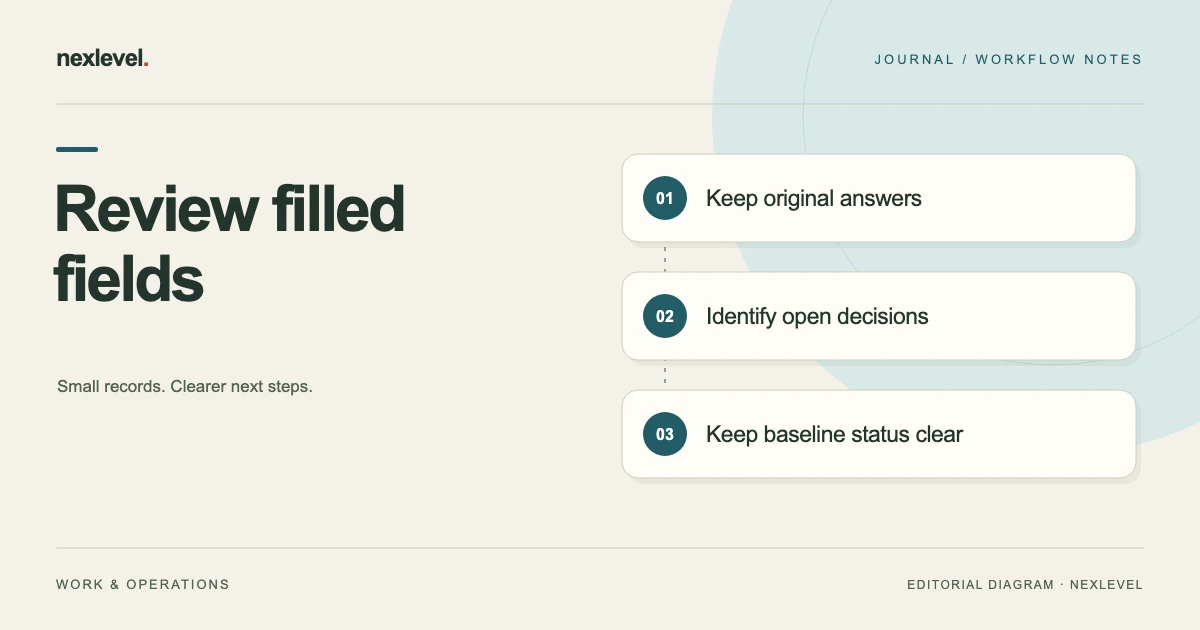
A filled client-brief field can still leave a decision unresolved. Answers such as “a website,” “everyone,” or “the team” may contain text without establishing the deliverable, audience, or approval arrangement needed for the selected project task.
Review the actual source answers, question context, intended decision, current working version, and selected baseline. Keep completeness indicators separate from the human judgment about whether the project has enough usable context.
This guide uses fictional answers. It supplies no contract wording, legal acceptance rule, guaranteed project outcome, or message to send. Start with the client brief template for the underlying structure.
Define the review question
Choose the selected project decision the brief should support. A readiness check for beginning one task is different from approving an entire engagement.
Write the project/version scope, source cutoff, intended reader, and exact unresolved point. The review should not appear to certify every requirement merely because all visible fields contain text.
Use fictional material during the exercise. There is no need to publish a real client link or send a clarification request merely to test the worksheet.
Separate answer presence from decision context
A response can be present while its meaning remains broad, ambiguous, or tied to an unclear source occasion. The actual review needs to identify what decision the selected answer supports.
Brievra’s current description includes local templates/editing, on-device deterministic gap review, a readiness score, optional encrypted client collection, response import, version evidence, and Markdown export with plan-dependent access.
Those features organize entered requirements. They do not guarantee completeness or independently decide whether an answer is sufficient for a real project.
Set up a fictional filled-field brief
Imagine project P47, working version V2, question set Q3, and response source R4. The fictional deliverable answer is “a website,” audience is “everyone,” and approval owner is “the team.”
Each field contains text, but the selected task still needs a bounded deliverable definition, usable audience context, and an actual decision arrangement. Baseline B6 is not selected yet.
No real client, scope, budget, deadline, approval, or project outcome is supplied. These answers illustrate an independent human-review exercise rather than actual app validation rules.
Use an answered-but-unresolved worksheet
| Fictional answer | Decision still unclear | Source question to retain |
|---|---|---|
| A website | The selected deliverable boundary | Which actual project result is in scope for this task? |
| Everyone | The audience context relevant to the work | Which source establishes the intended users/readers? |
| The team | The review/decision arrangement | Which role or process records the selected decision? |
The table is an independent companion worksheet. It does not claim that Brievra automatically flags those exact phrases or applies an undisclosed semantic-quality test.
Preserve the original answer before summarizing it
Keep R4’s actual wording and source occasion available under the authorized arrangement. A stronger-looking summary should not silently replace what the respondent actually supplied.
A proposed clarification, the original answer, and a selected working requirement have different roles. The reviewer should be able to trace the relationship rather than infer it from polished wording.
If a source is unavailable, retain that limitation. Do not invent a detailed requirement merely to make the brief look ready.
Ask what decision each field supports
For each selected answer, identify the task that depends on it. A broad description may be enough for an early exploration while remaining insufficient for a later execution decision.
Record the specific missing relationship rather than label the entire brief bad. A bounded question is easier to continue than a general request for more detail.
This guide recommends no universal project process or deliverable list. The actual engagement and responsible source arrangement determine what context is needed.
Keep ambiguity separate from conflict
An answer can be too broad without contradicting another source. A conflict involves selected sources that appear to disagree. Those findings can need different next checks.
Use the conflicting-answer review guide for that narrower task. Preserve the actual result or precise limitation.
Do not choose the most convenient interpretation to make the fields appear consistent. Keep the source and decision questions visible.
Keep readiness indicators in their actual role
Brievra currently describes a live readiness score and deterministic on-device gap rules. Those signals can support review without establishing that every filled answer is accurate, accepted, or sufficient.
This guide supplies no score threshold, weighting, or hidden validation algorithm. Inspect the actual selected workflow rather than inventing a universal pass condition.
A complete-looking field set and a usable project baseline are related but different states. The human review should preserve that distinction.
Separate response collection from review
The current app describes optional encrypted no-account client links and valid-response import under Pro. Receiving or importing an answer is not the same event as resolving its decision context.
A local brief can be prepared and reviewed without publishing a link. If an online collection step is used, identify its actual source and occasion rather than implying every local edit automatically reaches the client.
The current description says the service stores ciphertext and operational records for link delivery/limits/expiry/revocation. Do not describe that chosen network feature as though no server is involved.
Preserve receipt, review, and selected baseline separately
A respondent supplying R4, someone reviewing V2, and the responsible people selecting B6 are different events. One completed label may hide which actually occurred.
Use the receipt/review/baseline guide for that narrower distinction. Preserve the actual evidence boundary.
Brievra’s version evidence is not an electronic-signature service. A frozen version should not become a legal acceptance conclusion or guarantee of complete requirements.
Write the clarification task without sending it
A worksheet can identify which source question would resolve each selected ambiguity. It can name the responsible decision role under the actual arrangement without inventing a response.
The fictional exercise does not authorize contacting a client. A prepared clarification prompt is distinct from an actual communication, reply, or decision.
If later information becomes available, identify its own source occasion and relationship to R4/V2. It should not make the original answer appear more precise than it was.
Inspect the selected working or exported copy
Brievra Pro currently includes frozen canonical versions with SHA-256 evidence, a readable timeline, and Markdown export. Check actual access and open the representation relevant to the review.
Inspect project identity, selected question set, source answers, unresolved decision context, version, and cutoff. A companion explanation may be needed where the actual output does not represent every source relationship automatically.
The public description does not establish universal PDF reporting, arbitrary spreadsheet import, or complete-workspace restoration. Keep the review within actual supported capabilities.
Run a second-reader task test
Give a reader the fictional V2 and worksheet. Ask which source establishes the deliverable boundary, audience context, and decision arrangement needed for the selected task.
The reader should name specific unresolved questions rather than assume that nonempty fields establish a baseline. They should not need an invented client answer to explain the findings.
If the working source is accurate but a summary overstates it, repair the summary. A documentation correction is different from recording another response or selecting B6.
Write a bounded review receipt
Name the selected project/version, source answers inspected, decision relationships established, actual clarification still needed, and intended next review under the authorized arrangement.
A later clarification should retain its own occasion and source role. It should not make V2 appear to have contained later requirements from the start.
The receipt documents an administrative quality review without claiming project success, legal completeness, or client acceptance.
Connect the result to handoff or retention
For another contributor taking over, use the requirements handoff checklist. The result should state which decisions remain open and which source supports the selected context.
For a historical packet, use the brief archive guide. For method selection, use the requirements workspace comparison.
The fictional answers remain teaching inputs. Reuse the worksheet with actual authorized sources rather than importing invented scope or approvals into genuine project history.
Work through three answered-but-unresolved cases
The selected worksheet can preserve the original answer while making its decision gap specific. A fuller-looking sentence is not automatically a better source.
| Fictional source answer | What is established | Bounded next question |
|---|---|---|
| A website | A broad deliverable label was supplied | Which selected result/boundary supports the next task? |
| Everyone | A broad audience label was supplied | Which actual source defines the relevant audience context? |
| The team | A collective approval label was supplied | Which role or process records the selected decision? |
These are independent teaching cases, not exact phrases the app is claimed to reject or a hidden semantic-scoring specification.
Continue the review without inventing client answers
For the deliverable case, retain the original wording and name the specific boundary the selected task needs. Do not replace “a website” with a detailed scope that no source supplied.
For the audience case, record which project choice depends on audience context. A broad answer may fit an early conversation while remaining insufficient for another decision.
For the approval case, identify the actual arrangement that would establish who or what process selects the baseline. A collective label should not become an invented individual’s approval.
Then remove the original review conversation. Ask a reader to identify P47/V2/Q3/R4 and explain which decisions remain open before B6 is selected.
The reader should distinguish answer presence, source precision, clarification needed, and actual baseline selection. A readiness indicator can support that review without deciding every semantic question.
If later clarification becomes available, identify its own source occasion and relationship to R4. It should not make V2 appear to have contained later requirements from the start.
Keep project/version identity, question context, original answer, decision gap, and cutoff inside the review receipt as well as in filenames.
A bounded receipt can name sources inspected, relationships established, actual copy correction if any, and precise next question. It documents an administrative quality review without a legal acceptance or project-success conclusion.
The fictional answers remain teaching inputs. Reuse the worksheet with actual authorized sources while preserving human judgment, optional client-link sharing, and communication boundaries.
Prepare a review receipt for the selected decisions
In one fictional branch, R4 still contains the broad answer “a website,” and no later authorized source establishes a narrower deliverable boundary. The supported result is to name the exact decision needed next. It is not to insert a detailed scope that nobody supplied.
In another branch, later source R5 clarifies one selected audience decision while the approval arrangement remains open. Keep R5’s own occasion and bounded role. One clarification should not automatically make every field or the entire project ready.
A third branch has an accurate working answer but an overconfident cover summary. Repair the summary rather than change the source to match it. A documentation correction is different from receiving another response or selecting B6.
The receipt can identify P47/V2/Q3/R4, the selected task, source answers inspected, decision relationships established, actual correction if any, and precise next question. It should distinguish presence of text from usable decision context.
For a final check, remove the original review conversation and ask another reader which sources support the deliverable, audience, and approval arrangement required for the selected task. Record any manual explanation needed.
A useful review can leave a specific decision unresolved while making the next administrative step clear. It does not guarantee complete requirements, project success, or legal/client acceptance merely because the brief has a readiness indicator.
Use Brievra for clear entered requirement context
Brievra connects local brief preparation, on-device gap review, optional encrypted client collection, version evidence, and supported Markdown output.
Check the official Brievra App Store listing for current capabilities and Pro access. Keep filled answers, usable decisions, selected baselines, and external acceptance in their appropriate roles.