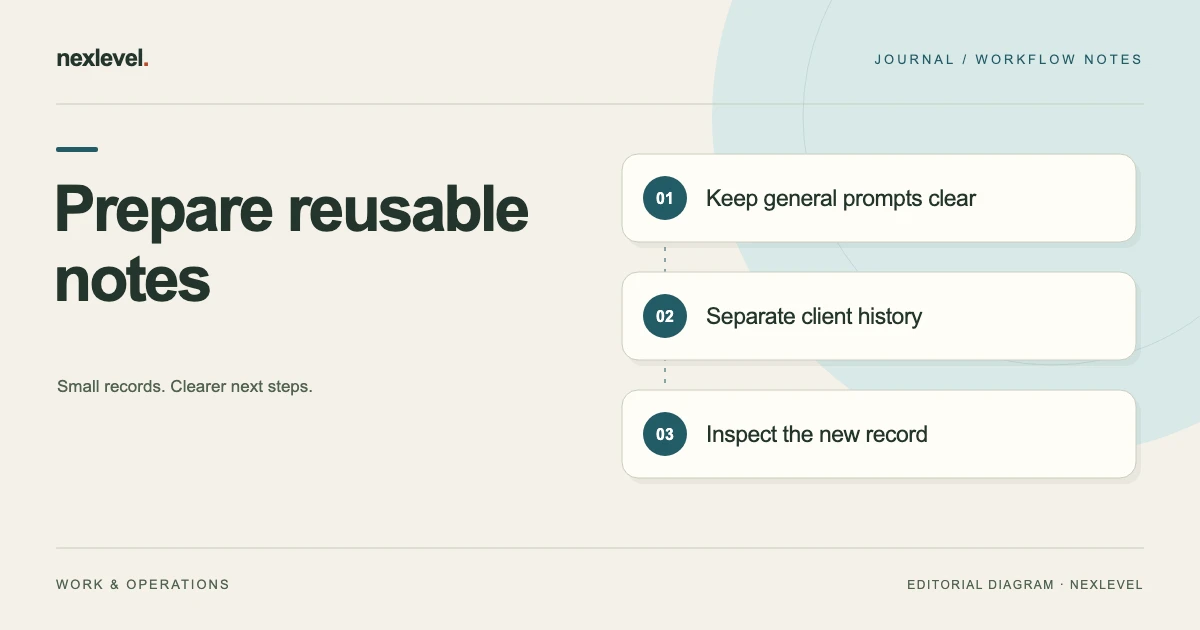
Reuse blank alteration-note prompts and field labels, while keeping customer-specific measurements, garment images, fitting observations and approval history in their original ticket. Before starting a new order, check every copied value and require a fresh source for anything that describes the new garment.
Clean the reusable starting point
- Select general prompts rather than copying a completed client ticket unchanged.
- Remove old client, garment, fitting and pickup references from the reusable material.
- Keep source images and measurements specific to their real occasion.
- Test the blank structure with fictional inputs before using it for a genuine new order.
Working fields:
Reusable prompt | Old value to remove | New source required | New ticket reference | Checked by
Useful next steps: Start from the alteration ticket template, Check the new garment’s identity.
Choose what is actually being reused
A blank prompt, a service label, a note structure, a prior fitting observation, and an approval snapshot have different roles. Do not call all of them a template merely because they are convenient to copy.
Write the selected reusable scope, source arrangement, intended new-record purpose, and actual supported feature. The task is not to duplicate every field from a completed client order.
Use fictional records during preparation. There is no need to copy real customer details into a shared working document merely to test the structure.
Separate prompts from historical facts
A prompt asks for a fresh fact or decision. A historical measurement or fitting note records what was entered for another occasion. Their similar layout should not make them interchangeable.
AlterationTicket’s current description includes customer/garment records, maps, measurements, fitting history, approval versions, pickup output, and reusable templates under Pro.
This guide’s worksheet is an independent convention. It does not claim the app automatically classifies or sanitizes every copied field.
Set up a fictional reuse task
Imagine prior ticket T101, garment G2, fitting F3, approval A4, and pickup representation P5. A general note outline N6 may be useful when preparing new ticket T102.
The question is which parts of N6 are reusable prompts and which references still describe T101/G2/F3. The new order needs its own actual source context.
No real customer, garment, measurement, fitting, approval, or pickup event is supplied. The references evaluate administrative reuse without creating genuine studio history.
Use a reusable-versus-specific worksheet
| Selected material | Role to identify | New-record question |
|---|---|---|
| Blank garment prompt | General structure | What actual item belongs in the new ticket? |
| Prior measurement/note | Historical client/visit record | Which fresh source establishes the new value? |
| Selected image/map | Actual garment context | Does this represent the new order? |
| Approval/pickup reference | Prior workflow event | What new event is actually established? |
| General note outline | Proposed reusable prompt set | What still needs review before use? |
These are independent preparation prompts, not a named native validator or a promise that every field can be reused through every plan.
Start with the minimum useful structure
Keep only the general labels or questions the next record actually needs. A longer copied example is not automatically a better starting point.
For the fictional N6, the useful general structure might separate garment identity, fitting occasion, proposed work, selected approval context, and pickup source. It supplies no actual values for T102.
A blank or unresolved field can be honest. Do not fill it with a previous customer’s value simply to make the new ticket look complete.
Inspect every retained client/garment reference
Search the selected reusable material for references to T101/G2/F3/A4/P5 and any actual source routes. The practical question is whether the material still points to a historical order.
A shortened label can hide that dependency. A note called standard may still contain one selected client’s garment or fitting context.
Use the garment identity check for a narrower mismatch. Preserve its actual result or precise limitation.
Keep images and visual-map context specific
The current app describes pins on garment imagery and detailed notes/measurements. A prior map is historical context, not automatically an appropriate image for another garment.
Inspect the actual supported template workflow rather than assume every image, annotation, or field copies in the same way. The public description does not establish a universal sanitization mechanism.
This guide supplies no measuring or visual assessment technique. Its task is to prevent a record’s identity from changing by implication during reuse.
Do not carry prior approval into a new scope
A4 belongs to a selected prior approval context. A general service label or prompt should not make it appear to authorize new work for T102.
Use the estimate-versus-approved-work guide for that narrower review. Preserve the actual source relationship.
A copied completed-looking field should not become a new fitting, approval, payment, or pickup event. Keep those purposes distinguishable.
Check actual template access
AlterationTicket currently advertises reusable templates under Pro, alongside expanded active tickets, pins, reminders, and insights. Check actual access before describing the selected workflow.
Free includes the core bounded-ticket workflow and existing records remaining readable/exportable. A reusable companion prompt can be prepared independently without inventing a Free native template feature.
A purchase does not create missing source information or make copied client context appropriate for a new order.
Prepare a clean trial record with fictional inputs
Use T102 as a separate fictional preparation case. Identify which prompts remain empty, which new source relationships are established, and which prior references should remain only in T101’s history.
Do not claim the trial represents a real customer or physical work. The useful result is whether another reader can distinguish general structure from historical facts.
If the selected source material remains ambiguous, preserve the question rather than changing accurate prior records to match a new draft.
Inspect the intended shared or retained representation
A native template, new working ticket, shared receipt, and independent prompt sheet can have different contents. Open the actual selected copy before relying on it.
Check source identity, old/new references, blank prompts, actual entered values, and cutoff. A filename called reusable does not establish that private historical material has been removed.
The public description does not establish arbitrary spreadsheet import or universal template transfer. Keep the preparation task within actual supported capabilities.
Run a second-reader separation test
Give an authorized reader the fictional N6/T102 preparation material. Ask what is general structure, what belongs to T101, and what fresh source the new record still needs.
Then introduce another prior ticket with similar service wording. The reader should not assign its measurements, images, or approval to T102 merely because the labels match.
Record any manual explanation needed. A clearer reusable prompt should reduce ambiguity in the selected task without pretending it verifies the new customer’s requirements.
Keep later template changes visibly later
A revised reusable prompt set can have its own source occasion. It should not make older fitting history appear to have used the new structure from the start.
A correction to the prompt sheet is different from changing T101’s historical facts or adding an event to T102. Preserve those distinctions.
A concise preparation receipt can name sources inspected, general prompts retained, specific references excluded from the reuse task, and precise next question.
Connect reusable preparation to handoff and retention
For a responsibility transfer, use the fitting-to-pickup handoff guide. A general prompt set does not transfer current task ownership.
For historical material, use the alteration archive guide. Its cutoff/retrieval purpose differs from preparing reusable notes.
The fictional references remain teaching inputs. Reuse the worksheet structure with actual authorized records while keeping client identity, technical work, and external outcomes in their actual source roles.
Work through a clean reusable-note outline
A fictional N6 outline can contain prompts for current garment identity, selected fitting occasion, proposed-work source, approval-version context when established, pickup-source context when established, and the precise open question. It contains no actual client value simply because an older ticket had one.
The distinction is visible in the grammar. “Record the current garment source” is a prompt. “G2 from T101” is a historical reference. The useful preparation task is to retain the former role where appropriate without making the latter appear to describe T102.
This outline is an independent worksheet. It does not establish exact native field names or a promise that every template contains the same prompts.
Classify four reuse cases
| Fictional material | Source role | Bounded preparation result |
|---|---|---|
| A blank fitting-reference label | General prompt | Keep it as a request for fresh context |
| A prior selected measurement | T101/F3 history | Keep it tied to that occasion |
| A garment image with a shortened caption | Unresolved identity/source context | Review the actual relationship before reuse |
| A4’s approval reference | Prior scope/version event | Do not treat it as a new authorization |
The cases do not classify every real field automatically. The actual selected source determines what is general structure, what is historical fact, and what remains uncertain.
Complete the fictional preparation review
In one branch, the source establishes that N6 contains only general section prompts, while T101 retains G2/F3/A4/P5. The supported result is that the selected prompt set can be used for the bounded T102 preparation task under the actual arrangement. It does not fill T102’s client or garment facts.
In another branch, N6 still contains a fitting note that clearly belongs to F3. The repair is to keep that historical note separate from the reusable prompt task. Do not change T101’s accurate history merely to make the reusable artifact cleaner.
A third branch has a shortened image label with no established garment relationship. Preserve that source question. Calling the image generic does not make it unrelated to a client or suitable for another order.
A fourth branch concerns approval. A4’s reference can remain useful history for T101 while being inappropriate as evidence of a new event for T102. The record should not acquire a new approval merely because copied text contains an approval label.
Now give another authorized reader only the fictional reusable material and new-record preparation note. Ask what is a prompt, what belongs to T101, and what fresh source T102 still needs. They should not require the original writer’s memory to distinguish those roles.
Record any manual explanation needed, the supported template/independent worksheet used, actual copy correction if any, and precise next source question. A filename called reusable should not substitute for inspecting the contents.
Keep old/new identity, general/historical roles, and cutoff inside the preparation receipt too. A copied note can lose its original folder path.
The receipt documents an administrative separation task without claiming technical suitability, legal acceptance, or a physical fitting/pickup outcome. It can be useful while leaving a new client’s source context open.
The fictional references remain teaching inputs. Reuse the role-classification structure with actual authorized records rather than importing invented facts into a genuine order.
Finish with an old-record versus new-record check
For a final practical check, give the reader only the fictional N6/T102 preparation material and its receipt. Ask which source each retained value belongs to, what is merely a prompt, and what new fact or decision is still needed. They should identify T101/G2/F3/A4/P5 as historical context where applicable rather than infer a new event from copied wording.
Record any manual explanation needed and whether the actual supported template representation was inspected. A useful preparation result can make the next administrative task clear while preserving uncertainty. It should not claim a clean new customer history merely because a file was renamed, or technical suitability merely because the prior order used a similar service label. Keep the evidence limit beside the affected source reference.
Use AlterationTicket for clear new and historical records
AlterationTicket connects customer/garment context, fitting history, approval versions, pickup records, and plan-dependent reusable templates in a local workspace.
Check the official AlterationTicket App Store listing for current capabilities and Pro access. Keep reusable prompts, client-specific facts, and new workflow events distinguishable.