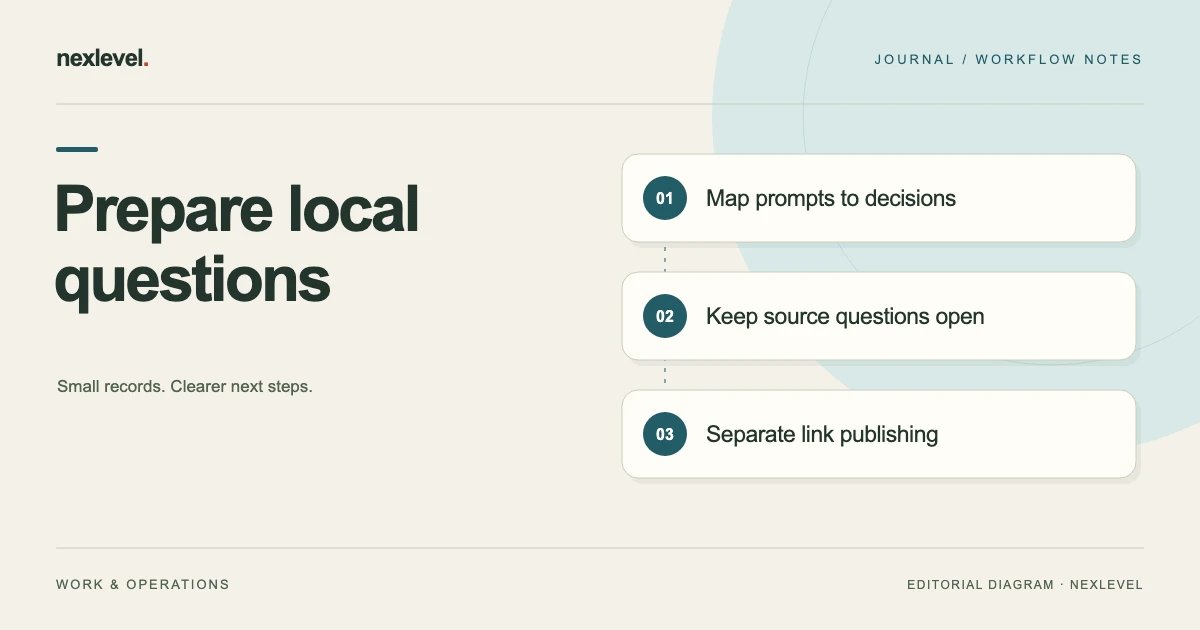
A local client questionnaire can be prepared and reviewed before any link is published. The useful task is to identify the project decision each question supports, keep source requests clear, and leave unsupported scope open instead of making the form merely look complete.
Build a bounded fictional question set in the local workspace. Separate preparation, optional encrypted publishing, response import, review, and baseline selection as different workflow stages.
This guide supplies no contract wording, legal acceptance rule, guaranteed project outcome, or client message to send. Start with the client brief template for the underlying structure.
Choose the next decision the questionnaire should support
A discovery conversation, a production handoff, and a selected project baseline may need different information. Write the actual selected purpose before adding questions.
Identify the project scope, source arrangement, intended respondent role, local working version, and next review. A form for one task should not appear to define the whole engagement.
Use fictional material during preparation. There is no need to publish a real link or collect private client data merely to test the question structure.
Start from advertised local capabilities
The verified current Brievra description includes six starting templates, local brief creation/editing/duplication/archive/search, a readiness score, and deterministic on-device gap review.
Free currently includes local briefs, templates, editing, gap checks, appearances, and the Watch glance. Pro adds encrypted client-link publishing/import, frozen version evidence, and Markdown export.
Check actual access rather than treating optional online collection as necessary for the local preparation task. The app does not guarantee complete requirements or create a legal signature.
Set up a fictional questionnaire
Imagine project P63, local working version V2, starting template T3, and proposed question set Q4. No client link has been published in this exercise.
The selected task is to prepare enough source context for a later bounded review. Proposed questions concern the deliverable, intended audience, source references, decision arrangement, and unresolved points.
No real client, scope, budget, deadline, approval, form submission, or project outcome is supplied. The example is an independent human preparation exercise, not an app-generated guarantee.
Use a question-to-decision map
| Proposed prompt | Decision/context it supports | What remains outside its scope |
|---|---|---|
| Which deliverable is this request about? | The selected project result and boundary | A complete legal scope by itself |
| Who will use it, and for what task? | Relevant audience/use context | A universal definition of every user |
| Which source references define the current context? | The actual evidence route | Automatic approval of every linked source |
| Which role or process records the selected decision? | The review arrangement | Legal signature or external acceptance |
| What is still unresolved for the next task? | The bounded clarification queue | A promise that no later question will arise |
These are fictional sample prompts, not mandatory native fields or exact phrases the app is claimed to validate semantically.
Keep each prompt tied to an actual purpose
A question should help establish source context or a selected decision. More questions do not automatically make the questionnaire more useful.
For Q4, identify which next task would use each answer. If the relationship is unclear, refine the prompt or retain the design question rather than collect detail simply because another template has it.
This guide recommends no universal engagement process. The actual project and responsible arrangement determine what context is needed.
Ask for source references without inventing upload features
A source prompt can identify the authorized location or reference relevant to the project. It need not ask for every original file in the questionnaire.
The current public description does not establish arbitrary file-upload or every attachment workflow. Do not rewrite a source-reference question as a promise that the form accepts all file types.
A route in an answer does not automatically embed the source or grant another reviewer access. Keep that dependency visible in the later review.
Use answer examples carefully
A sample can clarify the intended role while accidentally becoming a copied answer. Keep examples visibly fictional and separate from the actual project record.
For the deliverable question, a broad answer such as “a website” can be present without resolving the selected boundary. Do not replace it with invented details to make the form look ready.
Use the filled-but-unresolved field review for that later quality task. Preparation and answer sufficiency are different questions.
Review ambiguity before publishing
A prompt can be too broad, combine several decisions, or leave its source role unclear. Identify the specific problem rather than declare the whole questionnaire bad.
Use the conflicting-answer guide if later sources disagree. An ambiguity and a conflict may need different next checks.
For the local Q4 trial, preserve which question is being refined and why. A wording correction is different from receiving another client response.
Keep readiness within its actual role
Brievra currently describes on-device gap review and a live readiness score. Those signals can support preparation without deciding every semantic or project-specific question.
This guide supplies no hidden threshold, weighting, or exact validation algorithm. Inspect the actual selected workflow rather than inventing a universal pass condition.
A complete-looking questionnaire, an answered form, a reviewed brief, and a selected baseline are related but distinguishable states.
Separate local preparation from optional publishing
Pro currently adds a no-account client link with form/responses encrypted before leaving the device or browser. That chosen online step is different from editing Q4 locally.
The listing says the service stores ciphertext and operational records for delivery, limits, expiry, and revocation. Do not describe publishing as though no server is involved.
The fictional preparation exercise does not authorize creating or sending a real client link. It can be completed entirely in the local-record stage.
Keep response import separate from review
A valid imported response is a source for the working brief. It should not silently resolve every question or become baseline approval.
Use the receipt/review/baseline guide for that later task. Preserve the actual source occasion and evidence boundary.
A later answer or clarification should retain its own relationship to Q4/V2 rather than make the original local questionnaire appear to have contained it from the start.
Inspect the selected retained or exported copy
Brievra Pro currently includes canonical frozen versions with SHA-256 evidence, a readable timeline, and Markdown export. Check actual access and open the representation relevant to the selected task.
Inspect project identity, question wording, source roles, unresolved design points, version, and cutoff. A companion explanation may be needed where the output omits an independent source relationship.
The public description does not establish universal PDF reporting, arbitrary spreadsheet import, or full-workspace restoration. Keep the task within actual supported capabilities.
Run a second-reader local preparation test
Give a reader the fictional Q4/V2 and ask which decision each prompt supports. They should identify source/context roles without needing invented client answers.
Then ask which questions remain too broad or depend on unavailable sources. Record those specific design questions rather than filling the form with plausible content.
If the working prompt is accurate but a cover summary overstates its purpose, repair the summary. A documentation correction is different from publishing a link or selecting a baseline.
Write a bounded preparation receipt
Name the selected project/version, starting template, question purposes, source dependencies, actual wording changes, and precise next review.
Keep the actual cutoff and local/published distinction inside the preparation note as well as in filenames. A copied question list should not become an unexplained active client form.
The receipt documents local administrative preparation without a claim about complete requirements, legal acceptance, or project success.
Connect preparation to handoff and retention
For another contributor taking over, use the requirements handoff checklist. A local question set does not itself transfer source access or decision authority.
For historical material, use the brief archive guide. For method selection, use the requirements workspace comparison.
The fictional prompts remain teaching inputs. Reuse the question-to-decision map with actual authorized material while preserving optional network sharing and communication boundaries.
Prepare a copy-ready local question outline
The fictional Q4 outline can ask for the selected deliverable, relevant audience/use task, source references, decision arrangement, and unresolved point for the next review. Each prompt has a purpose; none supplies an actual client answer.
Keep the source-reference prompt narrow. A text route or document reference can support later review without claiming the form accepts every file type or automatically grants access.
Review four questionnaire-design cases
| Fictional prompt situation | Issue to identify | Bounded preparation task |
|---|---|---|
| A prompt asks for everything | The next decision is unclear | Name the selected task/context it supports |
| One field combines several decisions | The answer’s role may become ambiguous | Separate the source questions where useful |
| An example looks like an actual answer | Illustration and project data may be confused | Label the example and leave real context open |
| A source route is unavailable | Later review depends on actual access | Retain that precise dependency |
These are independent design prompts, not exact strings Brievra is claimed to score or reject.
Complete the local preparation without a client link
In one fictional branch, Q4’s proposed question clearly supports the next selected review. The supported result is to retain that purpose and source role in V2. It does not establish that a real client answered or that B6 has been selected.
In another branch, the proposed prompt is broad enough to produce several interpretations. Refine the question purpose or preserve the exact design issue. Do not add a plausible client answer merely to make the questionnaire look complete.
A third branch uses a sample answer such as “a website.” Keep it visibly illustrative. The actual project’s deliverable boundary still needs its authorized source, and a later response should retain its own occasion.
A fourth branch asks for a source reference without establishing who can use it. Preserve that access dependency for later review rather than describing the brief as self-contained.
Now remove the original preparation conversation. Give another contributor the fictional Q4/V2 and ask which decision each prompt supports, what source/context is requested, what remains unresolved, and whether the material is local preparation or an actual published form.
The reader should not infer client collection, imported responses, baseline approval, or legal acceptance solely from a completed-looking question set. Record any manual explanation needed.
If publishing later becomes part of the actual authorized workflow, inspect the supported current link arrangement separately. Local editing, chosen online publishing, response import, review, and frozen-version evidence remain different stages.
Keep project/version identity, question purposes, local/published role, and cutoff inside the preparation receipt as well as in filenames. A copied question list can lose its original folder context.
A useful receipt can name sources/templates inspected, prompt purposes established, actual wording correction if any, source dependencies, and precise next review. It documents administrative preparation without a completeness or project-success guarantee.
Finish with a local-versus-published check
For a final check, give the reader only Q4/V2 and the preparation receipt. Ask what decision each prompt supports, what source context is requested, what remains unresolved, and whether a link actually exists. They should not infer online publishing, a received response, or a selected baseline from a completed-looking local question set. Record any manual explanation needed and the precise next review. A useful local preparation result can remain bounded without collecting real client data or sending a message.
Use Brievra for clear local questionnaire preparation
Brievra connects local templates/editing, on-device gap review, optional encrypted client collection, version evidence, and supported Markdown output.
Check the official Brievra App Store listing for current capabilities and Pro access. Keep local preparation, publishing, response review, and baseline selection in their appropriate roles.