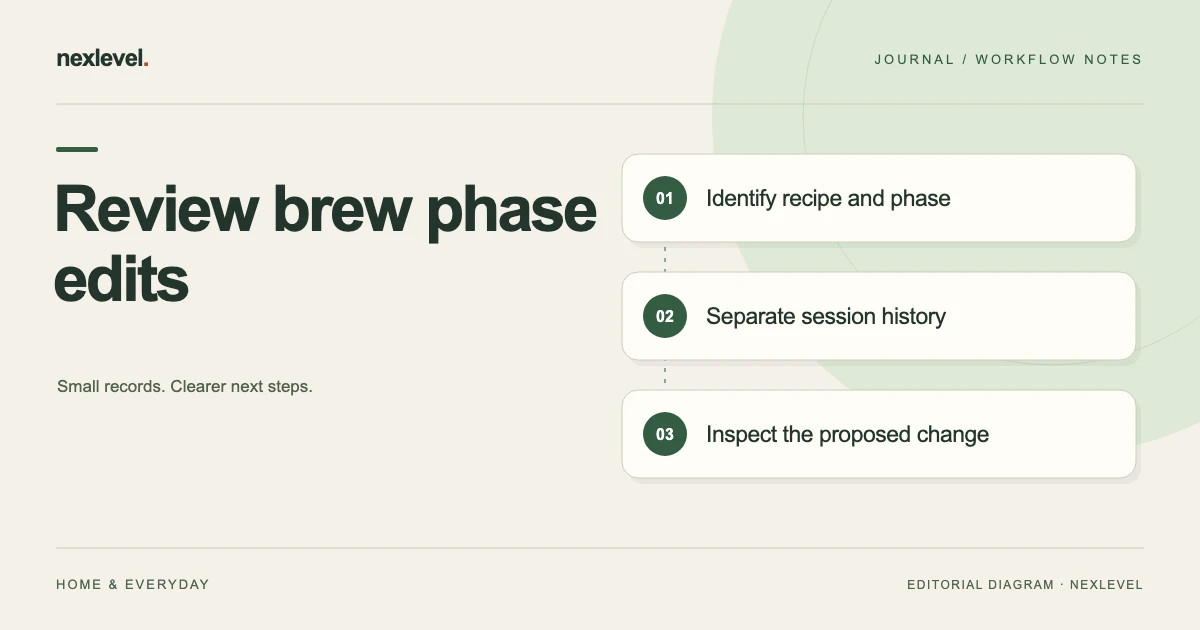
Before editing brew phases, identify the selected recipe and decide whether the change concerns future instructions, an earlier session event or a copied label. Preserve the session's original context and personal notes while giving the proposed plan its own clear reference.
Classify the change before editing the plan
- Identify the recipe, current phase plan, proposed edit and review cutoff.
- Check which sessions and observations refer to the current plan.
- Separate a label clarification, future planning change and early session completion.
- Inspect the retained copy and record what changed, what remains historical and any open unit question.
Working fields:
Recipe/current plan | Phase | Proposed change/reason | Historical session | Observation source | Units if relevant | Copy/cutoff | Open question
Useful next steps: Compare session history with the intended recipe, Check units when a phase amount changes.
Choose the selected edit and source scope
A phase-label clarification, a changed plan, an early session completion, and a new observation can have different roles. State which task is actually being reviewed.
Write the recipe/phase scope, source cutoff, intended edit, relevant session references, and actual output. A check for one phase change should not appear to verify every recipe or session.
Use fictional records during the exercise. There is no need to prepare coffee or edit a real personal library merely to test the worksheet.
Separate recipe, phase plan, and session
A reusable recipe and a completed brew session have different source roles. A personal note about one cup should not silently rewrite the recipe’s planning context.
BrewRatio’s verified current 2.1 description includes calculations, method presets, phase-aware timing, early completion details, ratings/notes, and Pro custom phase choreography in Recipe Studio.
The app organizes entered information. It does not independently measure ingredients or guarantee that identical inputs produce identical results.
Set up a fictional phase-review packet
Imagine recipe R14, current plan P2, proposed planning reference P3, selected phase B, completed session S5, and observation N4.
Retained copy C8 represents the selected cutoff. The example asks whether the intended edit concerns reusable planning or an explanation of what was recorded for S5.
No real recipe, amount, phase duration, method, temperature, physical action, or taste result is supplied. The references evaluate administrative relationships without creating genuine brew history.
Use a before-change record checklist
| Check | Source question | Result to retain |
|---|---|---|
| Recipe identity | Which selected recipe does the edit concern? | Actual reference or precise question |
| Phase context | What does P2/B represent now? | Source role and selected occasion |
| Proposed edit | What relationship does P3 change? | Bounded planning purpose |
| Session | What was entered for S5? | Historical context separate from the new plan |
| Observation | Which session does N4 describe? | Actual source relationship |
| Copy | What representation will be retained? | Contents, cutoff, and limitation |
These are independent preparation prompts, not a claim that BrewRatio supplies a dedicated recipe-version audit module.
Establish recipe identity before changing phase context
A familiar recipe title can recur across records or versions. Keep the selected source reference rather than relying on whichever item appears first in a recent list.
For R14/P2/B, identify the actual current relationship and source occasion. If it remains uncertain, retain the question rather than copying another similarly named plan.
A private companion note can preserve that context without claiming every field is automatically frozen by the app.
Preserve unit meaning where quantities are involved
If the selected edit also changes a quantity label, preserve the actual source unit and dimension. A bare number should not become mass or volume by guesswork.
Use the unit-and-scaling guide for that separate calculation task. This article supplies no amount or conversion model.
A precise phase interface should not create certainty about a quantity source that remains unclear.
Distinguish a planning edit from an early completion
A revised reusable plan and an early-ended session can both change the apparent timeline while having different historical meanings.
The current app describes early completion without losing session details. That capability should not be expanded into a promise of every possible recipe-version or automatic merge behavior.
For S5, preserve what the actual selected source establishes. Do not rewrite the earlier session merely to make it resemble P3.
Keep observations attached to the actual session
N4 is personal observation context for a selected occasion. It should not become a universal quality property or a claim that the new plan caused a particular result.
Use the session-versus-recipe guide for that narrower relationship. Preserve the actual result or precise limitation.
If a copied note is attached to the wrong session, repair that explanation rather than adding an invented session or changing accurate recipe inputs.
Check actual access for custom phase work
BrewRatio Pro currently advertises Recipe Studio/custom phase choreography, expanded recipes/history, grinder profiles, on-device coaching, trends, and JSON/CSV output.
Check actual access before attributing every custom-phase feature to the Free workflow. A companion planning note can be prepared independently without claiming a particular native control exists.
A purchase does not establish a missing source relationship or guarantee a brewing outcome.
Keep device controls within their advertised role
The current listing describes Watch calculation, Pro active-brew control/rating, widgets, and supported Live Activities. A glance, active action, and retained session record can have different roles.
Inspect the actual selected source rather than assume every device interaction immediately appears in every output or edits the reusable recipe.
This guide supplies no universal synchronization guarantee or workflow requirement to use another device.
Inspect the selected portable copy
BrewRatio Pro currently includes JSON or CSV export. Open the actual representation relevant to the review and inspect recipe identity, units where relevant, phase context, session/observation roles, and cutoff.
A companion explanation may be needed for relationships not represented automatically. A clear working view does not prove that every exported source meaning survives.
The public description does not establish arbitrary file import or universal full-library restoration. Keep the before-change task within actual supported capabilities.
Run a second-reader phase/source test
Give a reader the fictional P2/P3/S5/N4 packet. Ask what is reusable planning, what is historical session context, and what personal observation belongs to the selected occasion.
Introduce another recipe with a similar title. The reader should use actual references rather than assign B or N4 to the closest-looking record.
If the working source is accurate but C8 loses a relationship, repair that copy. If the original source remains uncertain, retain the question instead of reconstructing a plausible brew.
Preserve later changes visibly later
A later plan or note should retain its own occasion and relationship to the selected record. It should not make P2 or S5 appear to have contained later information.
A correction to an explanatory note is different from changing the recipe, recording another session, or entering a new rating. Keep those purposes distinguishable.
A concise preparation receipt can name sources inspected, selected edit purpose, relationships established, actual copy correction if any, and precise next question.
Connect the result to sharing and retention
For another person receiving a recipe, use the recipe sharing guide. A planning note does not itself transfer an editable library or guarantee recipient understanding.
For a historical packet, use the recipe/session archive guide. For method selection, use the coffee-log comparison.
The fictional references remain teaching inputs. Reuse the checklist with actual authorized records while preserving planning, physical brewing, and personal-observation boundaries.
Complete the phase-and-session review sheet
The fictional C8 note can keep recipe identity, current planning, proposed edit, session, observation, and output on separate lines. This is an independent worksheet rather than a promise of a native version-audit module.
| Reference | Role to preserve | Question before changing context |
|---|---|---|
| R14/P2/B | The selected current recipe/phase plan | What actual source establishes the relationship? |
| P3 | The proposed planning edit | What is being changed and why for the selected task? |
| S5 | A historical completed-session context | What was entered for that occasion? |
| N4 | The personal observation | Which session does it describe? |
| C8 | The selected retained representation | What contents and cutoff were inspected? |
The table supplies no physical recipe, timing, method instruction, or taste claim. Its purpose is to preserve source roles before the selected edit.
Classify four phase-review cases
In one fictional branch, P3 only clarifies a phase label in the new reusable plan. The supported note should identify that selected planning purpose and its source occasion. It should not claim S5 used the new label from the start.
In another branch, the apparent difference comes from an early session completion. That is historical action context, not automatically a reusable recipe edit. Preserve the actual source relationship rather than change P2 to make the two views look alike.
A third branch has N4 copied beside the wrong session. Repair that selected explanation if the source relationship is established. Do not add a fictional session or change accurate recipe quantities to make the summary agree.
A fourth branch has a proposed quantity label with no clear unit. Continue the specific source/unit review rather than use a precise-looking phase display to imply the meaning is known.
Prepare a before-change receipt
Give another reader only the fictional P2/P3/S5/N4 packet and the review note. Ask which record is reusable planning, which is historical completion, which is personal observation, and what actual source the intended edit still needs.
Introduce another recipe with a similar title. The reader should use established references rather than assign B or N4 by the nearest label.
Record the supported workflow inspected, actual access relevant to the task, source relationships established, precise edit purpose, copy correction if any, and next question. Do not describe an unperformed native edit or device action as successful merely because the feature is available.
Keep recipe/phase identity, session context, observation role, unit meaning where relevant, and cutoff inside the receipt as well as in filenames. A copied export can lose its original folder path.
A useful result can remain conditional on a repaired representation or source clarification. It does not need a claim about improved flavor, repeatability achieved, physical measurement, or health to support the bounded recordkeeping task.
The fictional references remain teaching inputs. Reuse the role-classification structure with actual authorized records while preserving planning, physical brewing, and personal-observation boundaries.
Finish with a planning-versus-history check
For a final practical check, give the reader only the fictional R14/P2/P3/S5/N4 packet and receipt. Ask which source identifies the current recipe, which phase the edit concerns, what the proposed change means, and what was entered for the historical session. They should distinguish an edited planning label, early completion context, and a personal observation without reconstructing a physical brew.
If N4 belongs to S5, preserve that relationship. A new plan does not make the earlier note a prediction of future cup quality. A similar recipe name should not move the observation into another session merely to make the comparison look tidy.
If a quantity/unit question appears during phase review, identify that separate source dependency. This article supplies no recipe amount or conversion. A visually precise phase interface should not make an unlabeled input appear certain.
Record the actual supported representation inspected, selected access relevant to the task, relationships established, copy correction if any, and exact next question. A proposed edit not performed should not be described as successful merely because a feature is advertised.
A useful before-change result can make the next administrative task specific while leaving a source relationship open. It should not claim better flavor, measured repeatability, physical completion, or a health result. Keep the evidence limit beside the affected reference so another reader can continue without the original writer.
Use BrewRatio for clear entered phase context
BrewRatio connects entered calculations, reusable plans, phase-aware timing, session details, personal observations, and plan-dependent outputs without requiring an account.
Check the official BrewRatio App Store listing for current capabilities. Keep proposed phase changes, recorded sessions, device actions, and physical cup results in their appropriate roles.