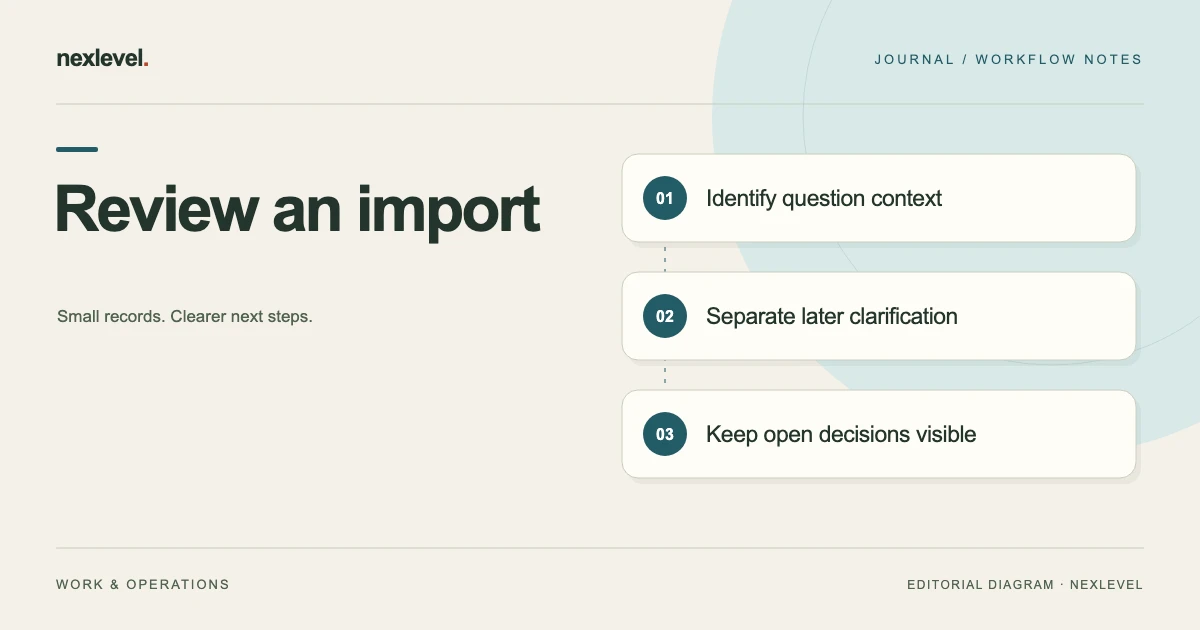
A client-response import review should establish which project and question context the selected answers concern, what working version is being updated, which source relationships remain open, and what later human review is needed.
A valid imported response is source material for a brief. It should not silently become complete requirements, an approved baseline, or legal acceptance. Preserve collection, import, review, and selection as different stages.
This guide uses fictional administrative references. It supplies no contract wording, security protocol, guaranteed completeness rule, or client message to send. Start with the client brief template for the underlying structure.
Choose the selected response task
Write the project/working-version scope, response source, question context, cutoff, intended reviewer, and precise next task. A check for one response should not appear to verify every client answer.
Possible triggers include a new response, a later clarification, changed working questions, or preparation for a selected baseline. A weekly cadence is only one organizing option.
Use fictional references during the exercise. There is no need to publish or send a real client link merely to test the review structure.
Start from the current advertised workflow
Brievra’s current description includes local templates/editing, deterministic gap review, optional encrypted no-account client links, valid-response import, frozen-version evidence, and Markdown export.
Free includes the local workspace and gap checks. Pro adds online collection/import, frozen evidence, and export. Check actual access rather than make optional publishing mandatory for local preparation.
The public description does not establish every payload format, merge rule, or pre-import preview control. This guide is an independent human review worksheet, not a hidden technical import specification.
Set up a fictional response packet
Imagine project P74, working brief V2, question-set reference Q3, published-link context L4, selected response R5, and later clarification C6.
Review note N8 represents the selected cutoff. The question is which source relationships the supported representation actually establishes and what remains unresolved before a baseline is selected.
No real client, form, link, response, source file, approval, or project outcome is supplied. The references evaluate administrative review without creating genuine client history.
Use a response-source checklist
| Check | Source question | Result to retain |
|---|---|---|
| Project identity | Which selected brief does R5 concern? | Actual context or precise question |
| Question set | What source establishes Q3’s role? | Available relationship and limitation |
| Working version | What is V2 intended to represent? | Actual selected scope |
| Answer quality | What decisions remain unresolved? | Bounded source/clarification questions |
| Later information | What role does C6 have? | Its own source occasion |
| Baseline | What review/selection is actually established? | State separate from receipt/import |
These are independent prompts, not claims that the app exposes these exact fields or automatically resolves semantic conflicts.
Establish project identity before using answers
A familiar client or project label may recur across briefs. Identify the actual selected response/project relationship rather than rely on whichever record appears first.
If the available supported representation does not establish the relationship, retain the precise source question. Do not assign R5 to P74 by a similar title alone.
A copied filename or note can support an index without being the complete source. Keep authorized routes and actual limitations visible.
Keep question context distinct from later working edits
Q3 and V2 may have related but different roles. A later wording change in the working brief should not make an earlier response appear to have answered a question it never received.
The current public description does not specify every version-binding or merge behavior. Inspect the actual supported workflow and record what it establishes rather than invent a universal rule.
For earlier preparation, use the local questionnaire guide. Its design task differs from reviewing a selected incoming source.
Review nonempty answers for usable decisions
An answer can contain text while leaving the selected deliverable, audience, source, or decision arrangement unclear. Import validity should not become a guarantee of sufficiency.
Use the filled-but-unresolved field review for that narrower task. Preserve the actual result or precise question.
Do not invent a detailed answer merely to make the brief look ready. A useful review can leave one bounded decision open.
Separate ambiguity from source conflict
A broad response and two apparently disagreeing sources can require different next checks. Classify the actual finding before selecting a correction.
Use the conflicting-answer guide for a narrower comparison. Retain the actual source relationship rather than the most convenient interpretation.
If C6 clarifies one point, keep its own occasion and scope. One later clarification should not automatically settle every question in R5.
Preserve the optional online boundary
The current app describes forms/responses encrypted before leaving the device/browser, with server ciphertext and operational records for link delivery, limits, expiry, and revocation.
Do not describe that chosen collection step as though no server is involved. Local brief work remains separate and available without publishing a client link.
This review exercise does not authorize creating, sending, or revoking a real link. It can be completed with fictional references and the source-role worksheet.
Keep receipt, import, review, and baseline distinct
A source being available, valid answers being imported, someone reviewing them, and responsible people selecting a baseline are different events.
Use the receipt/review/baseline guide for that narrower distinction. Preserve the strongest event the actual source establishes.
Brievra’s version evidence is not an electronic-signature service. A frozen brief should not become a legal acceptance conclusion.
Inspect the actual retained or exported representation
Brievra Pro currently includes canonical frozen versions with SHA-256 evidence, a readable timeline, and Markdown export. Check actual access and inspect the representation relevant to the review.
Review project identity, question/source context, answer relationships, unresolved points, version, and cutoff. A companion note may be needed where the output does not represent every independent source relationship.
The public description does not establish universal PDF output, arbitrary spreadsheet import, or full-workspace restoration. Keep the task within actual supported capabilities.
Run a second-reader import-context test
Give a reader the fictional P74/V2/Q3/L4/R5/C6 packet and N8. Ask what source establishes project identity, question context, later clarification, and actual review/selection state.
Introduce another brief with a similar title. The reader should use established references rather than assign R5 by the nearest label.
If the working source is accurate but a summary overstates it, repair the summary. If the original source remains uncertain, retain the exact question rather than invent client context.
Keep later changes visibly later
A later response or working-version change should retain its own occasion and relationship to the selected source. It should not make R5 appear to have contained later information.
A correction to an explanatory note is different from importing another response, publishing a link, or selecting a baseline. Keep those purposes distinguishable.
A concise review receipt can name sources inspected, available relationships, actual correction if any, unresolved decision questions, and precise next review.
Connect the result to handoff and retention
For another contributor taking over, use the requirements handoff checklist. A worksheet does not itself transfer source access or decision authority.
For a historical packet, use the brief archive guide. For method selection, use the workspace comparison.
The fictional references remain teaching inputs. Reuse the structure with actual authorized material while preserving human judgment, optional network sharing, and communication boundaries.
Make the response context concrete
A companion source register can record what a selected response actually answers without claiming an undocumented payload format or native merge rule.
| Companion field | Fictional entry | Source question |
|---|---|---|
| Project | P74, a services-site brief | What actual source establishes the selected identity? |
| Question context | Q3 asks about the selected deliverable and audience | Which question wording did this response concern? |
| Response | R5 contains “a one-page services site” | What scope does that answer establish? |
| Later clarification | C6 narrows one selected audience question | What is clarified and at which occasion? |
| Working record | V2 | What is current working text rather than source history? |
| Next review | Unresolved decision before baseline selection | Which actual source or responsible arrangement is still needed? |
The sample answer is fictional and is not a proposed contract or a real client’s response. The register is independent of the app’s internal data structure.
Work through an import-context branch
In one fictional branch, the available supported representation establishes R5’s relationship to P74/Q3. The reviewer can use that source relationship while still leaving one approval-arrangement question open. Valid import does not make every decision resolved.
In another branch, the current working brief has a later question wording. Preserve which actual source context R5 represents instead of making the earlier answer appear to have addressed the newer prompt from the start.
A third branch has another project with a similar client label. Identity must be established from the actual supported source, not guessed from the first matching title.
A fourth branch has C6 clarifying only the audience point. Keep its own occasion and bounded scope. One new answer should not silently supply every missing deliverable or decision detail.
Prepare a review receipt before selecting a baseline
Give another contributor only the fictional source register, selected working representation, and N8. Ask what R5 answers, what C6 clarifies, what V2 represents, and which decision remains open.
The reader should distinguish source availability, import validity, human review, and baseline selection without inventing an actual link or client message. A prepared response check can remain a local administrative exercise.
If the working source is accurate but a summary overstates it, repair the summary. A documentation correction is different from importing another response or selecting a frozen version.
Record the actual supported representations inspected, project/question relationships established, later-source scope, copy correction if any, and precise next review.
Keep identity, question context, source occasions, working/baseline distinction, and cutoff inside the receipt as well as in filenames. A copied brief can lose its original folder context.
A useful result can remain conditional on a specific clarification. It should not claim complete requirements, legal acceptance, or project success merely because the form and brief contain text.
The fictional records remain teaching inputs. Reuse the source register with actual authorized material while preserving human judgment, optional online collection, and communication boundaries.
Write a concrete response-review outcome
A fictional N8 result can identify P74/V2, the Q3 source context actually established for R5, and the bounded audience point C6 clarifies. It can separately name the decision arrangement that remains unresolved before a baseline is selected.
This is more informative than imported and ready. It tells another contributor which source relationships were reviewed and which still require judgment. It does not claim an actual client link, response, or approval outside the fictional exercise.
If the working brief later changes question wording, preserve that occasion. R5 should remain identifiable as the answer source it actually represents rather than appear to have addressed every later prompt.
For a final check, remove the original conversation and give the reader only the selected working representation, source register, and receipt. Ask them to identify project identity, question context, original answer, later clarification, open decision, and cutoff.
Record any manual explanation needed and whether the source route is usable under the actual arrangement. A bounded result can make the next review specific while leaving one requirement unresolved. It should not claim complete scope, legal acceptance, or project success merely because the imported text is present. Keep the evidence limit beside the affected answer so another contributor can continue without inventing client context.
Use Brievra for traceable entered response context
Brievra connects local brief preparation, on-device gap review, optional encrypted collection/import, version evidence, and supported Markdown output.
Check the official Brievra App Store listing for current capabilities. Keep valid import, usable decisions, actual review, and selected baseline in their appropriate roles.