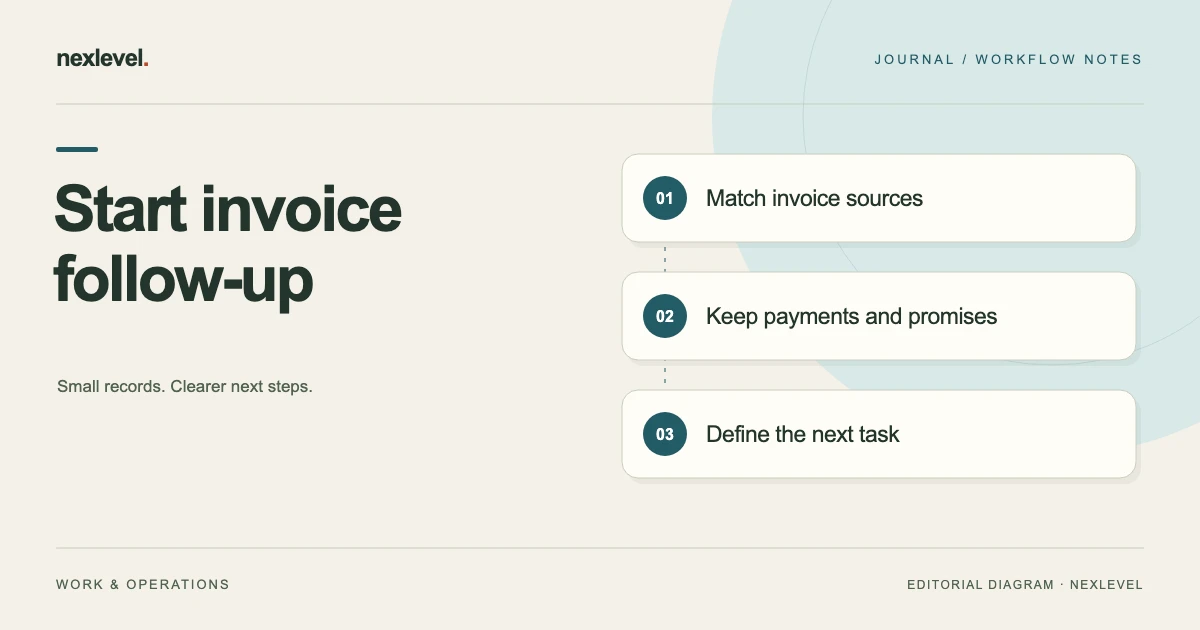
Start an invoice follow-up record with one invoice and the documents that actually belong to it. Confirm client and invoice identity, amount and currency, due-date source, payments and any promise. Leave a specific question open when the sources do not establish a relationship.
Build one invoice record from matched sources
- Select the original invoice and confirm its client and reference.
- Record the source amount, currency and date roles without copying from another invoice.
- Match each payment reference once and keep promises in their own role.
- Name the next source check or preparation task and inspect the retained intake copy.
Working fields:
Invoice/client | Invoice source | Amount/currency | Due-date source | Payment/allocation | Promise source | Next task | Cutoff
Useful next steps: Use the invoice follow-up record structure, Add a source-matched partial payment, Review a promise before the next task.
Choose the intake question
Write which existing invoice is being represented and what the initial record needs to support. A new local record, a later payment update, and an archived outcome can concern different source occasions.
The intake task is to preserve source meaning. It is not to decide a legal entitlement, verify a bank transaction independently, or send a reminder automatically.
A useful result can contain a specific unresolved question. Do not fill a missing relationship with a plausible assumption merely to make the initial record appear complete.
Set up a fictional source packet
Imagine I70 is the selected invoice reference, C2 the client source, D3 the invoice document, P4 a payment reference, M5 a promise reference, N6 the next-task note, and R8 a retained intake copy.
The independent worksheet uses a fictional invoice amount of 120 currency units and a matching recorded payment amount of 20. With no other adjustments included, 120 minus 20 gives a modeled outstanding amount of 100.
These are invented teaching inputs, not a real invoice, rate, payment, or claim about undocumented native calculations. The source labels are companion references rather than native field names.
Use a source-to-record intake worksheet
| Companion role | Question to establish | Keep separate |
|---|---|---|
| Client identity | What relationship does C2 establish? | A similar contact name |
| Invoice identity | Does D3 identify I70? | Another document from the same client |
| Amount and currency | What source supports the entered basis? | An assumed fee or conversion |
| Due context | What does the selected source actually state? | A guessed legal deadline |
| Payment reference | Does P4 concern this invoice and occasion? | A promise or unrelated receipt |
| Promise reference | What does M5 establish? | Completed payment |
| Next task | What remains to inspect or prepare? | A message already sent |
| Retained copy | What source cutoff does R8 represent? | Every later update |
This is an independent manual worksheet. It does not establish automatic document matching, inbox access, bank integration, or a native custom field for every row.
Establish client and invoice identity separately
One client can have several invoices. A familiar client name therefore does not establish that every document, payment note, or promise belongs to I70.
Match D3’s actual selected identity through the authorized source arrangement. Keep the controlled route useful without copying unnecessary personal details into a general worksheet.
If the relationship remains unclear, name that precise question. Adding a more confident invoice title cannot supply evidence that was not established.
Preserve the entered amount’s basis
Read the actual selected amount and currency source before comparing values. The fictional worksheet uses one currency and no other adjustments; those assumptions belong beside its result.
A number from another invoice, a broader statement, or a different currency should not be assigned to I70 merely because it is nearby in the source packet.
This guide performs no exchange-rate, tax, fee, or compensation calculation. An intake record can remain useful while a specific amount-source relationship awaits clarification.
Keep due context tied to its source
A document may contain several dates with different roles. Establish what the selected source states before assigning a date to the follow-up record.
If sources disagree, preserve the precise relationship needing clarification. Do not choose a more convenient date or interpret a contract through a generic template.
PaidCue organizes entered invoice context; it is not a legal or accounting authority. The exercise supplies no actual date or universal follow-up interval.
Associate payment references deliberately
P4 must retain its actual invoice and occasion relationship. A payment reference can be useful without independently explaining every outstanding balance in the client relationship.
For the fictional matched branch, P4 represents the selected 20-unit recorded amount against the 120-unit invoice model. The independent subtraction gives 100 with no other adjustments included.
Do not broaden that arithmetic into proof of bank settlement, legal entitlement, or correct accounting treatment. It demonstrates the source assumptions needed to make a simple entered model reproducible.
Keep partial payments separate from closure
A partial payment and a full-payment outcome have different roles. The selected invoice should not appear closed merely because a payment source exists.
The partial-payment recording guide covers that narrower update task. Preserve its actual source result rather than infer closure from a receipt title.
If a copied intake note calls the fictional invoice fully paid, repair that explanation using the established model. Do not alter accurate source amounts to eliminate a remaining balance on paper.
Keep a promise separate from payment
M5 concerns a recorded payment promise if the actual source establishes that role. A promise does not independently establish that money moved.
PaidCue’s current description says a recorded promise date pauses the normal sequence and resumes it after that date. That makes the promise-source relationship important to the entered workflow.
Do not invent a promise to postpone a queue or treat an unconfirmed note as a completed payment. The exercise supplies no actual promise date or client communication.
Prepare the next task from what remains open
N6 should name a specific source review or preparation task. For example, it can identify the need to establish P4’s relationship to I70 rather than a generic check client label.
Keep the recorded owner arrangement accurate without claiming another person accepted a task merely because their role appears in a worksheet.
The intake can make a later authorized action specific while leaving that action unperformed. Preparation, sharing, delivery, and recipient response are different source roles.
Keep message preparation under human review
PaidCue currently previews follow-up wording shaped by invoice stage. The user reviews it before copying or sharing, and the app never contacts a client automatically.
A source-accurate record helps that review, but it does not make every prepared word appropriate for every real situation. Actual message accuracy, tone, terms, and requirements need their proper review.
This exercise sends no message and supplies no demand wording. It should not be described as an automated collections sequence operating outside the user’s control.
Keep local warnings separate from contact history
The current app offers optional local warnings for invoice follow-ups and promises. Tapping a warning opens the matching invoice; full payment, archive, or deletion cancels the warning under the advertised behavior.
A warning is not an external reminder sent to a client. Its existence does not establish that anyone was contacted or that a payment occurred.
Do not delete accurate records merely to make a prepared explanation appear consistent. Identify the actual selected record and warning role through supported controls.
Work through a matched-source branch
In the first fictional branch, C2/D3 establish I70’s client and invoice context, and P4 belongs to the selected invoice model. R8 preserves the 120, 20, and 100-unit relationship with its explicit assumptions.
M5 retains its separate promise role if established. N6 identifies the actual next administrative task rather than describing a message as sent.
The result is a clear entered-source intake packet. It is not a financial statement, legal payment determination, or independent transaction verification.
Work through a wrong-invoice reference branch
In another branch, P4 concerns a different invoice from the same client. The useful correction is to remove that unsupported association from the selected model.
Do not change D3’s accurate amount to make an unrelated payment reference fit I70. The mismatch concerns source identity.
Retain the exact question about the selected invoice’s payment source. A familiar client name should not erase the difference between two invoices or periods.
Work through a promise-label error
In a third branch, R8 describes M5 as payment evidence even though its actual source only establishes a promise. Restore the promise role in the explanation.
The correction does not create a new promise or payment. It preserves what the selected source actually represents.
If the original source itself is unclear, retain that different limitation. A more decisive label cannot establish money movement.
Choose an output within current access
PaidCue Free currently supports up to three active invoices. Existing CSV and PDF exports with the PaidCue Free footer remain available without ads; an optional completed video can unlock a clean PDF of selected frozen report content. Pro adds unlimited active invoices, complete follow-up sequences, and clean CSV and PDF exports without videos.
Inspect the actual selected representation for invoice identity, amount basis, payment and promise roles, next task, and cutoff. The independent worksheet is not a promised native CSV schema.
The public description does not establish arbitrary document import, CSV merging, or full restoration. A portable readable copy should not be described as the entire editable workspace.
Run an independent intake-reading test
Give another authorized reader R8 and the controlled source routes. Ask which invoice is selected, how C2/D3/P4/M5 differ, and how the independent 100-unit model was derived.
Then introduce another invoice from the same client. The reader should preserve actual source identity rather than allocate a payment by familiarity.
Record any manual explanation needed. Repair an unclear copy when its sources are accurate; retain a precise question when the source relationship remains missing.
Use a copy-ready source receipt
A companion receipt can identify I70/C2/D3, the amount/currency basis, due-source context, P4’s established relationship, M5’s separate role, N6’s actual task, representation inspected, cutoff, and next question.
For the matched fictional branch, it shows the independent 120 minus 20 equals 100 model without a settlement or accounting claim. For the wrong-invoice branch, it identifies the mistaken association and preserves the actual open source question.
Read the receipt without its filename. A future reader should understand what was entered and what remains unresolved without reconstructing the original conversation.
Connect intake to handoff and retention
For an administrative transition, use the invoice follow-up handoff guide. For historical copies, use the outcome-evidence archive guide.
For choosing a working method, use the invoice tracker comparison. Keep the selected purpose visible when deciding which representation serves a task.
A useful record can make the next review specific while leaving actual communication, payment, accounting, and legal conclusions in their appropriate roles.
Distinguish repeated documents from separate payments
Two retained copies of P4 do not independently establish two payments. Identify the underlying selected source relationship before counting amounts in an intake worksheet.
The fictional twenty-unit reference is one modeled input against the selected one-hundred-twenty-unit invoice. A copied receipt title or repeated summary should not create another payment event by assumption.
A concise companion note can name I70/D3, identify P4’s established role, retain M5 as a separate promise reference, and show the independent no-other-adjustments subtraction. It should also name the actual preparation stage and source cutoff.
If the selected source does not establish P4’s relationship, retain that question rather than borrow another invoice’s amount. If the underlying records are accurate but R8 repeats the same source as separate events, repair the copy.
For a final check, ask an authorized reader to reproduce the model from the selected sources and explain what remains unknown. The answer should not infer settlement, client contact, or an accounting conclusion from the worksheet’s total alone.
Use PaidCue for clear local follow-up context
PaidCue connects entered invoice context, recorded payments and promises, chosen local warnings, human-reviewed message preparation, and supported outputs without requiring an account.
Check the official PaidCue App Store listing for current capabilities and access. Keep source intake, next tasks, prepared messages, actual contact, and payment evidence distinguishable.