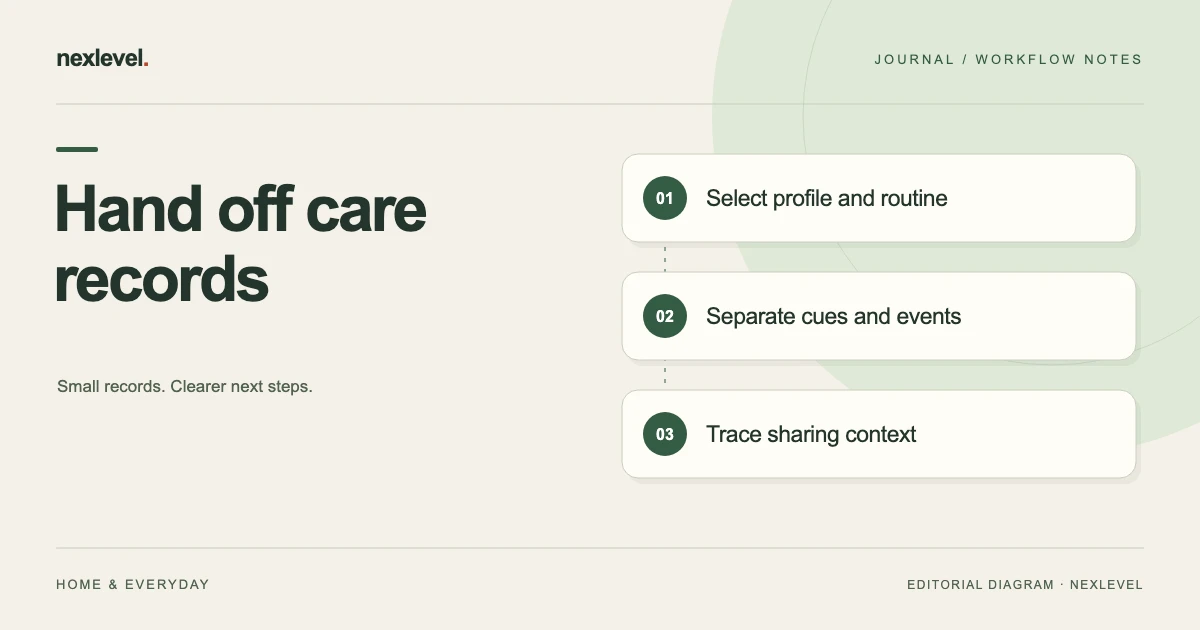
A pet-care handoff should distinguish a routine or reminder cue from a saved check-in. A prompt says attention is planned; an entered event records a selected caregiver and occasion. Neither should silently become a claim that every physical care action was independently verified.
This guide supplies a fictional administrative worksheet. It gives no feeding amount, walking interval, medication dose, treatment, or veterinary advice. Keep profile identity, routine context, local records, optional sharing, access periods, and actual care outcomes distinguishable.
Define the next caregiver’s record question
Write a bounded purpose: “Explain which routine cue and saved-event context the selected handoff represents.” Identify the pet profile, routine, source occasion, intended authorized reader, cutoff, and next task.
A handoff for understanding an entered event differs from prescribing care. Keep substantive instructions with their actual appropriate sources rather than inventing them to complete a template.
Preparation is separate from delivery. A packet can be ready without having been shared, received, understood, or acted on.
Use the advertised local-first starting point
PawHandoff advertises one pet and a daily routine without an account. Check-ins save on device first even when the connection is unreliable.
That local capability is distinct from optional household sharing. Do not introduce a mandatory server or app-login gate for the locally supported starting workflow.
The official description identifies a reminder and activity log, not veterinary advice or medication-dose calculation. The worksheet stays within administrative record roles.
Create a controlled fictional handoff
For this exercise, P21 identifies a pet profile, R2 a custom routine, and M3 a reminder-cue role. The neutral custom task is “review the designated care note.”
E4 identifies a saved-check-in role, C5 a caregiver attribution, T6 its occasion, and N7 the companion handoff note. Another profile, Q8, appears only in a look-alike case.
No real animal, caregiver, care instruction, date, medication, dose, or physical action is supplied. These labels are independent worksheet references, not native field names or an import schema.
Keep the routine cue separate from completion
M3 represents a selected prompt context. It does not establish that E4 exists or that a physical task occurred.
Conversely, a saved event can be readable while its relationship to a particular routine occasion remains unprovided in a companion packet. Preserve that exact question.
Do not invent a prediction window, confidence score, or automatic care-timing formula. Those are not capabilities established by the selected PawHandoff description.
Read the saved-event role precisely
The app advertises caregiver-attributed actions with who handled it and when, plus an activity timeline. Keep E4/C5/T6 together when their actual relationship is supplied.
An entered event describes the record source. This exercise does not independently observe a person or animal and should not claim a verified physical outcome.
A clear handoff preserves attribution and occasion without turning the log into an unsupported care guarantee.
Use a copy-ready cue/event worksheet
A practical companion worksheet asks for selected profile, routine/task context, reminder-cue role, saved-event reference, caregiver attribution, event occasion, and any missing association.
Add actual representation inspected, cutoff, intended reader, optional household-sharing stage, access context, correction source, and next task.
These prompts form an administrative structure. They are not native required fields, an automated care validator, or an import-ready format.
Fill the source-clear branch
In the first fictional branch, R2/M3 clearly concern P21, and E4/C5/T6 have their supplied check-in relationship. N7 can preserve the cue and event as different roles.
The note should not claim the reminder caused completion or that every possible care task is covered. It explains the selected source set only.
No native routine, reminder, or check-in is created by the example. The task supplies a reusable administrative explanation.
Fill a cue-without-event branch separately
In another branch, M3 is supplied but no E4 source is available in the packet. The supported conclusion is that this packet lacks a selected saved-event source.
That does not prove no care happened or no record exists elsewhere. Keep the conclusion within the actual review scope rather than invent a missed-care finding.
The next question can identify the relevant routine occasion and source needed. This guide recommends no physical care action.
Fill a look-alike profile branch
In another illustrative branch, an event belongs to Q8 rather than P21. Preserve that actual relationship instead of assigning it by a familiar routine label.
If the profile association is unknown, record an unprovided relationship rather than a proven mismatch. Different conclusions require different source evidence.
For broader source reconciliation, use the conflicting handoff note guide. This exercise establishes no native application defect.
Keep duplicate warnings within their advertised role
PawHandoff advertises duplicate warnings for recent check-ins. A warning can prompt review without proving a duplicate physical action or guaranteeing that all accidental duplicates are prevented.
The public description does not establish an exact duration, matching formula, or automatic blocking rule. Do not invent one for the worksheet.
Preserve the actual selected event context before interpreting a warning. This example triggers no native warning and supplies no observed result.
Handle mistaken entries at their actual stage
The listing advertises Undo or removal of mistaken check-ins. If an actual correction is made, identify what source and representation the companion explanation concerns.
Do not promise an immutable history of every removed entry or a particular audit schema absent from the official description. A companion review note is not a substitute for actual native behavior.
This fictional exercise changes no event. It preserves a clear distinction between an entered record, a correction, and a physical care outcome.
Keep optional caregiver updates separate from receipt
The app advertises opting in to care updates when another household member checks off a task, alongside local reminders chosen by the user.
A preference or scheduled prompt does not establish that another person saw a notification. Likewise, a local record existing does not establish immediate receipt on every device.
Do not borrow another app’s acknowledgment mechanism or cloud backend. The guide performs no notification or synchronization action.
Read household sharing within its actual boundary
PawHandoff Household advertises multiple pets, unlimited caregivers, secure household sync, medication schedules, expiring sitter access, and private care-history export.
Keep optional expanded sharing separate from the local one-pet starting workflow. Do not invent a specific cloud provider, household data protocol, or mandatory recipient account for every portable-copy task.
The term secure is the advertised capability, not an independent security certification supplied by this article.
Keep access periods separate from care outcomes
Expiring sitter access is an advertised Household feature. An access period describes a selected sharing context, not proof that a care action occurred during it.
For preparing that context, use the sitter-access handoff guide. Keep the actual period source and intended reader visible.
Do not claim that access expiry remotely removes every already shared copy or establishes a particular revocation protocol. The public description does not supply those guarantees.
Keep medication reminders separate from treatment
The app advertises medication reminders and expanded medication schedules with Household. It does not provide veterinary advice or calculate doses.
This worksheet supplies no medicine, dose, timing instruction, diagnosis, or treatment recommendation. Actual care instructions need their appropriate relevant sources.
A scheduled item or saved check-in should not become an unsupported statement about clinical effectiveness or safety.
Choose the supported representation deliberately
The listing advertises private care-history export with Household. Inspect the actual supported output before stating which profile, caregiver, routine, or event context another person receives.
The public description does not establish a universal CSV/PDF schema, arbitrary import, or complete restoration. A readable copy is not automatically a full household backup.
This exercise exports nothing, imports nothing, restores nothing, deletes no record, and shares no pet data.
State current access without inventing purchase terms
The advertised starting workflow creates one pet and daily routine without an account. Household expands pets, caregivers, sync, medication schedules, sitter access, and private history export.
Restore purchases is available from the plan screen. Do not invent a plan duration, introductory trial, localized price, or export format absent from the selected official source.
A purchase cannot establish missing event context or verify a physical care outcome. Keep entitlement separate from source review.
Run a cue/event handoff reading test
Give an authorized reader N7 and the fictional references without the original folder context. Ask which profile is selected, what M3 represents, what E4/C5/T6 establish, and what remains unprovided.
Then introduce the cue-only branch and Q8’s event separately. The reader should preserve their different relationships rather than treat every familiar routine label as completion.
Record any explanation still needed. A useful result identifies the next source task without prescribing care or claiming an actual event.
Write a bounded handoff receipt
A compact fictional note can state: “P21/R2 uses selected M3 cue context. E4/C5/T6 retain their supplied check-in, attribution, and occasion roles. A prompt is not completion, and a log is not independent observation. Sharing, access, actual notification receipt, and care outcomes require their own sources.”
Add actual corrections or later sources only when available, with their own occasions. For retention, use the pet-care source and access archive guide.
The result is an understandable administrative handoff. It certifies no animal condition, medication result, or caregiver performance.
Fill the routine-and-event note
N7 can identify P21/R2 as the selected profile and routine context, M3 as a cue, and E4/C5/T6 only with their actual supplied check-in relationship.
If the event source is unprovided, keep that specific gap visible. The note should not turn a reminder into completion or claim that no care occurred anywhere.
If a profile association is missing, identify the question before attaching a familiar routine label. The worksheet supplies no native matching algorithm or independent observation of a person or animal.
Keep corrections and physical events distinct
A companion explanation might mislabel an accurate check-in source. Correcting that explanation is different from changing the native event or establishing that a physical action occurred.
If an actual supported Undo or removal is performed, preserve what source and representation the review concerns. Do not promise an undocumented permanent record of every previous state.
A later actual check-in or clarification needs its own occasion. The older handoff can remain accurate history of its selected packet without appearing to contain later information automatically.
Keep sharing context within the evidence supplied
A locally saved event, optional household synchronization, an update preference, and a chosen export are different roles. None alone proves that every intended reader received and understood the selected context.
If a real handoff needs access-period evidence, identify the relevant actual source. Do not infer permission from a familiar caregiver label or turn purchase access into a guarantee about already shared copies.
The next reviewer should be able to identify profile, routine, cue, event, attribution, occasion, missing relationships, and sharing stage without reconstructing the original household conversation. This makes the administrative handoff useful while veterinary decisions and physical outcomes stay outside the packet.
No medication dose, care interval, diagnostic conclusion, or caregiver-performance rating is supplied by the exercise.
Use PawHandoff for clear care-record roles
Retain the selected profile, routine, event-reference set, and cutoff beside the handoff result. Another reader should be able to identify exactly which source context was reviewed without treating the note as a new check-in, a verified physical action, or a veterinary assessment.
PawHandoff connects local-first routines, caregiver-attributed check-ins, recent-duplicate warnings, chosen reminders, optional household sharing, and supported history output.
Check the official PawHandoff App Store listing for current capabilities and access. Keep cues, entered events, sharing context, and physical outcomes distinguishable.