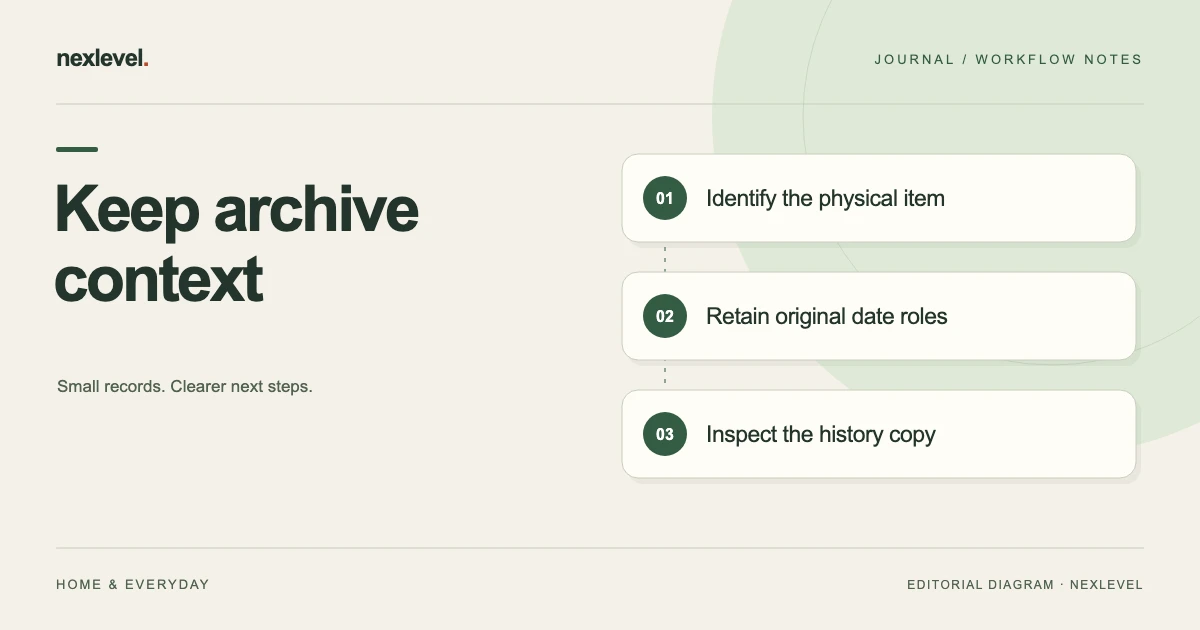
Before archiving a food record, identify the package and why the entry is leaving the active list. Retain the known label context, date roles and unresolved questions, then inspect the resulting history. An archived record should remain distinguishable from a recorded use, discard or deletion.
Check what the archive action should preserve
- Match the selected entry to the package and state the reason for archiving.
- Keep known dates, source wording and unknown history in a short index.
- Use the supported archive workflow and inspect the resulting record.
- Check which context is present in any retained CSV or companion note.
- Keep a later replacement package separate and test retrieval of the old record.
Working fields:
Item | Archive reason | Label/source | Known date roles | Unknown history | Resulting state | Retained copy | Retrieval route
Useful next steps: Preserve the original date meanings, Keep archived and discarded outcomes distinct, Prepare a household record handoff.
Define why the record is leaving the active review
Write the actual administrative reason before choosing a state. A record may be leaving the active list for one reason while the physical item’s disposition remains unestablished.
Do not mark an item used or discarded merely to make the list shorter. Those labels should reflect what the responsible household process actually establishes.
SavorSoon’s current listing describes used, discarded, and archived records. It does not make those words interchangeable or establish a universal archive-retention policy.
Use the actual supported workflow and inspect what it does in the current product rather than assuming that every app gives “archive” the same behavior.
Match the physical item before changing its record
Two packages can share a product name while having different dates, histories, or locations. Match the selected record to the item it actually represents.
An independent worksheet can use a reference such as K25 alongside the product identity and relevant source route. These are proposed review aids, not a claim that the app has dedicated package-ID fields.
Do not apply a state change to every similarly named record merely because one package’s disposition is known.
If identity is uncertain, preserve that question before modifying the working list. A cleaner active view is not worth losing the relationship between the record and its source.
Use an archive-review worksheet
Suggested fields are item reference, original label context, known date roles, current recorded state, established disposition if any, intended administrative action, portable-copy scope, and unresolved question.
| Record concept | Question to preserve |
|---|---|
| Used | What actual source establishes the recorded use? |
| Discarded | What source establishes that disposition? |
| Archived | What does the current supported state retain? |
| Deleted | What content would no longer be available? |
The worksheet is a companion review aid. It should not become another inventory full of completed-looking events copied from guesses.
Keep private household details proportionate. A short source route can preserve context without distributing unrelated purchase history.
Preserve the original date meanings
A package date, acquired date, opened date, and frozen date can concern different events. Archiving a record should not become an excuse to flatten them into one generic “expiry” statement.
SavorSoon’s listing describes an expiry field and optional acquired, opened, and frozen dates. Preserve the actual source meaning in an appropriate companion record where the field name alone does not communicate it.
For the date-entry task, see how to record food-label dates without changing their meaning. The current guide concerns retention and later interpretation rather than deciding what a printed phrase means.
If a source detail was never established, retain that limitation. Do not give an unknown opening date a precise value merely to finish the archive worksheet.
Work through a fictional archived item
Imagine record K25 for a fictional package. The household has a source label reference and a known acquired date, while the opened date is not established in the available record.
The reviewer wants the entry out of the active administrative review. Before using the actual supported archive action, they preserve the known source relationship and the unresolved opening-date question in the intended companion summary.
After the action, they inspect the selected history or actual available record view. The review should establish what was retained in this workflow rather than assume that every detail is recoverable forever.
The archived state makes no claim that the package was eaten, discarded, or suitable to consume. Those are separate questions with their own actual sources.
Inspect the resulting history state
A supported state change should have a concrete review target. Locate the selected record through the actual available history controls and check identity, date context, and displayed state.
Do not treat a successful tap as proof that the intended record was changed. Similar names can make it easy to inspect the wrong item afterward.
This guide does not invent an Undo, restore, or bulk-archive feature for SavorSoon. Use the current actual workflow and retain appropriate source context independently where needed.
If the record cannot be located as expected, keep that question explicit. Avoid repeatedly creating new copies merely to make the active list resemble the old view.
Keep a replacement package separate
A later purchase with the same product name is a new physical item, not automatically the archived package returning. Preserve its own source dates and identity through the actual supported entry workflow.
Do not reactivate an old record merely to save typing unless the actual source relationship and supported behavior make that the intended action. Reusing an old history can attach the wrong dates to a new item.
In the fictional example, a later package K26 should remain distinguishable from K25. A shared product name can help grouping without proving shared event history.
The independent archive summary can explain that relationship without assuming a native duplicate, merge, or purchase-detection capability.
Separate reminders from the archive decision
SavorSoon’s current listing describes optional local reminders that can be changed or disabled. Inspect the actual reminder state after the selected record action.
Do not assume that an old retained notification describes the current record, or that a notification disappearing establishes a physical disposition.
A reminder prompts a review. The archive worksheet should preserve whether a prompt remains relevant without interpreting it as a food-safety judgment.
This article does not claim automatic reminder behavior for every archive state. The actual resulting source should establish what happened in the selected workflow.
Keep values and history estimates honest
The listing includes optional estimated values and waste history. An entered estimate should remain an estimate after the record leaves the active set.
Do not describe an archived value as a verified saving, purchase price, refund, or loss unless the relevant source establishes that meaning.
If a later review compares history, identify the selected state and period. An archive count and a discarded-item count can answer different questions.
This guide supplies no economic conclusion or food-waste statistic. It preserves the administrative meaning of the records the household actually entered.
Inspect a CSV for the retention task
SavorSoon’s current description includes CSV export in Free. Prepare the actual supported output and open the file you intend to retain.
Check which item identities, dates, states, and values it actually contains. Do not assume every independent label reference or unresolved source question appears automatically.
A CSV is a portable representation, not automatically a restorable app backup. The current listing does not establish general import or restoration of arbitrary exported files.
If the archive purpose requires more source context, keep an appropriate companion explanation through the intended private arrangement. A filename alone is not a content check.
Distinguish archive, export, and deletion
These are separate decisions. Changing a record state, preparing a portable copy, and deleting content should not be treated as one interchangeable cleanup step.
Before any deletion decision in your own workflow, establish what the actual supported action affects and what source context you intend to retain. This guide does not perform a deletion or prescribe a retention period.
Likewise, do not assume that archiving removes every exported copy elsewhere. A static file has its own storage and sharing context.
The useful administrative question is which source will remain available for later review and what that source actually establishes.
Keep the archive separate from a safety decision
A tracker state concerns recorded organization. It should not replace actual product instructions, appropriate official guidance, or the responsible household process for questions about food.
FoodSafety.gov’s guidance treats handling, cooking, and chilling as practical food-safety subjects. An archived inventory entry is not a substitute for those checks.
This article gives no universal date extension, reheating rule, or safe-use determination. Keeping a history useful does not make the food’s condition certain.
For K25, the review can be administratively complete while leaving a source question explicit. It should not manufacture a food outcome to make the history look tidy.
Test later retrieval with one record
Ask the intended reader to find K25 using the retained source arrangement. They should identify the physical-item reference, known date roles, archive context, and unresolved opening-date question.
If they think the archive date is the preparation or label date, improve the role labels. If they think an archived entry proves use or disposal, improve the state explanation.
A short review receipt can identify the actual record action, resulting source inspected, portable copy checked, and any remaining question. Replace template phrases with the real result.
The test checks whether the history can be interpreted without the original writer’s memory. It does not establish edibility or certify handling conditions.
Build a readable archive index for the fictional item
An independent index row for K25 can say: “Original package source retained at the identified private location; acquired event known; opened event not established; archive workflow inspected at this review; selected portable copy checked.” The source locations and actual results must replace the generic phrases before use.
The row should distinguish the review occasion from the package’s dates. A later archive date does not establish a new opening, freezing, or preparation event. It describes the administrative action taken with the record.
Now suppose K26 is added later with the same product name. The index can identify it as a separate physical-item record with its own known source context. That prevents a future reader from treating K25’s history as K26’s history merely because the display labels match.
If an older export omits the companion source question, preserve a clear explanation beside the intended retained copy. Do not claim the export contains information you kept only in another note. A file can still be useful when its limitation is explicit.
At the next retrieval test, ask the reader to locate the known acquired date and identify the unresolved opening-date question. Then ask what the archive action establishes. The answer should concern the record’s organization, not a conclusion that the food was consumed or safe.
If the distinction is clear, the administrative retention task has a concrete result. If it remains confusing, improve the date-role or state labels before expanding the archive process to many similarly named records. Keep actual retention choices, file access, and any deletion decisions within the intended private household arrangement.
Retain the archive index only where the intended reader can actually find it. A useful private source route can be brief, but it must distinguish K25 from a similarly named later record. Test that route after preparing the copy. An index that points to an unexplained filename does not establish the package wording, date role, or disposition it was meant to preserve.
Use SavorSoon for a clear active list and history
SavorSoon organizes entered food dates, storage locations, local reminders, history states, and CSV records. Its current Pro Lifetime description expands active capacity, custom presets, insights, and Family Sharing.
Check the official SavorSoon App Store listing for current features and plan details. Preserve source meaning when a record leaves the active view so later review does not depend on a guessed date or disposition.