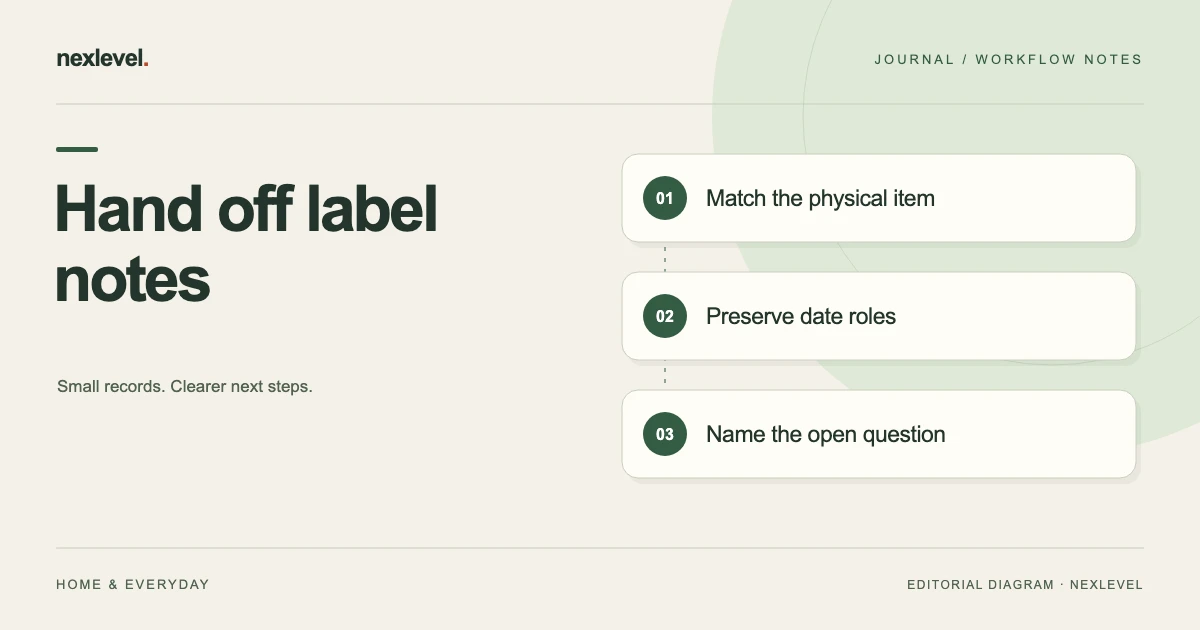
A food inventory handoff should identify the actual package, explain each recorded date and name the source question the next person will check. Include the copy's cutoff and location context. Similar product names should not cause one package to inherit another package's opening history.
Prepare an item-and-date handoff another person can use
- Define the selected items, recipient's task and preparation cutoff.
- Match each entry to its package and original label source.
- List label, acquired, opened and frozen dates by their actual roles.
- Keep location, recorded disposition and unanswered questions distinct.
- Open the intended copy and ask the recipient to identify the next source check.
Working fields:
Item/package | Label source | Date/role | Location context | Recorded state | Open question | Next owner | Copy/cutoff
Useful next steps: Clarify the meaning of a date, Inspect the CSV and companion note, Retain an older handoff copy.
Name the recipient’s actual task
Reading a selected inventory copy, maintaining the working log, and making a food decision are different responsibilities. State what the recipient is taking over before preparing a large export. A bounded source review can be useful without pretending to answer every household question.
Identify the selected items, source cutoff, intended reader, and next review. A copy covering one cupboard or a small set of products should not appear to represent every food in the home. Its scope should remain clear after the cover conversation is removed.
Use the actual private arrangement for sharing. A meaningful item reference does not require distributing unrelated purchase history, household notes, or personal information. Keep the packet proportional to the selected task.
Match the physical item rather than the name alone
Two packages can share a product name while having different label wording, date context, or storage locations. Preserve enough actual source information to distinguish the selected item. Similar names alone should not decide which history belongs to which package.
An independent reference such as F21 can help the handoff remain readable. It is a companion convention, not a claim about a mandatory SavorSoon field or a native batch-traceability system.
If an item relationship remains uncertain, name the exact question before preparing a confident date summary. Do not copy a date from the nearest matching name merely to fill a blank. The recipient needs to know what is established and what still needs its own source.
Preserve the wording behind a date
A short date column can lose the original label’s words and scope. Keep a usable route to the actual source where the meaning matters. An entered date should not silently become a universal safety deadline.
SavorSoon’s current description supports an expiry date and optional acquired, opened, and frozen dates. These are entered record roles. A date suggestion can help entry while leaving the selected value under the user’s control.
Use the date-meaning record guide when source wording is unclear. This handoff supplies no interpretation of a real manufacturer’s label or a rule that applies to every food.
Use an item-and-date handoff worksheet
One row should identify an actual item relationship and the question the recipient needs to continue. Keep different date roles separate rather than merging them into one unexplained deadline.
| Field | What to preserve |
|---|---|
| Item reference | The selected physical package or record relationship |
| Label source | The actual wording and source route where needed |
| Date role | Label, acquired, opened, frozen, or other established context |
| Location | The selected entered storage context |
| Recorded state | What the working record actually says |
| Open question | The next source check and intended reviewer |
These are independent companion prompts, not a claim that every column is an in-app field or appears automatically in an export.
Work through a fictional two-item packet
Imagine records F21 and F22 for similarly named packages. F21 has an established label source and an entered opened-date context. F22’s available source does not establish an opened date. The exercise supplies no actual food, date, period, or condition.
The first row preserves F21’s selected source relationships. The second keeps F22’s missing context explicit instead of copying F21’s opened date because the names match. A complete-looking table should not be created by inventing an event.
A third row concerns a recorded location note whose item relationship is unclear. The reviewer preserves that question separately from the missing opened date. Those limitations may need different sources, so one generic “check food” instruction would be less useful.
The final row identifies the intended copy and source cutoff. Another household member should distinguish F21, F22, the known date roles, and the unresolved questions. The packet does not tell them whether either item should be consumed, stored, frozen, reheated, or discarded.
Keep recorded location in its actual role
SavorSoon currently organizes fridge, freezer, and pantry locations. An entered location helps identify the working record’s context. It does not independently verify where the physical item is now or establish its storage history.
A later source may clarify that an item moved. Preserve the actual source relationship and occasion through the supported workflow. Do not assume every retained screenshot updates when the working location changes.
If only the companion summary is wrong while the working record is accurate, repair the summary. Changing good source data to match a mistaken cover note would create another discrepancy rather than resolve the first.
Distinguish reminders and urgency from a food decision
The current app sorts entered urgency and supports optional local reminders. A position in a queue or a notification reflects entered dates and settings. It is not an independent examination of the food’s condition.
Keep appropriate real-world guidance outside the inventory prompt. FoodSafety.gov’s food-handling guidance addresses practical safety subjects separately from administrative record organization.
This guide supplies no safe-use duration or substitute for an actual food check. The handoff can accurately preserve an item record while leaving a food question outside its scope. It should not invent a deadline to make the packet look finished.
Keep disposition history attached to the selected item
SavorSoon currently supports used, discarded, and archived states, optional estimated value, and waste-history review. Preserve the actual selected item and source occasion rather than applying one package’s state to every similarly named record.
A recorded state should remain distinguishable from an independent handoff-review note. Marking a worksheet as reviewed is not necessarily a new disposition in the working app. Use the actual supported controls for the selected record.
This article gives no disposal instruction or financial result. An optional estimated value in a record is not proof of a verified saving or a complete account of household waste. The selected source and its limitations need to remain visible.
Choose an actual portable form
SavorSoon Free currently includes up to thirty active foods, location tracking, reminders, history, and CSV export. Pro Lifetime expands active capacity, custom expiry presets, and waste insights. Check actual access before promising a selected output or history view.
The purchase description includes Family Sharing. That does not, by itself, establish an automatically synchronized household inventory. A purchase entitlement and multiuser record collaboration are different questions.
Open the intended export and inspect item identity, date roles, location context, recorded state, and relevant limits. Do not assume every independent worksheet prompt travels automatically or that a CSV provides arbitrary restore or import capabilities.
Prepare a short recipient cover note
A useful note can begin “Selected records F21/F22; prepared for item-and-date source review; cutoff [review occasion].” Then distinguish F21’s established context from F22’s missing opened-date source.
Put the uncertain location relationship on its own line. The recipient should know which actual source would address it and which person will continue the review. A vague instruction to “update everything” hides the bounded task.
Keep the intended copy identifiable. A file prepared earlier may remain useful history while the working record has later information. Preparing and sending a representation does not make it continuously current.
For an older retained packet, use the food-record archive guide. An archive can support a handoff without automatically establishing the recipient’s current responsibility or a food-safety outcome.
Test the recipient’s reconstruction
Ask the recipient to identify F21 and F22 without the original writer’s memory. They should explain which date roles are established, which opened-date question remains, and why a similarly named item is not a valid substitute source.
Then ask which part represents the working record and which part represents a retained copy. If the reader infers a safety verdict from a queue position or reminder, clarify the administrative scope.
The test can pass while a source question remains open. The useful result is a packet another person can continue, not a table whose every field was filled with a plausible but unsupported value.
Keep a concise handoff receipt
The receipt can identify the selected items, actual sources inspected, intended output checked, established relationships, and next question. It records a documentation review rather than proof of physical storage history or food condition.
When a later clarification arrives, keep its source occasion distinguishable from the original event. Do not make an earlier copy appear to have contained information that was unavailable when it was prepared.
Do not delete a working inventory merely because a file exists. File preparation and a usable continuation process are separate results. Inspect the actual supported output and private arrangement before relying on the packet for its selected task.
Complete a copy-ready item source note
For F21, begin with the selected physical-item reference and route to the actual label context. Keep the opened-date relationship on its own line. This lets the recipient distinguish a source-established label date from a separate recorded event without interpreting a short number column alone.
For F22, name the missing opened-date source explicitly. Do not borrow F21’s date or use the handoff preparation occasion as a substitute. The two items can share a name while their available histories remain different.
Put the uncertain location note on another line, with the actual next source to inspect where known. Resolving that relationship should not automatically mark F22’s opened-date question complete. Different questions need separate outcomes even when they concern the same household packet.
Add the selected source cutoff and intended copy. A recipient who receives the material later should know which working occasion it represents. The copy should not appear continuously current merely because it was forwarded recently.
Now test a shortened version. If it preserves the item names but drops the date roles or uncertainty, repair the explanation. A compact handoff is useful when it retains the relationships that make its fields meaningful, rather than only a list of familiar product labels.
The recipient’s return note can identify the sources opened and the questions clarified or left pending. It should not supply an edibility result or an invented storage duration to make the administrative review look complete.
Keep the fictional F21/F22 example separate from genuine inventory history. Its reusable part is the source-note structure. Real labels, dates, locations, and disposition events should be entered only from their actual sources and responsible process, with appropriate food-handling guidance remaining outside this record exercise.
Preserve the precision of the actual date source. If a selected source gives limited date context, do not supply an invented day or clock time to make a table look uniform. The recipient should be able to distinguish what the source states from what the worksheet would ideally contain, without treating a formatting choice as new food-history evidence.
Use SavorSoon for clear entered food records
SavorSoon organizes entered food dates, storage locations, reminders, and recorded dispositions in a local workspace. Use the companion handoff worksheet where the recipient needs source wording or uncertainty explained beyond a short date field.
Check the official SavorSoon App Store listing for current features and plan details. Preserve the actual item and date relationships while keeping food-handling decisions with appropriate current sources and guidance.