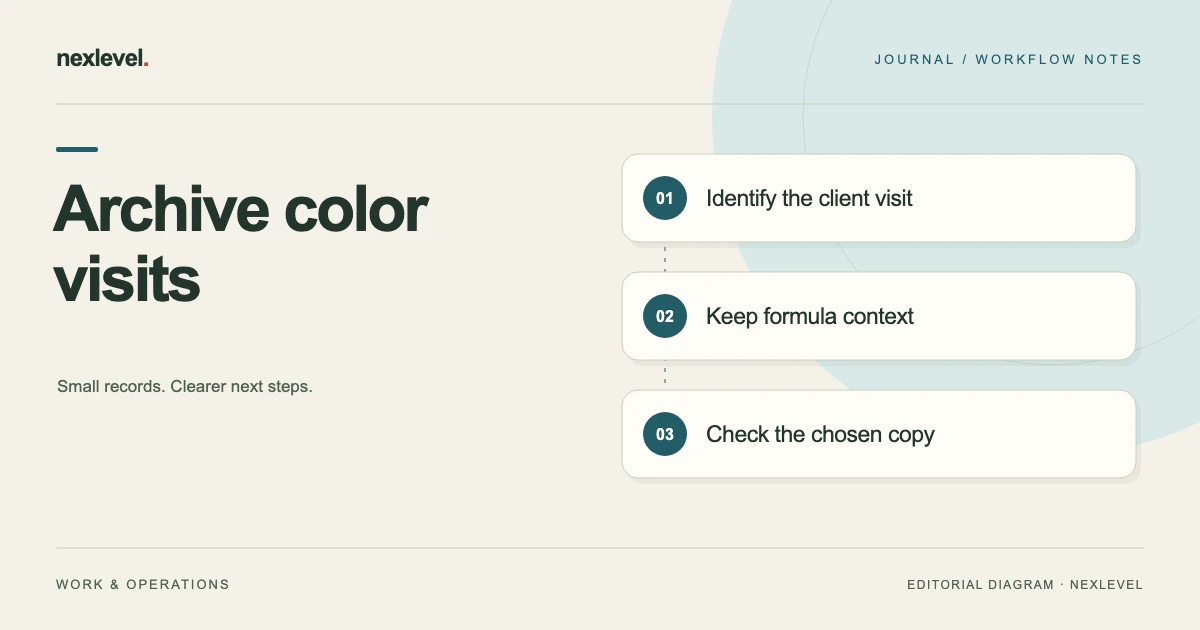
Archive a hair color visit with its client and service identity, recorded formula context, observations and relevant photo relationships. State which occasion the copy represents and whether it is for reading or recovery. A later visit or template update should remain separate from that historical record.
Keep the selected visit understandable
- Define the client, visit range, source cutoff and later retrieval task.
- Index the original formula, zone and unit context with its result notes.
- Identify the selected photos and relevant permission context, leaving uncertain relationships explicit.
- Open the actual report or export and distinguish it from any separately supported encrypted recovery backup.
Working fields:
Client/visit | Formula/zones/units | Observation source | Photo/permission | Report/export purpose | Backup purpose | Cutoff | Limitation
Useful next steps: Inspect the selected visit copy, Prepare history for another professional.
Define what the archive needs to explain
Choose the later retrieval task before preparing a large copy. A reviewer may need to find the formula context for one visit, inspect a selected observation, or recover a supported local backup. Those purposes need different representations and checks.
Write the selected client, visit range, source cutoff, intended reader, and archive purpose. A packet about one visit should not appear to contain the client’s complete history or every later clarification.
This article recommends no legal retention period. Use the actual private and professional arrangement for access. A usable archive preserves the relevant source relationships without distributing unrelated client details merely because they were nearby in the working vault.
Keep client and visit identity together
Similar names are not sufficient to combine histories. Preserve enough authorized context to identify the selected client and service occasion. A repeated formula name may refer to a reusable structure rather than one unique visit.
ColorFolio currently describes profiles, visit timelines, services, notes, outcomes, pinned successful visits, and access to the most recent formula. Those retrieval aids organize entered records. A pinned visit and the latest visit can be different sources.
Keep that distinction readable in the archive. A later visit becoming current should not make an earlier report look newly observed. If identity remains unclear, retain the exact source question rather than selecting the history that seems most familiar.
Use a visit archive index
One index row should identify the selected visit and its source relationship. Separate rows can describe formula context, a photo, and a later clarification when those materials have different source occasions.
| Field | What to preserve |
|---|---|
| Client and visit | The selected profile and service occasion |
| Formula context | The actual zone, components, units, and source role where recorded |
| Observation | Which result or note the source establishes |
| Photo | The image’s client/visit relationship and relevant permission context |
| Portable copy | The intended report, data export, or supported backup |
| Limitation | The next source question |
These are independent companion prompts. They do not establish a named archive module or guarantee that every column appears in every ColorFolio output.
Work through a fictional visit packet
Imagine client C31, visit V4, selected formula reference F7, observation note N2, and photo P3. Report R1 represents a selected source cutoff. A separate supported backup A6 has a recovery purpose rather than a reader-summary purpose.
The first row links C31/V4 to F7’s actual source context. The second identifies N2 as the selected observation. The third records whether the source establishes P3’s visit relationship and the relevant permission context for its intended use.
The fourth row identifies R1 as the readable representation actually prepared. The fifth identifies A6’s separate supported recovery purpose. The packet should not describe a report as a complete editable backup or a backup as automatically readable by every recipient.
No real client, formula amount, service result, photo, or technical recommendation is supplied. The fictional exercise demonstrates how the selected source relationships remain understandable after the original conversation is unavailable.
Preserve formula meaning without inventing values
ColorFolio’s current description supports zone formulas, multiple components, ratios, developer context, timing, batch sizes, and units. Preserve what the actual selected record establishes rather than filling a gap from another visit.
A precise-looking quantity is not meaningful without its source role and unit. If a retained summary omits a unit that F7 clearly contains, repair the summary. If the actual source is uncertain, retain that question rather than choosing the unit that makes the number look plausible.
The archive review does not evaluate whether the formula was or will be suitable. Actual manufacturer instructions, appropriate tests, and professional judgment remain separate from record completeness.
Keep reusable templates separate from historical visits
The current listing describes saving reusable formulas without copying client information. A template can support later planning while not being proof of what was used during V4. A later template change should not silently rewrite the visit explanation.
Keep the selected historical source and current reusable structure distinguishable. A report title matching a template name does not establish that every field represents the same occasion.
This guide does not invent an automatic template-version archive or a universal merge rule. Use the actual supported workflow and inspect the intended result. A companion index should explain the established relationship without claiming extra app controls.
Separate observations from future ideas
A result note describes an entered observation at a selected occasion. A future adjustment idea describes a proposal or question. Their relationship can be useful without making them interchangeable historical facts.
For N2, retain which visit and source role apply. A sentence copied into a later packet should not look newly observed merely because the file has a new preparation date. A review occasion is not another service event.
For appointment preparation, use the weekly client-record review guide. A historical archive can support that task without becoming a technical plan for the next appointment.
Review photo identity and intended use
ColorFolio currently includes before-and-after photos with an explicit consent record. Inspect which client, visit, and source occasion a selected image represents, along with the actual permission context needed for the intended copy.
An image existing in the vault is not, by itself, evidence that every external use is authorized. A recordkeeping packet and a public marketing image have different purposes. This guide does not determine legal consent requirements for a jurisdiction.
If P3’s relationship remains unclear, preserve that question. Do not infer service progress or a technical result from appearance alone. A photo can provide context without independently establishing every fact in a visit report.
Choose the actual portable form
The current listing describes visit PDFs and structured CSV output, with plan-dependent access. Free includes a bounded client allowance and one PDF export. Pro expands clients, exports, templates, private sync, voice notes, encrypted backups, and protection features.
Check the actual selected plan and output before promising an archive capability. A PDF can be a readable representation, while a CSV can serve a structured-data task. Neither should automatically be called the complete editable app.
Open the intended copy and inspect C31/V4, relevant formula roles and units, N2, photo context where included, source cutoff, and limitations. An independent explanation may be needed for a relationship the output does not represent automatically.
Treat backup and restore as a separate task
ColorFolio currently advertises encrypted backup and restore under Pro. A supported backup has a recovery purpose distinct from sending a readable visit summary. Its existence alone does not demonstrate that the intended retrieval task works.
Use the actual supported process within the authorized private arrangement and inspect the selected recovered context where appropriate. This guide does not instruct deletion of current data or invent an arbitrary file-import or conflict-merging feature.
Keep access proportional. A backup prepared for the owner’s recovery task should not be distributed as though it were a simple visit report. The archive index can identify its purpose without exposing credentials or unrelated client history.
Prepare a cover sheet for C31/V4
The cover sheet can identify the client and visit scope, selected source cutoff, and actual materials prepared. Keep R1 and A6 on separate purpose lines so a later reader does not assume they are interchangeable copies.
A source line can identify F7 and N2. A photo line can identify P3’s established relationship or precise limitation. A next-review line can name who will continue the source question within the intended private arrangement.
Do not make the cover sheet a second complete formula vault. A concise index with usable source routes is easier to keep aligned after a clarification than a large collection of disconnected screenshots and repeated notes.
For another professional receiving selected history, use the client color-record handoff guide. The archive can support that transfer while responsibility, access, and technical decisions remain separate.
Test the archive without the original writer
Ask an authorized reader to find C31/V4, distinguish F7 from a current reusable template, identify N2’s source role, and explain P3’s relationship. Then ask which copy supports reading and which supports the owner’s recovery task.
If the reader assumes a report contains the whole working vault, clarify scope. If they interpret a future idea as an earlier observation, improve the labels. Repair the explanatory layer that caused the misunderstanding rather than altering accurate history.
A concise receipt names actual sources opened, intended output inspected, backup purpose where relevant, established relationships, and remaining question. It documents a bounded archive review rather than validating a formula or certifying a service outcome.
Test the two different retrieval purposes
For the fictional C31/V4 packet, begin with R1’s reading purpose. Ask whether an authorized recipient can identify the selected visit, F7’s source role, N2’s observation, and P3’s established context or limitation without access to unrelated client material.
Then inspect A6’s separate recovery purpose through the actual supported process and authorized arrangement. The question is not whether its filename resembles R1. The reader needs to know which representation is intended for recovery and which is intended for a bounded visit review.
Do not assume that a successful file opening establishes every relationship. A readable report can still omit a source limitation. A supported backup can have a different access requirement and purpose. Keep those dependencies explicit without exposing credentials in the cover sheet.
Now introduce a later visit V5. It becoming the most recent visit should not change R1’s identity or make N2 look newly observed. The archive index should still route the reader to C31/V4 rather than whichever view is easiest to open today.
If a copied formula summary belongs to V5 while the report is labeled V4, retain that exact source question. Do not resolve it by choosing the more familiar formula or shifting a photo without an established relationship.
A useful retrieval receipt can name which selected sources were opened, which copy was inspected, which recovery purpose was tested where appropriate, and which context remains unresolved. It should not claim a technical service result merely because the documents were understandable.
Reuse this structure as a method, keeping the fictional identifiers outside real client history. Genuine formulas, observations, permission records, and service occasions should come from their actual sources. The archive should preserve those relationships without generating a new formula, observation, or client event.
Try a final retrieval using only the selected report and companion index. The reader should identify which visit is represented, distinguish a reusable template from that visit’s formula record, and locate the actual photo-consent context where relevant. Record any missing relationship as a specific follow-up question before expanding the packet with unrelated client material.
Use ColorFolio for a source-aware visit history
ColorFolio connects client identity, visit formulas, observations, photos, and plan-dependent portable outputs in a private local vault. Keep reusable structures and retained copies tied to their actual source occasions.
Check the official ColorFolio App Store listing for current features and access. Preserve the visit’s meaning while keeping technical service choices and appropriate instructions with their responsible professional sources.