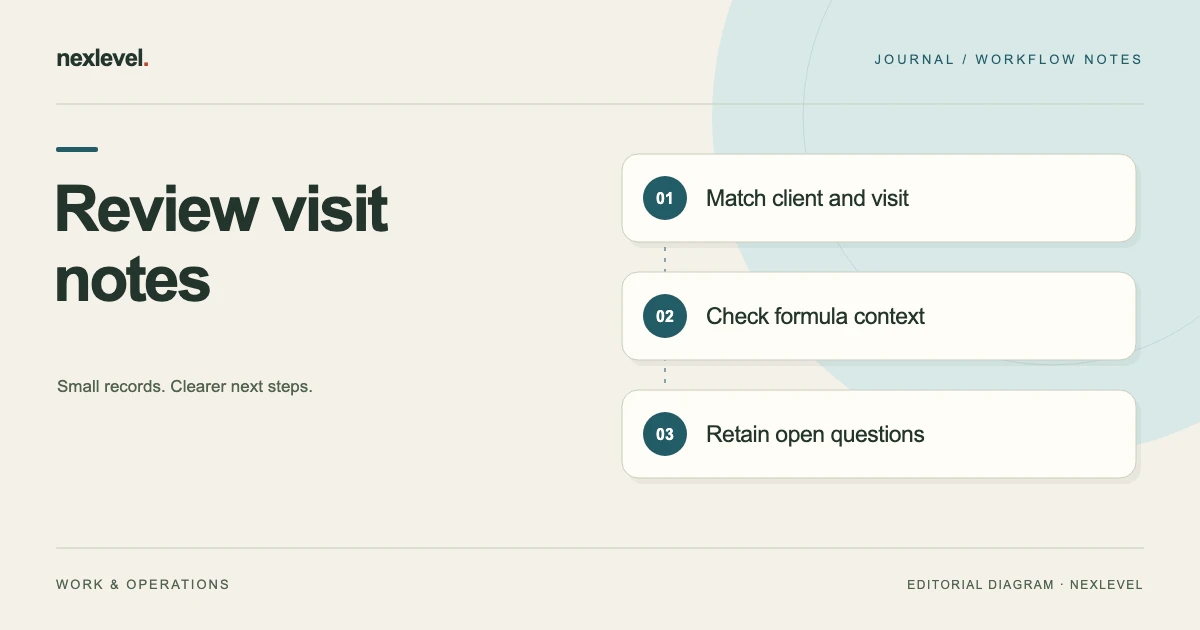
Use a weekly client-record review to prepare selected appointments or finish recent documentation. Confirm the right visit, formula context and missing source details, then leave a short note with established corrections and separate open questions. Keep the review date distinct from the service date.
Turn record gaps into specific next actions
- Choose upcoming clients, recent visits or unresolved records and state the review cutoff.
- Confirm client identity and distinguish the pinned visit from the most recent visit.
- Check recorded zones, units, notes and photo relationships without supplying missing technical values.
- Correct source-backed copying errors and assign each unresolved question separately in the appointment note.
Working fields:
Client/visit | Review scope/cutoff | Missing context | Source | Established correction | Open question | Next owner | Appointment reference
Useful next steps: Compare pinned and newest visits, Hand off the prepared history.
Choose the review set before opening individual records
Decide whether this pass concerns the next appointment list, recently entered visits, or unresolved documentation questions. Those sets can overlap without being identical. A missing note from an older visit should not disappear merely because that client is not on this week’s appointment list.
Write a short scope statement: selected clients, source period, reviewer, and intended result. This prevents a quick preparation pass from being presented as a complete review of the entire client vault. It also gives unfinished questions somewhere explicit to remain.
The weekly cadence is an organizational choice, not a required service interval. Adjust the administrative routine to the actual workload. The useful outcome is that the selected records can be reconstructed when needed, rather than that every record receives an unexplained checked mark.
Use a review index with one question per row
A practical index connects the client reference, selected visit, question, source route, and next action. Use a separate row when two questions need different sources. “Photo permission unclear” and “formula unit omitted” should not share a vague “finish file” instruction that hides their different resolutions.
| Review field | What to enter |
|---|---|
| Client and visit | References sufficient to find the selected history |
| Record question | The exact missing or conflicting context |
| Source | Where the answer should be checked |
| Outcome | Established detail or an explicit limitation |
| Next action | Who will address the remaining question |
This is a companion worksheet, not a claim that ColorFolio has a named weekly-review module. Keep it lean enough to maintain. Copying every formula and photo into another table creates more private material and another version to correct without necessarily improving preparation.
Confirm client identity and visit sequence first
Similar names are a poor basis for combining histories. Match the selected profile using the actual authorized client context, then inspect the relevant visits. A pinned visit, the most recent visit, and the visit containing a useful note can be different records.
ColorFolio’s current listing describes profiles, visit timelines, services, notes, outcomes, successful-visit pins, and access to the most recent formula. These retrieval aids help navigate entered information. They do not establish that two similar profiles belong to the same person.
If identity remains uncertain, retain that question before preparing an appointment summary. Do not resolve it by copying one history into the other. A short unresolved row is more useful than a polished summary attached to the wrong client.
Read formula context as a complete relationship
Review the selected formula’s zone, components, ratio context, developer description, units, batch context, timing entry, and related visit note where recorded. This is a completeness check of entered information, not permission to supply missing technical values from memory or from another client’s record.
A unit can matter even when the number looks familiar. If a retained summary omits the unit while the working record includes it, correct the summary. If the original source is unclear, preserve the question instead of choosing whichever unit makes the arithmetic appear convenient.
The current app supports zone formulas, multiple components, batch scaling, and reusable templates. A scaling function does not verify suitability, correct an ambiguous source, or establish what was actually used. Keep any proposed future formula separate from the historical visit.
Separate observations, adjustments, and next-visit ideas
A result note describes an entered observation from a selected occasion. An adjustment note may describe what was changed during that visit or what someone proposes for a later one. Label the role rather than relying on the reader to infer it from sentence position.
For example, “review zone note before next service” is a preparation prompt. It is not a completed adjustment or a prescribed formula. The review index should identify its source and intended question without turning the prompt into a new visit event.
When correcting a record, preserve enough context to distinguish an entry correction from a newly reported observation. Do not give an old result a fresh event date simply because the weekly review occurred today. The review occasion and service occasion have different meanings.
Check photos and consent together
ColorFolio advertises before-and-after photos with an explicit consent record. Inspect the selected image’s client and visit relationship and the relevant recorded permission context. A photo existing in the vault is not, by itself, evidence that any particular external use is authorized.
Keep the administrative question narrow: which image belongs to this visit, what permission context is recorded, and what use is intended? Do not infer public marketing permission from a recordkeeping purpose. This guide does not determine legal consent requirements for a jurisdiction.
A review copy can also be intentionally smaller than the complete vault. If the appointment-preparation task needs a text source question rather than a photo, avoid adding unrelated images simply to make the packet look comprehensive. Use the actual private arrangement for access.
Work through a fictional appointment-preparation pass
Imagine client C14, visits V7 and V8, and an upcoming appointment reference A3. V7 is pinned. V8 is the most recent recorded visit. The index asks which history the preparation summary is describing, rather than assuming the pinned visit is always the latest.
The first row identifies C14/V8 and notes that its formula summary omits a unit. The reviewer finds the unit in the actual working source and repairs only the summary. V7 remains pinned history; no new service or formula result is created by the administrative correction.
The second row concerns a next-visit note associated with V8. Its wording is a question about an earlier result, not a completed adjustment. The reviewer retains it as a question for the responsible professional rather than copying it into the role of a confirmed service instruction.
The third row concerns a photo attributed to V7 in the summary but linked to V8 in the selected source. The relationship needs clarification. The preparation copy marks that limitation instead of silently moving the image or inventing an outcome from its appearance.
The final row identifies the intended appointment copy. It should preserve C14, the selected visit references, the corrected summary unit, and the two remaining questions. This fictional exercise shows record preparation only; it supplies no technical recommendation for A3.
Prepare a short next-appointment note
A useful note begins with identity and scope: “C14; review of V7/V8 for A3; selected sources checked on [review occasion].” Then list established record details separately from questions. The note should explain which visit is being referenced whenever the relationship might be ambiguous.
Keep each unresolved item actionable. “Confirm which visit this photo describes” is clearer than “check photos.” “Clarify whether this sentence reports an earlier change or proposes a future one” gives the responsible reviewer a source question without prescribing the service.
Do not make the note a duplicate formula vault. Retain a usable route to the actual record and include only the context needed for the selected task. A compact index is easier to keep aligned after a correction than a collection of disconnected screenshots.
Inspect the actual export or retained copy
The current ColorFolio listing describes visit PDFs, structured CSV files, encrypted backup and restore, with plan-dependent access. Free includes a bounded client allowance and one PDF export; Pro expands clients and the listed workflow extras. Check the actual plan before promising a particular output.
A visit report and an encrypted backup serve different purposes. One can be a readable representation for a bounded review, while the other supports the advertised recovery workflow. Do not assume either automatically contains every independent worksheet field or is suitable for every recipient.
Open the intended copy and inspect client reference, visit identity, relevant notes, units, photo context, and limitations. A plausible filename does not prove those relationships survived. Preparing a copy also does not prove delivery, understanding, or a later update on another device.
Close the review with outcomes rather than ticks
For each selected row, record the established result, unresolved source question, or reason the item was outside the pass. This lets the next review continue from a specific position. A generic completed flag can conceal that the most important information is still unavailable.
Ask a reader to find C14/V8, distinguish the pinned earlier visit, and identify the two open questions. If they can do that without the original writer’s memory, the preparation packet has passed its narrow retrieval test. It has not validated a formula or service decision.
For an actual transfer to another professional, use the client color-record handoff guide. For system selection, compare the paper, spreadsheet, and app approaches. Those tasks have different scopes from this weekly pass.
Turn the fictional review into a reusable appointment card
The C14 card can use four short blocks: selected history, established correction, unresolved questions, and next reader. Under selected history, write V7 as the pinned earlier visit and V8 as the most recent recorded visit. That wording prevents either retrieval aid from silently changing the chronological relationship.
Under established correction, identify the summary unit that was checked against V8. Retain the source route instead of repeating the entire formula. The card explains what was corrected administratively; it should not look like a new technical service record or an adjustment prescribed for the next appointment.
Under unresolved questions, keep the photo relationship and the meaning of the next-visit sentence on separate lines. They require different source checks. A reader who resolves the photo question should not accidentally mark the proposed-adjustment question finished as well.
The next-reader block identifies who will continue each question within the actual private arrangement. It can also state which sources remain in the working vault. A prepared appointment card does not need to contain every image or reveal unrelated client history to be useful.
Now test the card after removing its original cover message. Can the reader tell why V7 is mentioned, which unit was established, and which matters remain open? If not, fix the card’s labels. Adding more copied content is not always the right repair when the actual problem is an unclear relationship.
Keep the completed card’s review occasion distinct from the appointment occasion. A later reader should recognize that this is a preparation note based on selected sources, rather than evidence that A3 already happened. That distinction makes the card reusable as a review method without copying fictional observations into a new client’s history.
Use ColorFolio for the working history
ColorFolio organizes client visits, zone formulas, observations, photos, and reusable structures in a private local vault. Optional private sync and expanded exports depend on the current plan. Keep the working history authoritative within the actual record arrangement, while using the review index to surface bounded questions.
Check the official ColorFolio App Store listing for current features and access. Manufacturer instructions, appropriate tests, and professional judgment remain separate from a documentation check. The review succeeds when the next reader understands the history and its limits.