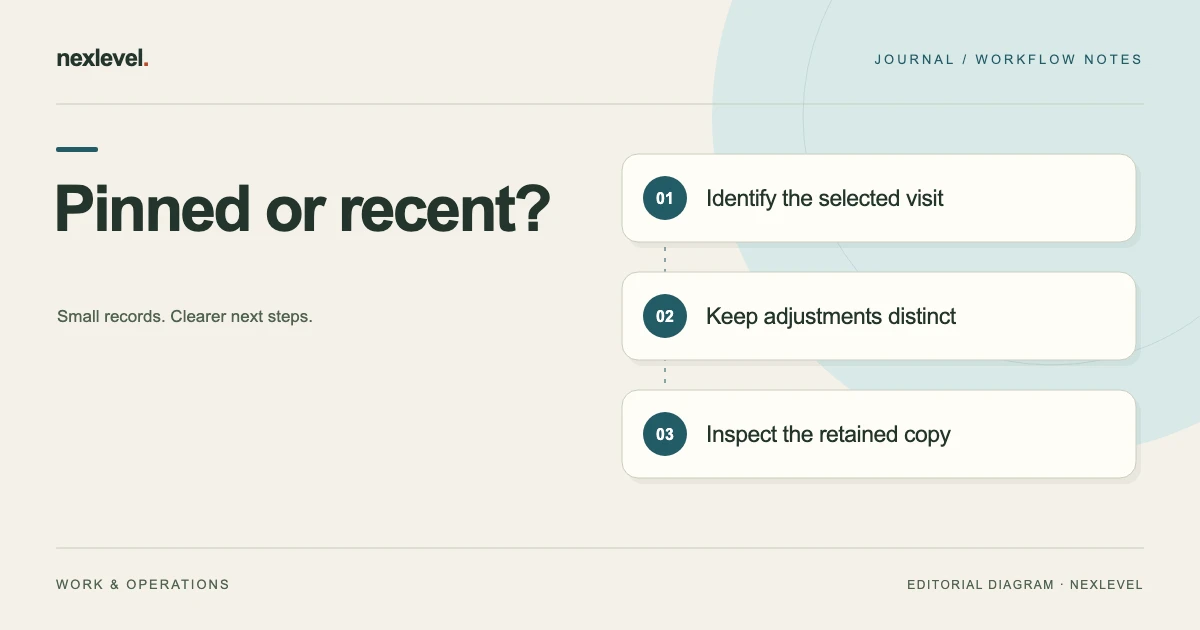
A pinned visit is a selected historical reference; the newest visit is the latest recorded occasion. Both can be valid. When a note says ‘last formula,’ replace the ambiguity with the actual visit reference before using its formula, adjustment or photo context in a summary.
Identify the visit behind the reference
- Write the client, pinned visit, newest visit and specific source question.
- Trace each formula and adjustment note to its actual visit rather than its screen position.
- Check the selected photo and permission context by occasion.
- Correct an unsupported caption or copied reference while preserving accurate history, then label the inspected output and cutoff.
Working fields:
Client | Pinned visit | Newest visit | Selected formula/note | Actual source visit | Photo/context | Copy corrected | Cutoff/question
Useful next steps: Review upcoming appointment records, Check the visit selected for export.
Choose the selected source question
Write the client/visit scope, selected task, pinned and recent references, source cutoff, and exact discrepancy. A check for two visits should not appear to verify the whole client history.
Useful questions include which visit a copied note represents, whether a selected adjustment belongs to the recent occasion, or what a pinned reference actually establishes.
Use fictional records for the exercise. There is no need to review a real client photo or choose a treatment merely to test the worksheet.
Separate display convenience and historical identity
A pinned record can be intentionally useful history. A most-recent record has a different occasion. Neither should silently acquire the other’s values because the client name matches.
ColorFolio’s current description includes profiles, visit timelines, services, notes, outcomes, pinned successful visits, recent-formula context, and searchable records.
The app organizes entered information. This guide’s comparison is an independent source-review convention, not a native recommendation engine or professional suitability assessment.
Set up a fictional pinned/recent packet
Imagine client C35, pinned visit V2, most-recent visit V6, zone/formula reference F3, adjustment note N4, and selected photo/consent context P5/A7.
Retained copy R8 represents a selected cutoff. One shortened note says last formula without establishing whether it means the pinned reference or most-recent visit.
No real client, formula, amount, ratio, developer, duration, photo, consent, or outcome is supplied. The references evaluate administrative selection without creating salon history.
Use a visit-source comparison table
| Selected source | Relationship to establish | What not to infer |
|---|---|---|
| C35/V2 | The actual pinned-visit context | That it is the newest occasion |
| C35/V6 | The actual recent-visit context | That it replaces every historical reference |
| F3 | The selected formula/zone source | Which visit it belongs to from a familiar label alone |
| N4 | The actual adjustment-note role | A universal instruction for another visit |
| P5/A7 | The photo/consent-source context | Permission or identity for another occasion |
| R8 | The retained copy and cutoff | The permanent current state of the client record |
These are independent review prompts, not exact native field names or a promise that the app automatically resolves every source discrepancy.
Confirm client and visit identity first
A familiar service label can recur across visits. Establish the actual C35/V2/V6 references before interpreting a copied formula or note.
A pinned position or recent-items order can help locate a record without explaining every source relationship. Keep actual occasions readable.
If identity remains uncertain, retain the precise question rather than assign F3 by the closest-looking title.
Ask what the selected task actually needs
A historical review, a handoff, and preparation for another professional decision can need different source context. State the task rather than assume the most recent or pinned source always wins.
The current app supports pinning and recent-formula retrieval. That convenience should not become a claim that a particular historical formula is appropriate for a real client now.
This guide supplies no technical choice. The actual source and professional arrangement govern operational decisions outside the recordkeeping task.
Keep formula and adjustment occasions distinct
F3 and N4 can describe different roles or occasions. A later adjustment should not make an earlier visit appear to have contained it from the start.
For reusable structure, use the salon template separation guide. A template and a selected historical visit have different meanings.
If the working source is accurate but a cover note says last formula too broadly, repair the note. Do not change correct visit history to make an ambiguous summary look consistent.
Preserve photo and consent context
A selected photo needs its actual client/visit relationship and source occasion. A consent record belongs to its actual scope rather than every future copy or visit by assumption.
The current app advertises before/after photos with explicit consent records. This guide does not turn that feature into a legal determination or universal permission to share.
The fictional check requires no real photo or consent collection. A placeholder reference is sufficient to test whether the selected roles remain distinguishable.
Keep numerical formula review outside this comparison
If actual quantities or units need review, they require their own authorized source and professional assessment. This article supplies no grams, ounces, ratios, strengths, or timings.
A matched visit reference should not independently establish a formula’s safety or suitability. A readable record is an administrative source, not a treatment recommendation.
Preserve the exact source question where a copied quantity lacks context rather than choose a plausible value to make the packet complete.
Inspect the selected PDF or CSV
ColorFolio currently advertises visit PDF and structured CSV output with plan-dependent access. Open the actual representation relevant to the selected review.
Inspect client/visit identity, pinned/recent source roles, formula/zone context, adjustment relationship, photo/consent context, and cutoff. A companion explanation may be needed where the output omits an independent source role.
The public description does not establish arbitrary CSV merge/import. A report is also different from the advertised encrypted backup/restore workflow.
Run a reverse source test
Begin with F3 and ask a reader to identify the actual selected visit context. Then begin with V2/V6 and locate the note or photo relationship needed for the task.
Introduce another visit with a similar service label. The reader should use established references rather than the most prominent card.
If one route fails, identify the missing relationship precisely. More records are useful only when they supply the source context the bounded question needs.
Classify the discrepancy before correcting it
Distinguish an unclear pinned/recent label, wrong copied visit reference, later adjustment, photo-source question, and actual conflicting source context.
A documentation correction is different from a new formula, visit, consent record, or physical service. Keep those purposes distinguishable.
For routine record maintenance, use the visit review guide. This selected comparison should state its limited scope.
Write a bounded visit-source receipt
Name the selected client/visits, sources inspected, relationships established, actual copy correction if any, and precise next question.
A later clarification should retain its own occasion and connection to R8. It should not make a historical visit appear to have known later information.
The receipt documents an administrative source review without a technical formula, consent-law, or client-result conclusion.
Connect the result to handoff and retention
For another professional taking over records, use the client color-record handoff guide. A comparison does not itself transfer source access or professional responsibility.
For a historical packet, use the visit archive guide. For method selection, use the record-tool comparison.
The fictional references remain teaching inputs. Reuse the worksheet with actual authorized material while preserving privacy, source-specific consent, and professional-judgment boundaries.
Compare the selected visits with concrete source roles
The fictional review can keep pinned and recent records side by side without choosing a treatment. The worksheet should make the identity and occasion of every selected reference clear.
| Companion field | Pinned reference V2 | Recent reference V6 |
|---|---|---|
| Role | A selected historical visit kept prominent | The selected newest visit context |
| Client identity | C35 under the actual source | C35 under the actual source |
| Formula/zone reference | Use only the relationship actually established | Do not inherit another visit’s F3 by title alone |
| Adjustment note | Preserve its own source occasion | Preserve N4’s actual relationship |
| Photo/consent | Use the actual selected P5/A7 context | Do not assume another occasion’s scope |
These are independent documentary roles. The table supplies no formula component, quantity, technical suitability decision, or legal consent conclusion.
Work through a last-formula label problem
In one fictional branch, the source establishes F3 as part of V2, but R8’s cover says last formula as though it meant V6. The supported repair is to label the selected source explicitly. It is not to change accurate visit history.
In another branch, N4 is a later adjustment for V6. Preserve its actual occasion. It should not make V2 appear to have contained the adjustment from the start.
A third branch has P5/A7 clearly tied to one selected visit while another copied representation loses that context. Repair the copy or retain the exact source limitation. Do not infer a broader photo/consent relationship from the client name alone.
A fourth branch leaves F3’s actual visit relationship uncertain. Name the source needed to distinguish V2/V6 rather than choose whichever record looks more prominent.
Prepare a visit-selection receipt
Give another authorized reader only the fictional selected packet and receipt. Ask them to identify C35/V2/V6, the source role of F3/N4, actual P5/A7 context, purpose of the review, and cutoff.
They should distinguish a pinned historical reference from a most-recent occasion without inferring which formula is appropriate for a real client now.
Record sources inspected, relationships established, actual explanatory copy corrected if any, and precise next question. A documentation correction is different from a new service, formula, or consent event.
Keep those roles inside the receipt as well as in filenames. A copied PDF or CSV can lose its original folder path.
A useful result can make the next administrative source check specific while leaving a professional decision outside scope. It should not claim treatment suitability, safety, or client outcome merely because the record match is clear.
The fictional references remain teaching inputs. Reuse the side-by-side source worksheet with actual authorized material while preserving privacy, consent scope, and professional-judgment boundaries.
Write a concrete pinned-versus-recent result
In one fictional branch, the source establishes F3 as belonging to pinned V2 and N4 as a later V6 adjustment. The check receipt can preserve those separate roles rather than use last formula for both.
If R8’s caption points to the wrong visit, correct that explanatory reference using the established source. A documentation repair should not change accurate history or create a new service event.
In another branch, the selected photo/consent relationship remains unclear. Name the source that would establish P5/A7’s actual occasion instead of assigning it by the client’s familiar name or service label.
For a final check, give another authorized reader only R8 and its receipt. Ask them to identify the pinned visit, recent visit, selected formula/adjustment context, photo-source role, review purpose, and cutoff.
The reader should distinguish historical prominence from newest occasion without choosing a treatment for a real client. Record any manual explanation needed and the precise next source question.
A bounded result can make the administrative repair clear while leaving a professional decision outside scope. It should not claim formula suitability, legal consent, or a physical client outcome merely because the selected record relationship is established. Keep that evidence limit beside the affected reference so another professional can continue without reconstructing the original conversation.
A practical final check is to read the visit references without their screen position. The reader should still identify V2 as the pinned historical occasion and V6 as the newer visit. If that distinction disappears, improve the caption before relying on the copy.
Use ColorFolio for clear entered visit context
ColorFolio connects entered formula/zone records, client histories, pinned/recent retrieval, selected photo/consent context, and supported outputs in a private workspace.
Check the official ColorFolio App Store listing for current capabilities and Pro access. Keep record prominence, source occasion, actual professional decisions, and physical outcomes in their appropriate roles.