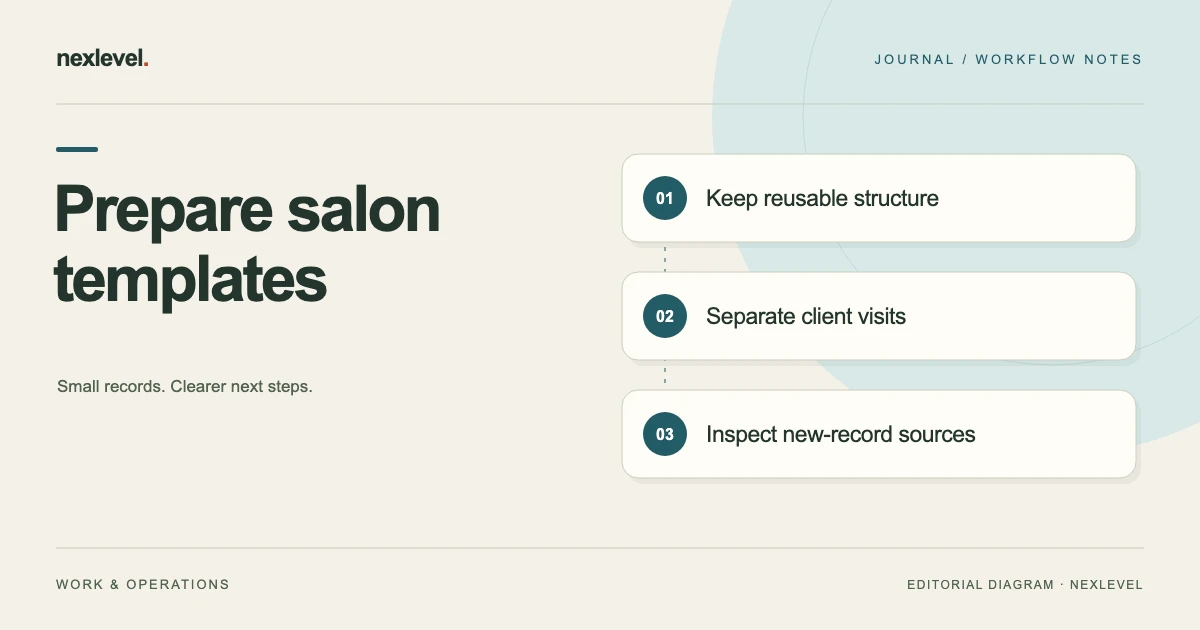
Reuse a salon template’s general structure while leaving client identity, visit observations and photo or consent history with their original record. Inspect the new visit after reuse: it still needs its own confirmed context, and a previous adjustment note should not become a universal instruction.
Check the boundary before reusing a template
- Identify the historical visit and the general structure you intend to reuse.
- Classify each copied note as reusable structure or client-specific history.
- Keep photos, permission records and visit-specific observations tied to their actual occasion.
- Inspect the supported template and proposed new visit, naming the fresh source information still needed.
Working fields:
Source visit | Proposed reusable structure | Client-specific item | Keep with original | New visit | Fresh source needed | Checked representation
Useful next steps: Structure the new visit record, Choose the correct historical source.
Choose the actual reuse task
A general zone/component structure, a previous visit’s entered formula, a personal adjustment note, and a client photo can have different source roles. Do not call all of them a template merely because they are convenient to copy.
Write the selected reusable scope, source arrangement, intended new-record purpose, and actual supported feature. The task is not to duplicate an entire client’s history.
Use fictional records during preparation. There is no need to put real client names, formulas, or photos into a shared worksheet merely to test the separation.
Start from the current advertised boundary
ColorFolio’s verified current description includes zone/component formulas, ratios/units, visit histories, templates without copying client information, selected photos with explicit consent records, pinned visits, and recent-formula context.
Pro currently includes reusable templates, expanded clients, private iCloud features, voice notes, exports, encrypted backups/restoration, and device authentication tools.
Check actual access. This guide’s worksheet is an independent convention, not a claim that every copied source is automatically sanitized or that a template determines an appropriate treatment.
Set up a fictional template preparation
Imagine client alias C27, visit V4, zone/formula reference F2, selected adjustment note N3, photo P5, and consent-source reference A6.
Reusable template T7 and proposed new visit W8 concern separate roles. The selected question is which source context belongs in T7 and what should remain tied to C27/V4.
No real client, ingredient, amount, ratio, developer, duration, photo, consent, or treatment outcome is supplied. The references evaluate record organization without creating genuine salon history.
Use a reusable-versus-client-specific worksheet
| Selected source | Role to establish | Question before reuse |
|---|---|---|
| General zone/component structure | Proposed reusable material | What actual supported template context is intended? |
| C27/V4 | Historical client/visit identity | What remains specific to this occasion? |
| N3 | Selected adjustment note | Is this general structure or a particular visit observation? |
| P5/A6 | Photo and consent-source context | Which actual client/occasion does it concern? |
| T7/W8 | Template and proposed new visit | What fresh source does the new record need? |
These are independent preparation prompts, not a named native validator or a promise that every field copies in the same way.
Keep visit identity stronger than a familiar label
A client can have several visits, and a familiar service name can recur. The selected formula/adjustment context needs its actual source occasion.
For C27/V4/F2, preserve the established relationship before deciding what is reusable. A shortened note should not silently become the basis for W8.
If a source relationship remains uncertain, retain the precise question rather than copying a plausible formula record to make the new visit look complete.
Distinguish template structure from visit observations
A reusable structure and a selected result/adjustment note can be related without being interchangeable. N3 may explain V4 rather than define a general instruction for another visit.
The current app describes templates without copying client information. Use the actual supported workflow and inspect the selected representation rather than infer every privacy or field-transfer behavior.
This guide supplies no technical formula or suitability assessment. Record organization does not replace manufacturer instructions or professional judgment.
Keep pinned and recent visits in their source roles
A pinned successful visit and the most recent visit can describe different occasions. Neither should automatically become a universal template for every future client.
Use the client-visit review guide for that narrower source-selection task. Preserve the actual result or precise limitation.
The reuse note should identify which source was actually selected and why under the authorized arrangement, without inventing a treatment conclusion.
Preserve photo and consent context
P5 and A6 belong to their actual selected client/occasion. A copied template label should not make a photo or consent record appear to concern another visit.
ColorFolio currently advertises explicit consent records with before/after photos. That capability should not be expanded into a legal determination or universal permission to share every image.
The fictional preparation task requires no real photo or consent collection. A placeholder source reference is sufficient to test whether the roles remain distinguishable.
Keep units and quantities outside this reuse decision
If actual formula quantities are later reviewed, they need their own source/unit context and professional assessment. This article supplies no grams, ounces, ratios, strengths, or timings.
A clean-looking template should not create certainty about an actual formula’s suitability. An entered label can remain a record prompt rather than a recommendation.
If the old source is accurate but a new companion explanation broadens it, repair the explanation. Do not change correct visit history to match a general template.
Inspect the actual template and new-record representation
Open the supported selected workflow and identify what T7 contains, what remains in V4, and what W8 still needs from a fresh authorized source.
A native template, a visit PDF, a CSV, and an encrypted backup can have different roles. The current app advertises those Pro tools but does not make them interchangeable.
Do not invent arbitrary CSV merge/import or assume a report is a complete editable backup. Inspect the actual representation relevant to the selected task.
Keep optional cloud and backup choices distinct
ColorFolio currently describes private iCloud sync and encrypted backup/restoration. A synchronized working view, retained backup, and shared report can have different purposes.
Do not assume a chosen file creates live multiuser client management or that every older report receives later edits. Identify the actual arrangement and source cutoff.
A purchase or recovery capability does not establish the accuracy of a selected formula or make copied client context appropriate for another record.
Run a second-reader separation test
Give an authorized reader the fictional T7/W8 preparation packet. Ask what is reusable structure, what belongs to C27/V4, and which fresh source the new visit needs.
Introduce another visit with a similar service label. The reader should not assign N3/P5/A6 by the closest-looking title.
If the retained copy loses a relationship preserved in the working source, repair the copy. If the original source remains uncertain, retain the exact question instead of creating a client or treatment event.
Keep later template changes visibly later
A revised reusable structure can have its own source occasion. It should not make older visit history appear to have used later assumptions.
A correction to a template explanation is different from changing a formula, entering another visit, or recording new consent. Keep those purposes distinguishable.
A concise preparation receipt can name sources inspected, reusable material selected, client-specific context kept separate, actual copy correction if any, and precise next question.
Connect the result to handoff and retention
For another professional taking over records, use the client color-record handoff guide. A template does not itself transfer source access or professional responsibility.
For historical material, use the client-visit archive guide. For method selection, use the color-record tool comparison.
The fictional references remain teaching inputs. Reuse the worksheet with actual authorized material while preserving client privacy, technical judgment, and actual consent/source boundaries.
Complete the template-and-visit separation sheet
The fictional preparation note can keep reusable structure, prior client/visit facts, adjustment notes, photo/consent context, and proposed new record on separate lines. This is an independent worksheet rather than a guarantee about every native copy behavior.
| Reference | Role to preserve | Question before reuse |
|---|---|---|
| C27/V4/F2 | The selected historical client/visit context | What actual occasion does this record describe? |
| N3 | The selected adjustment note | Is it general structure or a visit-specific observation? |
| P5/A6 | The selected photo/consent-source relationship | Which actual client/occasion is established? |
| T7 | The reusable template context | What does the supported representation contain? |
| W8 | The proposed new visit | What fresh authorized source does it still need? |
The worksheet contains no formula quantity, ingredient, developer, processing time, test method, or treatment recommendation.
Classify four reuse cases
In one fictional branch, T7 contains only the selected general structure under the supported workflow. The new W8 record still needs its own actual client/visit facts. A reusable structure should not make an earlier outcome appear to describe another person.
In another branch, the proposed companion template still quotes N3 as though it were a universal next-visit instruction. Review its actual source role. If N3 concerns V4 only, keep that context separate rather than broaden the historical note.
A third branch has P5 with a shortened label. Preserve the exact photo/consent-source question instead of assigning it to W8 by a similar service title.
A fourth branch confuses a pinned visit with the most recent visit. The selected source should establish which occasion is actually being used. Their display convenience does not make either a universal template.
Prepare a reusable-material receipt
Give another authorized reader only the fictional T7/W8 preparation packet. Ask what is general structure, what belongs to C27/V4, which sources establish P5/A6, and what fresh context the new visit needs.
Introduce another historical visit with a similar label. The reader should use actual references rather than copy its formula, note, or photo context into the new record.
Record the supported workflow inspected, actual access, reusable material selected, client-specific relationships kept separate, copy correction if any, and precise next source question. Do not claim an unperformed template export or recovery test succeeded merely because a feature exists.
Keep source identity, general/historical role, photo/consent context, new-record purpose, and cutoff inside the receipt as well as in filenames. A copied CSV or PDF can lose its original folder path.
A useful preparation result can remain conditional on a repaired representation or source clarification. It does not need a legal consent conclusion, technical formula recommendation, or client-result claim to support the bounded administrative task.
The fictional references remain teaching inputs. Reuse the role-classification structure with actual authorized sources while preserving privacy, professional judgment, and source-specific consent boundaries.
Finish with a new-visit source check
For a final practical check, give the reader only T7/W8 and the preparation receipt. Ask what is reusable structure, what belongs to C27/V4, which source establishes N3/P5/A6, and what fresh context the proposed new visit still needs.
The reader should not infer that a prior adjustment is universally suitable or that a historical photo/consent record concerns another client. Record any manual explanation needed and the exact source relationship still open.
A useful preparation result can identify a bounded repair without changing accurate visit history or creating a new client event. It should not claim technical formula suitability, legal consent, or a treatment outcome merely because the selected template is clean-looking. Keep those evidence limits inside the receipt rather than relying on a filename or the original writer’s memory.
Use ColorFolio for clear reusable and visit records
ColorFolio connects entered formula/zone context, client visit histories, selected photo/consent records, and plan-dependent templates and exports in a private workspace.
Check the official ColorFolio App Store listing for current capabilities and Pro access. Keep reusable structures, client-specific facts, and actual professional decisions distinguishable.