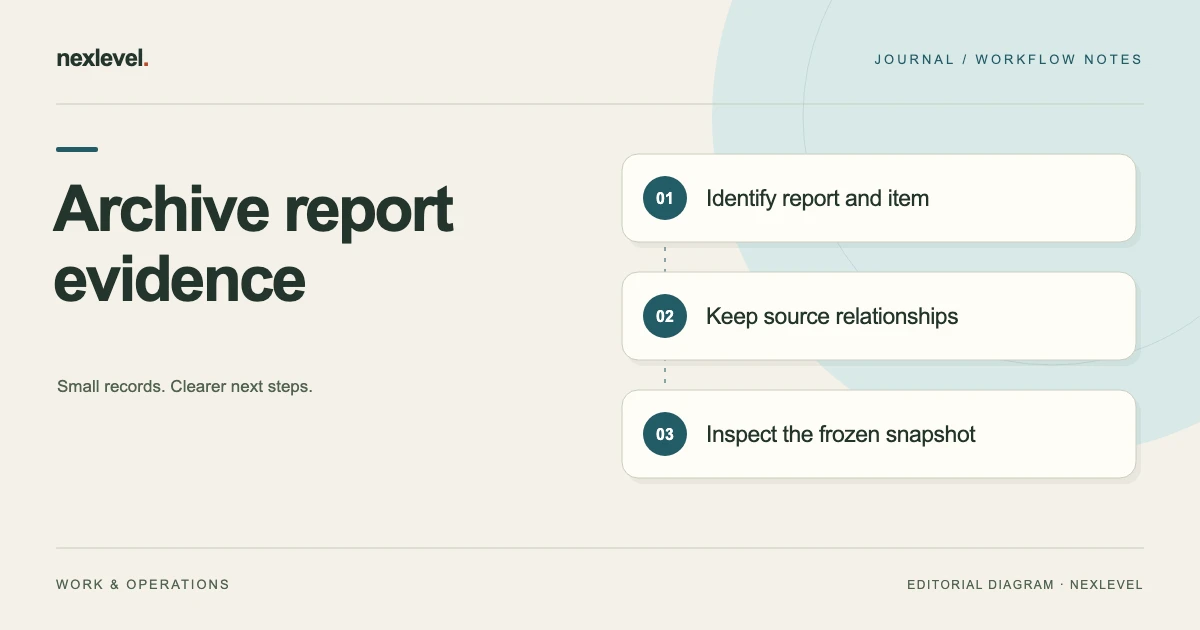
An inspection-evidence archive should explain the selected report, area/item context, entered observations, chosen evidence, acknowledgement, and frozen snapshot. A final-looking PDF cannot necessarily reconstruct which source relationships supported it.
Build a bounded packet around one selected report and source cutoff. Keep observations, proposed actions, readings, photos, administrative acknowledgement, and later revisions distinguishable rather than treating them as one certified conclusion.
This guide uses fictional administrative references. It supplies no inspection method, technical threshold, repair instruction, compliance determination, or safety verdict. Start with the inspection evidence log template for the underlying structure.
Choose the historical question
A later reader may need to identify one photo’s item relationship, locate an entered observation, or understand which frozen report version was shared. Those questions can need different sources.
Write the report/area scope, source cutoff, preparation occasion, intended reader, and actual output. A packet about one inspection record should not appear to represent every later site or report change.
Keep access proportional. A companion index can preserve authorized source routes without copying unrelated client, property, or account material into a broad shared folder.
Preserve report, area, and item identity
A room or checklist label can recur across reports. The archive needs enough actual identifying context to distinguish the selected item and its evidence.
Inspecova’s current description includes entered checklist work, selected photos, readings, severities, recommendations, explicit critical-finding acknowledgement, frozen report snapshots, PDF/CSV output, and traceability details.
A familiar filename should not be the sole basis for assigning a photo. If the source relationship remains uncertain, preserve the precise question.
Use a report-and-source archive index
One row can identify each selected source role. Keep report identity, observation, evidence, acknowledgement, snapshot, output, and limitation separate where their sources differ.
| Field | What to preserve |
|---|---|
| Report and item | The selected area/item context |
| Observation | The actual entered fact/source role |
| Evidence | The selected photo or reading relationship |
| Acknowledgement | The actual administrative event |
| Snapshot | The selected frozen report representation |
| Output | The retained copy, cutoff, and limitation |
These are independent companion prompts, not a dedicated archive module or a promise that every explanatory line appears automatically in the PDF.
Work through a fictional evidence packet
Imagine report R22, area A4, checklist item I3, observation N2, selected photo P5, acknowledgement K6, and frozen snapshot V7.
Retained packet C8 represents the selected cutoff. A later source clarification belongs to its own occasion and should not silently replace what C8 originally represented.
The first rows identify R22/A4/I3/N2. Separate rows preserve P5/K6/V7. A limitation row asks which source establishes P5’s actual item relationship.
No real site, observation, reading, hazard, repair, acknowledgement, or professional conclusion is supplied. The references demonstrate administrative relationships without creating genuine inspection history.
Separate entered observations from proposed actions
An observation note and recommendation can have related but different source roles. The archive should preserve what N2 actually records rather than make a proposed action appear completed.
Use the observation-versus-repair guide for that narrower task. Preserve its actual result or precise limitation.
A polished report should not broaden an entered note into a physical diagnosis or repair outcome. Keep the selected source and scope readable.
Keep photos and readings tied to their context
A selected photo needs its actual report, area, item, and source occasion. An entered reading needs its unit/context meaning. A nearby row should not be the only explanation.
Check actual Pro access for selected evidence photos, readings, recommendations, and advanced outputs. The app records chosen evidence rather than detecting or measuring physical conditions independently.
For a larger packet, use the multi-room evidence index. Preserve actual source routes rather than assigning plausible item references.
Preserve acknowledgement without calling it repair
K6 represents a selected administrative acknowledgement. It should not silently become proof that a hazard was removed or a repair was performed.
The current app describes explicit acknowledgement before completion for critical work. That workflow boundary organizes documentation without guaranteeing safety or professional sufficiency.
If the actual event relationship remains unclear, retain the precise question. Do not invent an acknowledgement to make a historical report look complete.
Keep unavailable evidence and scope limits visible
A selected source may remain unavailable, or an area may be outside the documented scope. An archive should preserve that limitation instead of filling every field with plausible content.
Use the inaccessible-area documentation guide for that narrower task. This archive supplies no access procedure or physical inspection method.
A useful packet can identify a bounded next source question while leaving it unresolved. Fewer visible blanks are not by themselves stronger evidence.
Preserve snapshot identity and traceability details
Inspecova currently describes immutable completed-report snapshots, unique report numbers, page numbering, and SHA-256 traceability details. Keep the selected representation and source occasion identifiable.
Those details can support version recognition without independently certifying the contents or proving a physical condition. A later report may have another legitimate source cutoff.
For V7, identify what was actually retained. A filename called final should not replace the actual snapshot relationship.
Keep sentence cleanup in its narrow role
The current app describes advisory on-device cleanup of spacing, initial capitalization, and ending punctuation under inspector control. That feature should not be expanded into fact correction or diagnosis.
A formatting change, a new observation, and an evidence clarification have different roles. Preserve the actual source occasion if that distinction matters to the packet.
This guide supplies no professional wording or technical conclusion. It concerns traceability of entered documentation and selected representations.
Inspect the actual PDF or CSV
Inspecova currently advertises PDF and structured CSV output with plan-dependent access and watermarking. Check actual access and open the selected representation.
Inspect report identity, item context, observation/evidence roles, acknowledgement, snapshot, source cutoff, and limitations. A companion index may need to explain relationships not represented automatically.
The public description does not establish arbitrary spreadsheet import or universal full-workspace restoration. A portable report can support bounded retrieval without being the complete editable app.
Prepare a cover note for C8
The first line can identify R22/A4/I3, the selected cutoff, and the archive purpose. An observation line names N2 and its actual source role.
Separate evidence, acknowledgement, and snapshot lines identify P5/K6/V7. A limitation line names the exact photo/item relationship still open.
A contents line should name only what was retained. A report PDF, CSV, selected evidence representation, source reference, and companion index can serve different purposes.
Test retrieval from the photo and snapshot
Ask a reader to begin with P5 and locate its selected report/item context. Then begin with V7 and identify the actual snapshot occasion and acknowledgement role.
Introduce another fictional item I4 with a similar title. The reader should use actual references rather than assign P5 by the closest-looking label.
If a retained copy loses a relationship preserved in the working source, repair that copy. If the original source remains uncertain, retain the question rather than inventing inspection content.
Keep later clarification visibly later
A later source may clarify a photo or observation relationship. Retain its own occasion and connection to C8 rather than making the historical packet appear to have known it earlier.
A correction to a companion explanation is different from entering another observation, recording acknowledgement, or creating a new snapshot. Keeping those purposes distinguishable prevents archive repair from creating inspection history.
A concise receipt can name sources inspected, representation opened, relationships established, and next question. It documents an administrative review without a technical, compliance, or safety conclusion.
Separate retention from a method decision
For tool selection, use the inspection workspace comparison. Choosing a system and preparing one historical packet have different requirements.
Keep identity, source roles, and cutoff inside the packet as well as in filenames. A copied report should remain understandable when its original folder path is unavailable.
The fictional references remain teaching inputs. Reuse the source-index structure with actual authorized documentation while leaving physical inspection and professional conclusions with responsible people.
Complete the report-and-evidence cover sheet
The C8 cover note can keep report/item identity, observation, evidence, acknowledgement, snapshot, and output on separate lines. This is an independent explanatory worksheet rather than a promise that every line appears automatically in the PDF.
| Reference | Role in the packet | Question to test |
|---|---|---|
| R22, A4, and I3 | The selected report and item context | What distinguishes another similar area or item? |
| N2 | The entered observation | What is source context rather than a proposed action? |
| P5 | The selected photo relationship | What actual source establishes the match? |
| K6 | The administrative acknowledgement | Which event does the available source establish? |
| V7 and C8 | Snapshot and retained representation | Which cutoff and contents were inspected? |
Ask the reader to begin with P5 and locate its actual report/item relationship, then begin with V7 and identify the selected acknowledgement and source cutoff.
Compare two possible inspection archive packets
Imagine packet A contains only the final-looking PDF. Packet B contains the selected supported output and a companion source/snapshot index. Neither is automatically sufficient; compare each with the actual historical question.
If the task is to find a selected report page, packet A may supply a useful route once identity and cutoff are established. If the task is to explain P5 or K6, the additional source relationships in packet B matter.
Now suppose packet B labels K6 as proof of a repair even though the source establishes only acknowledgement. Its extra detail does not make it accurate. Repair the explanation rather than inventing a physical outcome.
A bounded continuation question can ask which authorized source establishes P5’s actual item relationship. This keeps the next review specific without reconstructing a whole site visit or assigning a plausible photo match.
Keep report identity, item context, source roles, snapshot, and cutoff inside the packet as well as in filenames. A copied PDF should remain understandable when its original folder path is unavailable.
If later evidence clarifies a relationship, identify its own occasion and connection to C8. Do not make the historical snapshot appear to have contained later information from the start.
The completion receipt can name sources inspected, representation opened, relationships established, and next question. It records a bounded administrative result without certifying technical correctness, compliance, or safety.
The fictional references remain teaching inputs. Reuse the source-role structure with actual authorized documentation while preserving physical-inspection and professional-conclusion boundaries.
For a final practical check, give the reader only C8 and the companion index. Ask them to identify the report, area/item, observation, selected photo, acknowledgement, snapshot, and actual cutoff. Then ask which source establishes P5’s most specific missing relationship. The answer should remain a bounded documentation question rather than an inferred physical finding or repair result. Record any manual explanation needed and whether the intended reader can use the actual evidence route.
If a later report version is present, preserve its own source occasion and selected purpose. A historical snapshot and a newer working record can differ without one automatically being wrong. Keep original-source uncertainty visible instead of treating a matching report number or traceability detail as certification. A useful packet can identify the next source review while leaving professional conclusions outside its scope. It should not claim a site is safe or compliant merely because the retained output is polished.
Keep traceability identifiers beside the actual selected representation. A report number or digest can help identify a copy without independently establishing its contents. The source index should still explain which item and evidence relationship the reader needs.
Use Inspecova for traceable entered report history
Inspecova connects entered checklist work, selected evidence, acknowledgement context, frozen snapshots, and supported outputs in a local documentation workspace.
Check the official Inspecova App Store listing for current capabilities and Pro access. Preserve the documentation trail without treating it as independent measurement, certification, or safety assurance.