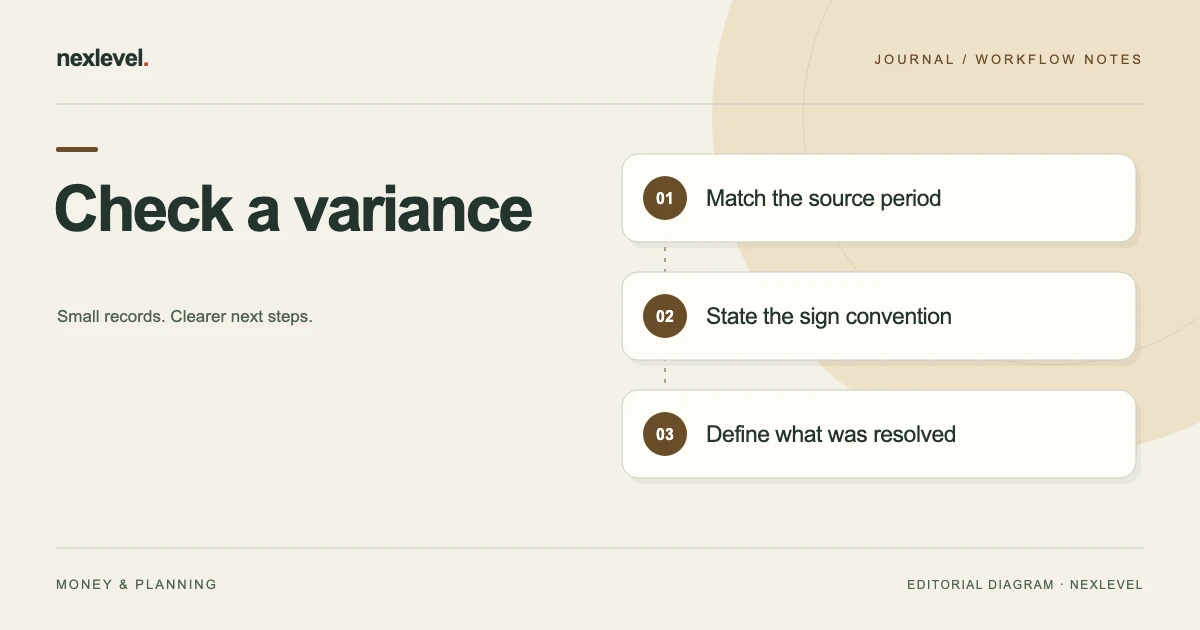
Before marking a commission variance resolved, check that the forecast and statement concern the same deal, period and amount basis. Then identify the source that answers the specific issue. Correct arithmetic and an administrative resolution do not establish a payment event.
Verify what the resolution actually answers
- Match deal, plan version, scenario, statement period and currency.
- Review which forecast inputs are source-backed and which are assumptions.
- Reproduce the difference using the actual labeled sign convention.
- Name the evidence and exact question it resolves; keep other questions open.
Working fields:
Deal/plan/scenario | Statement/period | Currency/basis | Difference direction | Evidence | Issue resolved | Remaining question | Copy checked
Useful next steps: Review input provenance, Separate forecast, statement and payment records, Hand off an unresolved comparison.
Choose the selected comparison question
Write the deal/plan scope, forecast source, statement source, period/currency basis, source cutoff, and exact issue being reviewed. A check for one comparison should not appear to verify an entire employer plan.
Useful questions include whether the selected statement belongs to the same deal/period, what the displayed sign means, or which source actually resolves the issue.
Use fictional records during the exercise. There is no need to contact an employer or disclose private compensation information merely to test the worksheet.
Separate forecast, statement, and payment
An entered expected amount, recorded statement amount, and evidence of payment can have different source roles. A correct subtraction should not make them interchangeable.
PayoutVerity’s current description includes entered plans/deals, calculation trails, scenarios, statement comparison, supporting evidence, issue-resolution records, and plan-dependent exports.
The app applies user-entered rules and values. Employer plan documents/statements govern actual payment; the app is not payroll, legal, tax, or compensation-plan advice.
Set up a fictional variance packet
Imagine deal alias D83, plan version V2, selected forecast F3, statement source S4, evidence reference E5, and issue note N6.
The invented forecast is seventy-five units and selected statement amount seventy units in one invented currency. For this independent worksheet only, variance means statement minus forecast: seventy minus seventy-five equals negative five.
Retained copy R8 represents the selected cutoff. No real plan, deal, payment, employer error, or entitlement is supplied. The convention is not a claim about every native display label.
Use a variance-source check table
| Selected source | Relationship to establish | Result to retain |
|---|---|---|
| D83/V2 | The selected deal and plan context | Actual reference or precise question |
| F3 | The forecast/scenario source | Entered scope and assumptions |
| S4 | The selected statement/period relationship | Actual amount/source occasion |
| Sign convention | What the displayed difference means | Explicit direction and unit basis |
| E5/N6 | Evidence and issue-resolution context | What is actually established? |
| R8 | The retained representation | Contents and cutoff inspected |
These are independent review prompts, not a native employer-verification process or legal-resolution mechanism.
Match deal and period before interpreting a difference
A similar alias or nearby statement row may concern another source occasion. Establish the actual D83/F3/S4 relationship before treating the numbers as a valid comparison.
Keep currency and selected scope beside the amounts. A difference between unlike periods or unlabeled currencies can be numerically tidy while answering the wrong question.
If the source relationship remains uncertain, retain the precise question rather than choose a matching amount to make the comparison appear complete.
Preserve the selected plan/scenario context
V2 and F3 need their actual source basis. A current plan version or different scenario should not silently replace the one used for the selected historical question.
Use the plan-input change review for that narrower task. Preserve its actual result or limitation.
A later plan can be useful current information without making an older closed-deal record wrong as history.
Check source-confirmed and assumed inputs separately
A forecast can depend on explicit source values and scenario assumptions. Their different roles should remain visible before someone treats a variance as externally confirmed.
Use the input-provenance dictionary guide for that narrower review. Its labels are independent conventions, not automatic employer verification.
A missing rule should not be replaced by a plausible number merely to obtain a result. Preserve the actual source dependency.
State the sign convention explicitly
The fictional worksheet uses statement minus forecast, giving negative five. A reverse convention would display the opposite sign, so the actual output’s labels must be inspected.
This article does not assert an undocumented native formula. Preserve the actual selected meaning when copying a difference into another representation.
Correct subtraction does not explain the cause. A sign alone should not become a claim that a real employer owes or overpaid money.
Keep evidence and resolved state within scope
E5 may support one selected explanation without proving every external outcome. N6 should say what source relationship was actually resolved.
The current app supports marking issues resolved. That administrative state should not independently establish a bank transaction, employer acceptance, or legal conclusion.
Use the forecast-versus-payment guide for that narrower evidence boundary.
Classify the finding before correcting records
Distinguish a wrong copied amount, mismatched deal/period, different plan/scenario source, reversed sign explanation, and unresolved evidence question.
If the working source is accurate but R8 overstates it, repair the explanation. Do not change correct historical inputs to match a confident summary.
A documentation correction is different from a new statement, plan change, issue event, or payment. Keep those purposes distinguishable.
Inspect the selected PDF or CSV evidence pack
PayoutVerity Pro currently advertises focused PDF/CSV evidence exports. Check actual access and open the representation relevant to the review.
Inspect deal/plan identity, selected scenario, input scope, statement source/period, currency, sign convention, evidence role, and cutoff. A companion note may be needed where the output omits an independent relationship.
The public description does not establish arbitrary spreadsheet import or universal full-system restoration. A portable pack is not automatically the complete editable app or employer record.
Run a reverse comparison test
Begin with the fictional negative-five result and ask a reader to reconstruct F3/S4 and the convention. Then begin with E5 and identify the actual issue relationship it supports.
Introduce another deal with a similar alias. The reader should use established references rather than assign S4 by the nearest label.
If one route fails, identify the missing source relationship precisely. More files are useful only when they supply the context the bounded question needs.
Write a bounded variance-check receipt
Name the selected deal/plan/scenario, sources inspected, period/currency basis, actual sign meaning, evidence relationship established, copy correction if any, and precise remaining question.
A later clarification should retain its own occasion and connection to R8. It should not make a historical forecast appear to have known later statement information.
The receipt documents an administrative comparison without a compensation entitlement, employer-error, or payment conclusion.
Connect the result to handoff and retention
For another reviewer taking over, use the variance-evidence handoff guide. A worksheet does not grant employer-source access or compensation authority.
For a historical packet, use the forecast archive guide. For method selection, use the forecast-system comparison.
The fictional figures remain teaching inputs. Reuse the source-check structure with actual authorized material while preserving management-model and external-payment boundaries.
Keep a concrete comparison-scope record
The fictional worksheet can retain the selected forecast, statement source, period/currency basis, sign convention, and resolution question on separate lines. It is not a native employer-verification or payroll record.
| Companion field | Fictional selected entry | Review question |
|---|---|---|
| Deal/plan | D83/V2 | Which actual source context is in scope? |
| Forecast | F3, seventy-five units | Which scenario and assumptions produced it? |
| Statement | S4, seventy units | Does it belong to the selected deal/period? |
| Independent difference convention | Statement minus forecast equals negative five | What does the actual display label mean? |
| Evidence/resolution | E5/N6 | What relationship is established rather than assumed? |
| Cutoff | R8’s selected occasion | What later information remains separate? |
The values use one invented currency. No actual entitlement, employer error, bank transfer, or recommended action is established by the example.
Work through a valid comparison branch
In one fictional branch, authorized sources establish that F3 and S4 belong to the selected D83 period and V2 context. The reader can reproduce the independent negative-five difference while still leaving its cause unresolved.
In another branch, S4’s seventy units concern another period. The same subtraction would be numerically correct while comparing the wrong scope. Identify that mismatch before describing a variance issue as resolved.
A third branch has the right sources but a copied sign explanation reversed. Repair the explanation using the actual selected convention. Do not change a correct statement amount to zero the difference.
A fourth branch has E5 resolving one source-identity question without establishing payment. N6 should say what was actually resolved, not upgrade the result to paid or legally settled.
Prepare an issue-review receipt
Give another authorized reader only the fictional packet and receipt. Ask them to identify deal/plan/scenario scope, selected statement period, currency, difference direction, evidence role, and precise remaining question.
They should distinguish arithmetic from cause and administrative resolution from an external payment outcome. A signed-looking document or similar alias should not supply a missing relationship by implication.
Record sources inspected, scope established, actual convention used, copy correction if any, evidence relationship resolved, and next question. A clarification not received should remain unclaimed.
Keep those roles inside the receipt as well as in filenames. A copied evidence pack can lose its original source path.
A useful result can be a bounded correction or an explicit open issue. It does not need a claim about compensation owed, money recovered, or an employer’s mistake to make the next administrative review clear.
The fictional figures remain teaching inputs. Reuse the comparison-scope record with actual authorized sources while preserving source-interpretation, management-model, and external-payment boundaries.
Write a concrete resolution-scope note
In one fictional branch, the selected sources establish D83/V2, the forecast scenario F3, and S4’s matching statement period. The independent statement-minus-forecast convention gives negative five from seventy minus seventy-five. The source relationship and subtraction are established, while the cause can remain open.
In another branch, S4 belongs to another period. The same subtraction would be mathematically correct while answering the wrong comparison question. The useful result is to correct the selected scope or retain the missing source relationship, not to call the employer wrong.
A third branch has an accurate statement amount but a reversed copied sign explanation. Repair that explanation using the actual selected convention. Changing seventy to seventy-five merely to eliminate the difference would create another unsupported record.
If E5 resolves a source-identity issue, N6 can name that specific administrative result. It should not silently become paid, accepted, or legally settled. Evidence of money movement remains a separate source role when relevant to the actual question.
For a final check, give another authorized reader only R8 and the resolution-scope note. Ask them to identify deal/plan/scenario, statement period, currency, difference direction, evidence role, actual issue resolved, and precise remaining question.
Record any manual explanation needed and whether the source routes are usable. A useful result can be a bounded correction or an explicit open issue. It does not need a compensation entitlement, employer-error claim, or payment conclusion to make the next administrative review specific.
Keep those limits inside the note as well as in filenames. A copied pack can lose its original directory context, and a future reader should not have to infer what resolved meant from a generic status alone.
Preserve the comparison convention beside the displayed difference. A future reader using forecast minus statement would obtain the opposite sign from the same inputs. Explicit labels let that reader reproduce the selected calculation without mistaking the direction for another source amount.
Use PayoutVerity for traceable entered comparison context
PayoutVerity connects entered plan versions, scenarios, calculation trails, statement comparisons, evidence, and issue records without requiring an account.
Check the official PayoutVerity App Store listing for current capabilities and Pro access. Keep arithmetic, source matching, administrative resolution, and actual payment evidence in their appropriate roles.