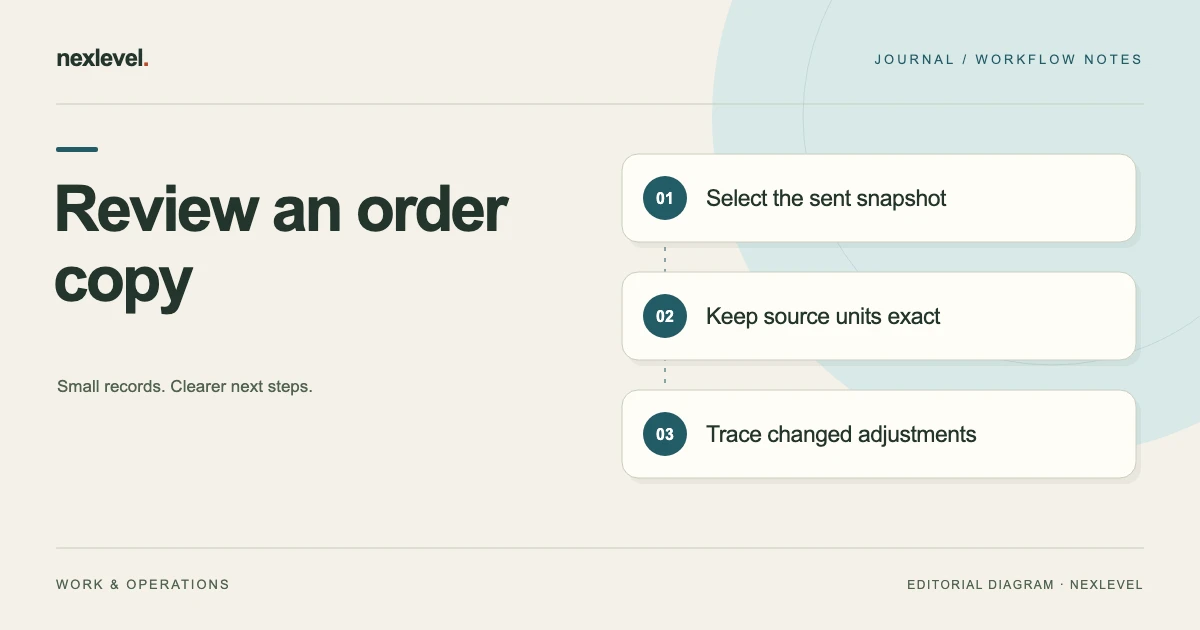
Check another copy of a purchase order against the preserved sent snapshot for the selected order and occasion. Compare vendor details, line units, adjustments and totals; a familiar order number or a different page layout alone cannot tell you whether the content represents the same document.
Compare the selected facts in both copies
- Identify the historical sent snapshot and the candidate copy’s source occasion.
- Compare vendor details, item descriptions, quantities and units before checking amounts.
- Reproduce differences in shipping or other adjustments while leaving an unconfirmed cause open.
- Record which facts match or differ, the copy inspected and any correction source; keep later revisions distinct.
Working fields:
PO/sent occasion | Snapshot | Candidate copy/source | Vendor/line/unit differences | Adjustments/totals | Layout-only difference | Result/next question
Useful next steps: Retain the snapshot and receipt context, Review a new draft before sending.
Define what “another copy” means for this task
Write a bounded purpose: “Check whether candidate C6 represents the selected sent snapshot S2 for order O48.” That is different from preparing a revised order, updating a vendor, or creating a new purchasing instruction.
Identify the intended reader, representation being inspected, cutoff, and next question. A person reviewing an old delivery may need the historical document; a person preparing a new purchase may need current sources.
Do not let those purposes blend. A familiar order number does not establish that every later file with that number contains the same selected commercial details.
Use the app’s preserved sent context
Vendraft advertises an actual Letter or A4 PDF preview. Marking a draft Sent preserves the order number, totals, vendor details, and document snapshot.
Keep that historical role separate from current reusable vendor or item records. A later contact detail change should not automatically be described as part of the old snapshot.
Sent also does not establish external delivery or supplier acceptance. If those facts matter, identify their actual supplied sources rather than infer them from a document label.
Create a controlled fictional comparison
For this exercise, O48 identifies the order, S2 the selected sent snapshot, V3 its vendor-detail context, and L4 one line. C6 identifies a candidate companion copy. N7 is the independent comparison note.
The hypothetical line contains three individual units at four currency units each. Shipping is one in the same currency. The teaching model excludes all tax, discounts, fees, and other adjustments.
No actual order, supplier, item, price, commercial term, or document is supplied. These labels demonstrate roles rather than native field names or an import schema.
Check identity before comparing amounts
Confirm which order and sent occasion S2 represents, then identify what source establishes C6’s relationship to it. A matching title is a clue for inspection, not proof of equivalence.
If C6 belongs to another order or a later draft, record that difference before comparing totals. Perfect arithmetic against the wrong occasion does not answer the selected copy question.
If its relationship is unprovided, retain the precise question. Do not choose the most familiar snapshot merely to complete the worksheet.
Compare vendor details at the right occasion
Read the vendor context preserved with S2 and the actual details displayed in C6. Distinguish a changed current address or contact from a mistake in the historical copy.
If C6 uses later reusable data, it may be unsuitable as a copy of the earlier sent document even if the vendor name looks familiar. That observation does not establish which address is currently valid or which document governs a transaction.
The next task can be to identify the correct representation for the intended reader. Do not amend historical source material simply to make a later copy appear consistent.
Keep item identity and stored units exact
Compare selected item references, descriptions, quantities, and units rather than only line amounts. Three individual units and three packs represent different bases unless the relevant source establishes their relationship.
A reusable catalog label can change while a sent snapshot preserves the earlier document context. Keep those roles explicit when a person asks why two copies look different.
For the earlier source-preparation stage, use the reusable reference and order-fact guide. This comparison begins after the selected sent snapshot exists.
Reproduce the limited teaching arithmetic
Under the fictional assumptions, three multiplied by four gives a line amount of twelve. Twelve plus one shipping gives a limited order total of thirteen.
Those calculations establish the independent model only. They do not describe a native tax formula, actual supplier charge, invoice, payment, or acceptance.
Preserve the exclusions beside the values. A total of thirteen is not evidence that omitted real-world charges are zero, and it is not a recommendation for pricing an actual purchase.
Review a changed-shipping branch
Suppose C6 instead displays shipping of two and a total of fourteen under the same limited line assumptions. The independent arithmetic is twelve plus two equals fourteen, a difference of one from the model for S2.
The worksheet can identify a changed adjustment input. It cannot establish whether C6 is a revised draft, a copying error, or another occasion without the relevant source relationship.
Do not call the difference a native rendering defect or supplier overcharge. The exercise supplies neither an observed application error nor an actual transaction.
Use a copy-ready snapshot comparison worksheet
A practical worksheet asks for selected order, sent-snapshot occasion, candidate-copy source, intended reader, vendor-detail relationship, item/quantity/unit comparison, adjustment roles, totals, observed differences, and missing associations.
Add representation inspected, correction source, cutoff, next task, and actual sharing stage. Keep acceptance, receipt, invoice, and payment material under their own roles if supplied.
These prompts are an independent administrative structure. They do not assert a native checksum feature, automated document comparison, correction control, or import format.
Distinguish layout differences from meaning changes
Letter and A4 output can have different page layout while still requiring review of the same selected commercial facts. A different page count or line break does not by itself establish a changed order.
Likewise, identical-looking covers do not establish identical line units, vendor details, or adjustments. Read the relevant content rather than rely on appearance.
This guide does not prescribe a byte-hash test or claim a native semantic comparison algorithm. The reader’s question is whether the candidate represents the selected snapshot for the intended task.
Correct a companion explanation at its actual level
If S2 and C6 match but N7 incorrectly calls C6 a new order, correct the note. That explanation change does not issue another purchase order.
If C6 contains a mistaken copied value while S2 remains accurate, retain what source supports the correction and which representation changed. Do not alter the preserved source to make the incorrect copy look right.
If a true later revision is supplied, identify its own occasion and relationship. Keep it separate from a request for a historical copy rather than silently substituting one task for the other.
Keep receipt history outside a copy-equivalence conclusion
A candidate copy matching S2 does not establish that goods arrived. A later receipt entry does not retroactively change what the sent document contained.
If the next reader needs receiving context, identify selected receipt sources and exact units separately. For that task, use the partial-receipt handoff guide.
Vendraft advertises entered order states and a boundary preventing receipt quantities from exceeding ordered quantities. Keep those native capabilities separate from what this independent document comparison establishes.
Choose the supported representation deliberately
The listing advertises purchase-order PDFs and Pro features including JSON backup and formula-safe CSV. Inspect the actual selected output rather than assume every format reproduces every historical relationship.
A readable CSV may help compare selected values while needing companion document context. A PDF may preserve a selected document representation without being evidence of delivery or acceptance.
Do not describe a backup as arbitrary import or guaranteed complete restoration without supporting documentation. This exercise imports nothing, restores nothing, and deletes no records.
Keep local review separate from communication
Vendraft is advertised as local and does not require an account. Inspecting a locally supported document should not introduce a new mandatory website or supplier login.
Preparing a copy is separate from sharing it. If an actual document is later sent, identify the intended recipient and communication stage from relevant evidence.
A person comparing one selected snapshot may not need unrelated vendor records or the entire order archive. Supply only authorized material needed for the task.
State access without changing the evidence requirement
The advertised free allowance is three purchase orders per calendar month with watermarked PDFs. Pro expands order volume, unwatermarked output, custom numbering, JSON backup, and formula-safe CSV.
The annual plan advertises an eligible seven-day trial. Do not infer a monthly introductory offer or a localized price from that statement.
A purchase cannot establish that two documents match, that a supplier accepted an order, or that an adjustment is commercially valid. Entitlement and source review remain different questions.
Run a snapshot-reading test
Give an authorized reviewer the fictional references without their original folder context. Ask which order and sent occasion are selected, what C6 represents, and which exact item/unit and adjustment facts were compared.
Then show the changed-shipping branch. The reviewer should identify the one-unit modeled difference while leaving its cause unresolved until the actual source relationship is supplied.
Finally, introduce a different page layout with unchanged selected facts. The reviewer should distinguish appearance from the commercial content inspected.
Write a bounded comparison result
A compact fictional note can state: “O48/S2 is selected. Its independent three-by-four line and one-unit shipping model totals thirteen. C6 displays two-unit shipping and fourteen. A changed adjustment is visible; the packet does not establish whether C6 is a new draft, a copied mistake, or another occasion.”
Add an actual correction only from its relevant source. Keep the historical snapshot intact while clarifying what the next reader should inspect.
For retention, use the order snapshot archive guide. Preserve the distinction between a selected document and its later copies.
Record three different comparison outcomes
If the selected identity, occasion, line basis, adjustments, and vendor context match, record exactly that inspection scope. “Matches the selected facts reviewed” is more precise than “identical in every possible respect.” The comparison has not inspected external acceptance, payment, or every source in the workspace.
If the relationship is established and a selected fact differs, identify the affected fact and supporting source. For the shipping branch, that means recording one versus two as the input difference before interpreting thirteen versus fourteen as its modeled result. An arithmetic explanation does not establish why the input changed.
If the candidate’s source occasion is unprovided, retain that relationship as unknown. A reviewer should not have to infer whether an apparent difference reflects a new order, an old draft, or a copied error.
Keep the result useful when another copy arrives
Give a later candidate its own reference before comparing it. Do not silently replace C6 in N7 and leave the old conclusion attached to new material. A previous comparison can remain accurate history of the representations actually inspected.
The next reviewer should be able to identify the selected snapshot, candidate copy, comparison scope, differences, unresolved source questions, and correction occasion without reconstructing the original conversation.
A short administrative receipt can accomplish that without sharing unrelated orders or asserting a native audit schema. Its value is a reproducible explanation of the selected document relationship, not a claim that a purchasing transaction was validated.
Use Vendraft for clear order-document context
Record the inspected copy and cutoff beside the conclusion, so a later reader knows exactly which representation was reviewed.
Vendraft connects reusable references, draft previews, preserved sent documents, entered order states, receipts, and supported output in a local workspace.
Check the official Vendraft App Store listing for current capabilities and access. Keep document copies, source occasions, actual order changes, and external outcomes distinguishable.