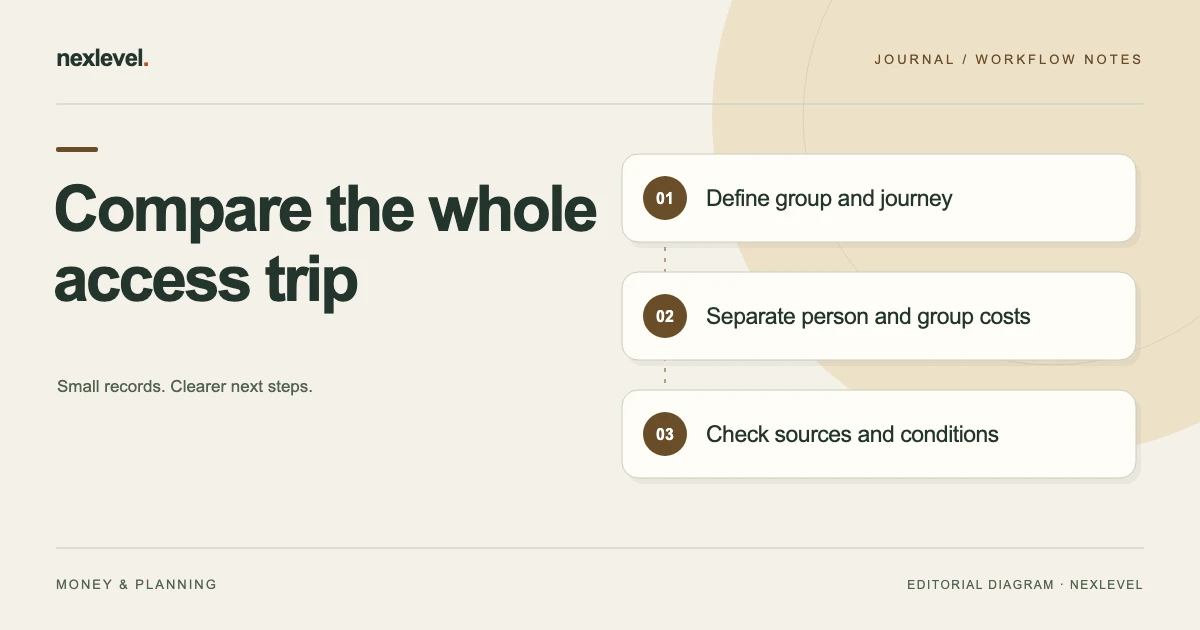
Compare parking, rail and transfers for the same travelers, dates and door-to-door boundary. Check whether each source is per person, vehicle, billed parking unit or direction; a low one-way fare cannot be compared directly with a complete return parking stay.
Put every access option on the same group and journey basis
- Define the group, luggage context, origin, terminal and outbound/return scope.
- Record each provider source, coverage, quantity basis and capture time.
- Add the relevant connecting costs once and leave missing segments explicitly unresolved.
- Compare cash totals and door-to-door time, then recheck suitability and quotes before selection.
Working fields:
Option | Group/directions | Source/time | Billed unit | Included connections | Estimate/unknown | Cash total | Duration
Useful next steps: Include airport access in the whole-trip budget, Check shared charges and included items, Hand off mixed travel cost scopes clearly.
Define the common journey
Record the origin, airport or terminal context, outbound and return events, number of travelers, relevant luggage assumptions, and comparison date. Keep the destination and journey boundary consistent across every option.
Include the return journey when the decision concerns a round trip. A one-way rail fare and a full parking stay are different quantities. State what each source covers before comparing the headline amounts.
Keep costs common to every option separate if you deliberately exclude them. For example, this worksheet compares airport access and excludes the same underlying flight from all three paths. The omission is part of the boundary, not a claim that the flight costs nothing.
Record the source and unit for each price
For every entered amount, identify the provider source, time checked, currency, applicable dates, quantity basis, and relevant conditions. A price can be per traveler, vehicle, booking, day, or direction.
Distinguish quoted values from your own planning estimates. If a fee is unknown, keep it unresolved instead of quietly treating it as zero. A ranking based on missing inputs should remain provisional.
Retain the actual source or a useful reference. A screenshot without its dates or group size can be difficult to use later, particularly if the provider offers different prices for different conditions.
Build the parking path from its stated basis
Record the quoted parking period, billed-unit description, vehicle count, and any separately entered access costs. Do not assume every provider counts a parking day or partial day in the same way.
Add relevant journey costs that your chosen comparison includes, such as an entered road charge or fuel allowance. Label an internal estimate as an estimate rather than presenting it as a provider quote.
Check the actual terminal connection and timing assumptions. A quoted parking amount does not establish how long the entire door-to-door route takes or whether another transfer is included.
Build the rail path for the whole group
Identify whether the fare is one-way or return, which traveler categories it covers, and whether all relevant route segments are included. Use the actual source conditions rather than multiplying a generic fare by the group size automatically.
Record travel to the station and any separate airport connection where they belong in your boundary. A cheap rail ticket can still be one component of a longer access journey.
Keep availability and timing questions visible. This worksheet does not establish that a service operates at the needed time or reaches the required terminal. Verify those details with the actual provider before acting.
Build the transfer path by vehicle and direction
Record the quoted vehicle or group coverage, direction, dates, and included pickup or drop-off scope. Confirm whether the group and relevant luggage fit the quoted arrangement through the provider’s own information.
If the return leg requires a separate quote, record it separately. Do not double a one-way price and describe the result as a confirmed return offer unless the provider establishes that relationship.
Keep any additional waiting, access, or other charges as quoted conditions or open questions. Do not invent a universal transfer policy to make every row look complete.
Work through a fictional four-traveler comparison
Imagine four travelers comparing a round trip. The parking example uses six billed units at 12, plus entered road charges of 8 and a fuel estimate of 20. Its illustrated cash total is 100: 72 + 8 + 20.
The rail example uses a return fare of 18 per traveler, or 72 for four, plus a separately entered whole-group station transfer of 12. Its total is 84. The transfer example uses two separately assumed 45 group legs, totaling 90.
These invented values rank rail lowest by the stated cash inputs, then transfer, then parking. They are not live prices or available offers. The ranking remains conditional on the source details and exclusions recorded in the example.
Keep group costs and per-person costs distinct
A whole-group charge should be entered once for the relevant group, not multiplied again as if each person pays the full amount. A per-traveler fare needs the appropriate traveler count under the actual quote.
For the fictional parking total, 100 divided by four is 25 per traveler if the group chooses an equal comparison view. Rail is 21 each and transfer is 22.50 each under the same invented equal division.
Those per-person figures are comparison outputs, not a determination of who must reimburse whom. Keep any real group’s payment arrangement separate and record it through the method the group chooses.
Use a complete access-cost worksheet
Useful fields include option, source, checked time, currency, traveler count, vehicle count where relevant, directions covered, billed units, quoted amount, additional costs, included items, estimates, unknowns, total cash view, and duration assumptions.
Add a decision field and a list of conditions to verify before booking. Keep the selected option distinguishable from a purchased ticket or confirmed reservation.
Retain original units alongside calculated totals. A summary of 84 is difficult to audit if the record no longer explains that it includes four return fares plus one whole-group station transfer.
Record door-to-door time on the same boundary
Use the same journey scope for timing. Include the relevant origin-to-terminal and return movements under your chosen comparison, with source or assumption labels. Do not compare a train’s in-vehicle time with a car’s full access journey.
In a fictional timing view, parking totals 120 minutes across both directions, rail 190, and transfer 140. These are entered examples, not timetable claims or guarantees about traffic.
Keep timing uncertainty visible rather than adding decorative precision. A duration estimate can help organize a choice without establishing that the group will arrive within that exact number of minutes.
Treat a time-value view as an optional model
If you choose to value travel time, state whether the entered value applies to the group or each traveler. Keep it separate from cash that will actually be paid. The chosen value reflects your planning preference, not a supplier charge.
For a manual fictional view using 8 currency units per group-hour, the entered time amounts are 16 for parking, approximately 25.33 for rail, and approximately 18.67 for transfer. Adding them to the cash examples gives 116, 109.33, and 108.67.
This model changes the ordering under its chosen assumptions. It does not establish an objectively best trip or claim the app uses this exact illustrative formula. Inspect the actual tool’s fields and displayed calculation.
Test changed conditions without rewriting the baseline
Create a separate variation when a relevant condition changes. A different return time, traveler count, or provider quote can alter more than one line. Preserve the original input set so the reason for the change remains understandable.
If the fictional parking arrangement adds one billed unit at 12, its illustrated cash view becomes 112 with the other inputs unchanged. That arithmetic is not a statement about a real provider’s late-return policy.
Likewise, an additional charge should be included only when its role is established or clearly labeled as an assumption. Avoid adding a guessed fee to one option while treating comparable unknowns in another as confirmed zero.
Check the route and quote before selecting
Verify current operating information, group coverage, terminal connection, timing, and the actual price conditions through the relevant sources. A valid arithmetic comparison cannot make an unavailable or unsuitable journey fit the group’s needs.
Keep suitability and convenience considerations explicit rather than disguising them as a monetary fact. The decision-maker can weigh them without claiming that a numerical ranking resolves every preference.
Record the source time and the unresolved conditions in the decision note. If a price changes, prepare a distinguishable updated view before relying on the earlier winner.
Keep selection separate from booking
Choosing a preferred option in a worksheet does not book a service, reserve parking, or purchase rail tickets. Record actual booking events and confirmations separately through the relevant provider process.
Connect the booking record to the comparison edition used if that helps explain the choice. Keep the quote and actual confirmation distinguishable, including any changed quantity or date.
After the trip, compare relevant actual costs with the selected boundary. Identify scope changes rather than describing every difference as a bad estimate. One trip does not establish universal provider prices or performance.
Recalculate when the group size changes
Separate fixed-group inputs from traveler-dependent inputs before changing the headcount. A vehicle price remains a valid group input only if the actual source confirms that the revised group and luggage are covered.
With two travelers in another fictional view, the same 18 return fare gives 36, plus the same assumed 12 station transfer, totaling 48. If the original parking and transfer quotes still apply, their cash totals remain 100 and 90. Equal per-person views would be 50, 24, and 45 respectively.
These calculations do not establish that a real quote remains valid for the changed group. Recheck its source conditions, then record a new comparison edition. Keep the earlier four-person calculation as a distinct view rather than leaving its per-traveler output attached to the new count.
Keep an unknown access segment explicit
An incomplete option can be useful while a source is being checked, but label the missing component. If the fictional rail fare is confirmed as 72 and the station-transfer amount is unresolved, the current view is 72 plus an unknown amount, not a complete 72 trip.
Record who will establish the missing price and what source is needed. Do not substitute zero merely to make the comparison tool display a ranked list. If you enter a planning estimate instead, mark it as estimated and preserve its basis.
When the source arrives, update the relevant view and inspect the total and ordering again. A ranking is only as complete as the entered boundary. The worksheet should show what was actually known at the decision cutoff.
Keep a compact option summary behind the decision
A fictional rail summary can read: “Four travelers; return access journey; 18 per traveler gives 72; one group station transfer entered as 12; cash view 84; round-trip duration estimated 190 minutes; provider timing and coverage checks retained separately.” Use readable units and source references in the actual record.
The summary helps another traveler inspect the plan without reconstructing every field. Keep the original quote or source location behind it, and identify whether the amounts are confirmed quotes or internal estimates.
If someone shares only the 84 total, ask for the quantity and inclusion context before treating it as comparable with another option. The same number could represent one direction, one traveler, or a different period. Clear labels preserve the decision’s meaning.
Use TripCost Guard for entered trip assumptions
TripCost Guard compares door-to-door trip costs from entered fares and extras, including per-traveler and whole-trip charges. Its current listing describes timing views, optional time value, and saved decision assumptions.
It does not scrape fares, sell tickets, or guarantee provider prices. Check current features and plan details in the official TripCost Guard App Store listing, and verify real sources before acting.