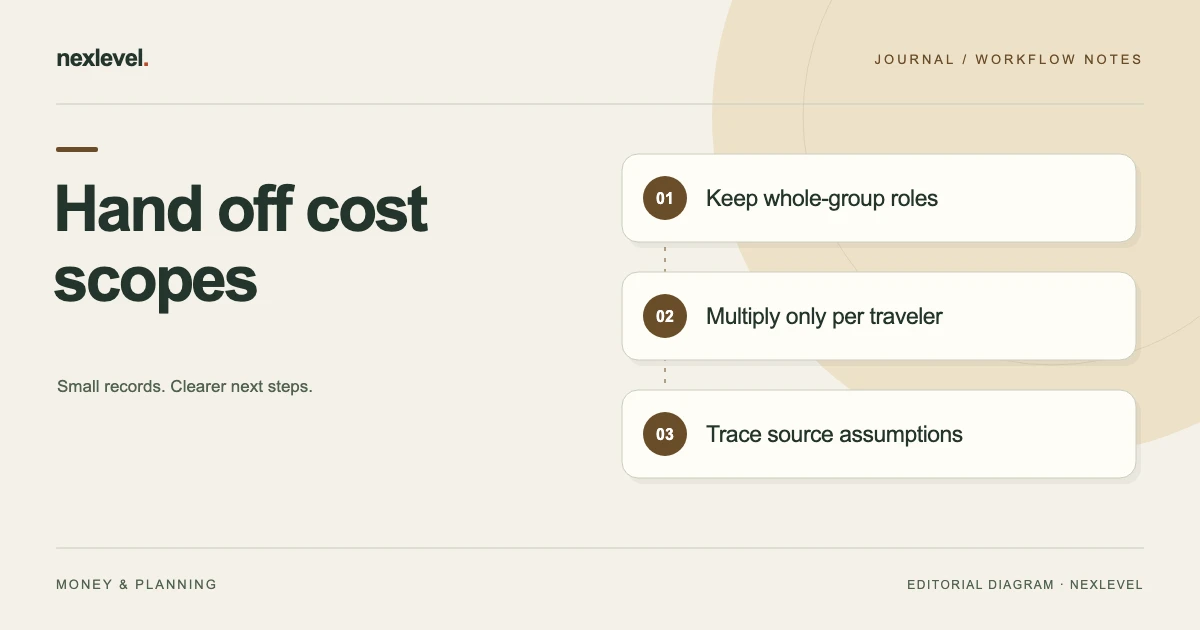
A trip-budget handoff needs the traveler count and charge basis beside each amount. Give the next reader the source for per-traveler and whole-group costs, the calculation and the model's exclusions so they can reproduce the total and identify any unresolved scope question.
Show why each cost is multiplied or added once
- Name the selected comparison, group, reader, source occasions and cutoff.
- Label every amount with currency and per-person, vehicle or whole-group basis.
- Show the group calculation and distinguish inclusion, estimate and missing-scope states.
- Inspect the actual handoff copy and ask the recipient to reproduce the total before acting on it.
Working fields:
Comparison/group | Cost/source occasion | Amount/currency | Charge basis | Included/estimated | Group amount | Next question | Delivery stage
Useful next steps: Build the budget from separate sources, Check included costs and shared charges, Review a later cost-source change.
Define the next reader’s task
Write a bounded purpose: “Explain the selected comparison’s per-traveler and whole-trip inputs to the next authorized reviewer.” Identify trip/group context, source occasions, selected model, cutoff, intended reader, and next question.
A handoff for checking cost scope is narrower than asking somebody to choose the cheapest real journey. A clear packet can preserve assumptions without making a booking recommendation.
Preparation is also separate from delivery. A file can be ready without having been shared, received, understood, or acted on.
Use the advertised cost distinctions
TripCost Guard advertises per-traveler and whole-trip charges, included items, estimated amounts, and multiple extra-cost categories. Keep each selected source role visible beside its number.
A matching currency label does not establish matching scope. Two amounts can use the same currency while one covers a person and another covers a vehicle or the entire group.
The listing describes entered assumptions, not automatic provider-price discovery. Do not invent an auto-fetch or source-validation feature.
Create a controlled fictional handoff
For this exercise, T48 identifies the trip model and G2 a group of two travelers. F3 is the selected comparison role, Q4 its source set, and H5 the independent handoff note.
The fictional inputs are 90 whole-group base fare, 6 per traveler for one extra, and 20 for a whole-group transfer. All amounts use one currency.
The model excludes every other charge, tax, fee, bag, seat, meal, lodging, insurance, time value, and adjustment. No actual provider, route, traveler, fare, or booking is supplied.
Keep the base fare’s group basis explicit
The teaching model’s 90 already covers the selected group. It is not a per-person amount to multiply by two.
If a real source uses a different basis, preserve that relationship before comparing results. A familiar option name or copied total does not establish how many travelers the price covers.
The handoff should identify the selected source occasion rather than assume a later quote has the same basis as an older comparison.
Show the per-traveler calculation
Under the explicit fictional assumptions, the selected extra contributes 2 multiplied by 6, or 12, for the group. Keep both the per-traveler input and derived group amount understandable.
The amount is independent teaching arithmetic, not a current price or an observed native result. It supplies no rule about bags, seats, meals, or another real provider category.
If group size changes later, identify the new source context before reusing the earlier calculation. Do not assume every other group amount remains unchanged.
Keep the whole-group transfer whole
The selected fictional transfer source covers the group for 20. It is not multiplied again merely because two people travel.
The limited total is therefore 90 plus 12 plus 20, or 122. On the same two-person teaching basis, that corresponds to 61 per traveler.
That derived figure is not a separate provider fare, payment allocation, or reimbursement obligation. It represents the same limited model scope.
Review a scope-misreading branch
Suppose a companion copy treats the 20 transfer as per traveler. Its independent group amount becomes 40, and its limited total becomes 90 plus 12 plus 40, or 142.
The difference from the selected model is 20. Dividing the alternative total by two gives 71 per traveler, ten above the selected derived figure.
The worksheet can identify the changed scope assumption. It cannot establish an app defect, provider overcharge, or actual transaction.
Use a copy-ready mixed-scope handoff worksheet
A practical companion worksheet asks for trip/group context, selected comparison/source occasions, each cost amount and currency, per-traveler or whole-trip basis, included/estimated role, and independent calculation basis.
Add exclusions, missing associations, representation inspected, cutoff, intended reader, next source task, and actual delivery stage.
These prompts are an administrative structure, not native required fields, an automatic quote checker, or an import-ready template.
Fill the source-clear branch
In the first fictional branch, Q4 clearly establishes the 90 and 20 group roles and the 6 per-traveler role for G2. H5 can preserve the limited calculation of 122.
The result remains conditional on those selected teaching assumptions. Excluded from this exercise does not mean zero or irrelevant in a real trip.
No comparison is created in the app, no file is shared, and no travel action occurs. The example supplies a readable administrative model only.
Fill a missing-scope branch separately
In another branch, the transfer source does not establish whether 20 covers one person or the group. The review cannot safely choose a multiplication merely to produce a complete total.
Retain the precise question: what actual material establishes the selected transfer scope for this group? That is different from a proven copied-scope mistake.
For initial setup, use the separate-cost source guide. A useful handoff can finish with the relationship unresolved.
Keep included and estimated items explicit
The app advertises included costs and estimates. A selected inclusion source should not silently become an added extra, and an estimate should not become confirmed merely because a report is polished.
Preserve the actual source basis behind each selected role. Do not infer an inclusion from a familiar fare or package name.
For the narrower issue, use the included-cost review guide. This example supplies no real provider condition.
Keep cost ranking separate from other criteria
TripCost Guard advertises lowest-total, fastest-journey, and least-hassle views, door-to-door duration, and optional value of travel time. Those roles answer different questions.
The fictional handoff supplies no duration, hassle input, or time-value assumption. A readable total does not establish a preferred real trip.
Do not invent ranking weights or tie-break rules. The independent example explains scopes rather than reconstructing a native decision algorithm.
Preserve currency and rate context when relevant
The listing advertises conversion using an exchange rate and source the user records. Rate direction, currency, and source occasion matter to interpreting a real model.
This example uses one currency and performs no conversion. It supplies no current financial rate or advice about exchange timing.
For that source task, use the currency-assumption guide. Do not combine mixed currencies without establishing the relevant basis.
Keep frozen decisions tied to their occasions
The app advertises freezing winning totals and assumptions in a decision record. A later source should not make an older decision appear to contain information that arrived afterward.
Identify what actual representation the handoff uses: selected saved decision, current draft, or portable copy. Matching titles do not establish unchanged inputs.
For later-source review, use the changed-cost decision guide. This handoff creates no saved decision or booking.
Choose the output for the real reader task
The listing advertises PDF/CSV export and Pro PDF decision sharing. Inspect the actual supported representation before stating what source and scope context the reader receives.
A compact report may need H5 to explain an unresolved scope question. A portable file is not evidence that the recipient received or adopted it.
Do not invent a universal export schema, arbitrary import, or guaranteed complete restoration. The exercise imports nothing, restores nothing, and deletes no data.
Preserve local planning and deliberate sharing
The app requires no account, and trip data stays on device unless explicitly shared. Locally supported review should not acquire a mandatory booking login or remote-content requirement.
The app does not scrape fares, sell tickets, or guarantee third-party prices. This exercise contacts no provider and makes no payment or reservation request.
Supply only authorized material needed for an actual selected task. A scope question may not require unrelated traveler records or an entire trip archive.
State current access accurately
The first trip and first two booking options advertise the complete comparison for free. Pro expands trips and options and includes reusable cost templates and PDF decision sharing.
Trip Pass is a non-renewing 30-day purchase. Monthly and annual subscriptions renew; the annual seven-day trial appears only when Apple reports eligibility.
Do not infer a monthly trial or invent a localized price. A purchase cannot establish an input scope or guarantee a charge.
Run a mixed-scope reading test
Give an authorized reviewer H5 and the fictional references without the original folder context. Ask which amounts are group costs, which is per traveler, and why the selected limited total is 122.
Then show the 142 companion branch and the missing-transfer-scope branch separately. The reader should distinguish a changed assumption from an unprovided relationship.
Record any explanation still needed. A useful result can identify the next source task without choosing a provider or claiming an actual expense.
Write a bounded handoff receipt
A compact fictional note can state: “T48/G2 uses 90 whole-group fare, 6 per traveler, and 20 group transfer. The limited model totals 122, or 61 per traveler. The 142 alternative changes transfer scope; it is not a new provider fact. Missing scope requires its own source.”
Keep exclusions and absent criteria beside the result. For retention, use the comparison archive guide.
The result is an understandable administrative handoff. It establishes no live availability, provider acceptance, payment, savings, or final charge.
Fill the mixed-scope receipt concretely
H5 can preserve the selected group size and each source basis before showing the total. The base and transfer belong to whole-group roles; the selected extra belongs to the per-traveler role.
Keep the independent group calculation beside those inputs rather than provide only a favorable-looking result. A reader should be able to explain why one amount is multiplied and another is not.
If the transfer basis is unprovided, retain that source question instead of treating the alternative multiplication as equally supported. A readable amount is not a complete scope relationship.
Keep source changes separate from a copied error
If a later actual quote establishes another transfer scope, give it its own occasion before preparing a revised comparison. The earlier model can remain accurate history of its selected assumptions.
If only a companion copy doubled a whole-group amount, correct that explanation against the selected source. Do not invent a provider price change to make the copy appear true.
A source update and a calculation based on the wrong unit are different administrative outcomes. The handoff should say which one the supplied material actually establishes.
Keep the next reader’s conclusion bounded
Checking the transfer scope does not validate every other trip cost or establish the best real journey. Record which relationships were inspected and which criteria remain outside the packet.
If another group size or currency enters the task, identify the new source basis before reusing an older total. The teaching model holds those relationships fixed explicitly rather than implying they stay unchanged in real offers.
A clear handoff can identify one exact next question without choosing a provider, confirming availability, assigning payment shares, or making a reservation. That is useful preparation while actual travel and financial outcomes remain separate.
Use TripCost Guard for clear cost-scope handoffs
Retain the selected group and inspected comparison reference beside the handoff result so later readers know exactly which source basis was reviewed.
TripCost Guard connects entered fares, cost scopes, included/estimated items, travel-time context, recorded exchange assumptions, and frozen decisions.
Check the official TripCost Guard App Store listing for current capabilities and access. Keep source scopes, comparison models, shared copies, and actual transactions distinguishable.