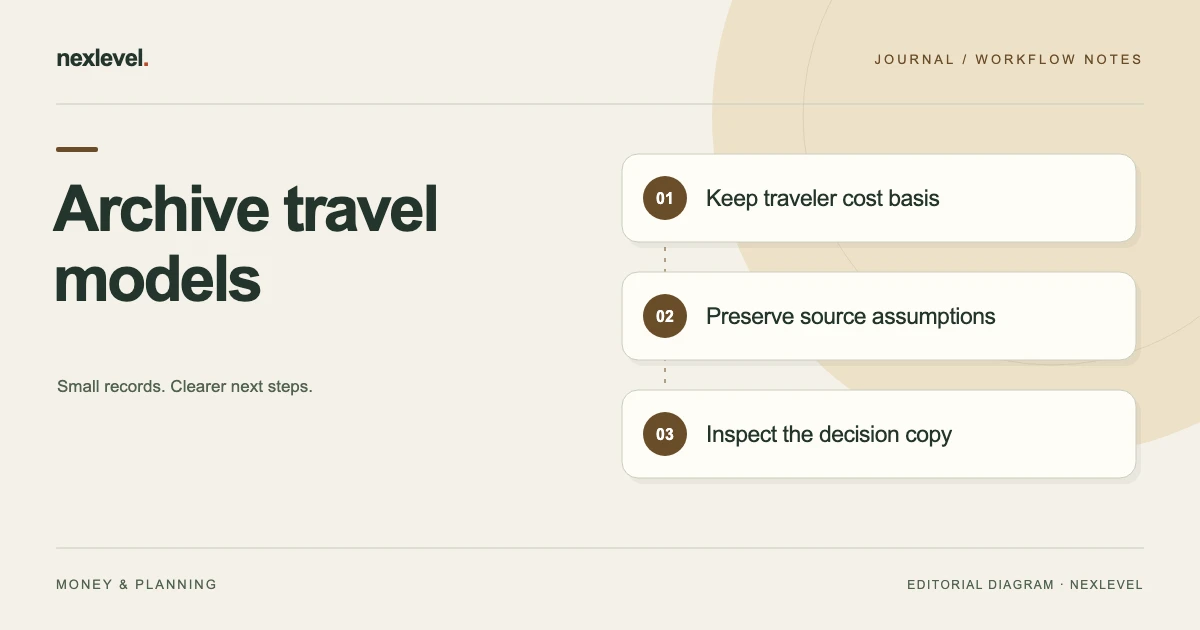
Archive a travel comparison around the options and assumptions used at its decision cutoff. Retain traveler count, charge bases, source times and the ranking criterion with the actual output; a winning total alone cannot explain the modeled journey or establish a booking.
Keep enough context to reconstruct the saved decision
- Choose the historical question, trip/options, intended reader and cutoff.
- Index fare sources, inclusions, estimates, currency assumptions and shared charges.
- Identify the saved decision criterion separately from any booking or payment source.
- Open the retained copy and ask a reader to reconstruct one option total and its limits.
Working fields:
Trip/option | Source occasion | Travelers | Included/shared/estimated costs | Currency basis | Criterion | Output/cutoff | Open question
Useful next steps: Preserve the currency assumption, Check cost inclusion before retention, Prepare a clear travel-budget handoff.
Choose the historical question
A later reader may need to reconstruct one total, identify the selected inclusion source, or understand which ranking criterion produced a saved decision. Those questions can need different representations.
Write the trip/option scope, traveler count, source cutoff, preparation occasion, intended reader, and output. A packet about one decision should not appear to represent every later provider offer.
Keep access proportional. A companion index can preserve authorized source routes without copying unrelated traveler or account information into a broad shared folder.
Preserve option identity and source occasion
A provider nickname or familiar route can recur across different offers. The archive needs the actual selected source context rather than a general label alone.
TripCost Guard’s current description includes entered fares/providers, extra costs, per-traveler/whole-trip charges, inclusions, estimates, currency assumptions, rankings, and frozen decision totals.
A later current offer should not silently replace the source that supported an older comparison. Keep the selected occasion and actual assumption basis readable.
Use an option-and-assumption archive index
One row can identify each selected source role. Keep fare source, cost basis, inclusions, currency, ranking, output, and limitation separate where their sources differ.
| Field | What to preserve |
|---|---|
| Trip and option | The selected identifying context |
| Source | The actual fare/provider observation and occasion |
| Cost basis | Per-traveler, whole-trip, included, and estimated roles |
| Currency | The entered unit and any actual conversion-source context |
| Decision | The selected ranking criterion and saved assumptions |
| Output | The retained representation, cutoff, and limitation |
These are independent companion prompts, not a dedicated archive module or a promise that every explanatory line appears automatically in an export.
Work through a fictional comparison packet
Imagine trip T48 with three travelers in one invented currency. Option A has fare one hundred per traveler and a whole-trip transfer of forty-five. Its selected source states the relevant baggage is included.
A’s entered total is three hundred plus forty-five, or 345. Option B has fare ninety per traveler, baggage ten per traveler, and a whole-trip transfer of sixty.
B’s entered total is 270 plus thirty plus sixty, or 360. The simplified difference is fifteen, with no other cost assumed.
Source references S2/S3, selected decision D6, and retained copy C8 concern separate roles. No real trip, provider price, inclusion policy, ticket, conversion, purchase, or travel outcome is supplied.
Keep cost basis beside the figures
Three traveler fares produce three hundred for A and 270 for B. The whole-trip transfers remain forty-five and sixty rather than being multiplied again.
Use the group transfer-cost worksheet for a narrower basis question. Preserve its actual result or precise limitation.
The fictional arithmetic recommends no group size or travel option. Correct multiplication should not conceal uncertainty about what a real source amount covers.
Preserve included and estimated costs
A’s fictional source includes selected baggage, so the trial adds no separate baggage amount for A. B’s source has a separate entered baggage charge.
Use the included-cost review guide for that narrower task. Similar provider or fare names should not automatically inherit the same inclusions.
An estimated cost and a quoted amount can have different source roles. Keep their actual meanings in the retained copy rather than making every number appear equally confirmed.
Keep currency and conversion assumptions explicit
The fictional T48 example uses one invented currency and no exchange conversion. A real multi-currency packet needs the actual entered rate, source, and occasion.
Use the currency-assumption guide for that narrower record task. This archive supplies no live rate or conversion recommendation.
A saved rate can make an entered model reproducible without guaranteeing a bank’s actual charge, fee, or later exchange outcome. Preserve that boundary in the selected representation.
Preserve the selected ranking criterion
Lowest entered total, fastest journey, and least hassle answer different questions. The archive should identify which criterion D6 actually represents.
The current app describes optional travel-time value. A chosen valuation is an entered assumption, not a universal market fact or recommendation.
The fictional trial supplies no durations or time value. Its fifteen-unit difference concerns only the stated cost model and does not identify a universally best trip.
Keep saved decision separate from booking and payment
D6 is a selected planning record. It does not independently establish that a ticket was purchased, a fare remained available, or a provider accepted a booking.
TripCost Guard currently says it does not scrape fares, sell tickets, or guarantee third-party prices. Do not broaden a saved comparison into live provider verification.
If the historical question concerns actual booking or payment, identify the separate source or precise limitation. The fictional archive exercise requires no provider contact or purchase.
Inspect the actual decision representation
The current listing describes frozen totals/assumptions, PDF/CSV sharing, and Pro PDF decision sharing. Check actual access and open the selected supported representation.
Inspect trip/option identity, source occasion, traveler basis, included/estimated costs, currency context, ranking criterion, and cutoff. A companion index may be needed for relationships not represented automatically.
The public description does not establish arbitrary spreadsheet import or universal full-workspace restoration. A portable decision packet can support bounded retrieval without being the entire editable app.
Prepare a cover note for C8
The first line can identify T48 and the selected options, cutoff, and purpose. Source lines name S2/S3 and their actual authorized routes.
A calculation section preserves the three-traveler basis, whole-trip transfers, inclusion note, and no-other-cost model. A decision line identifies D6’s actual ranking criterion.
A contents line should name only what was retained. A supported export, source representation, decision note, and companion index can serve different purposes. A filename called winning does not establish a booking outcome.
Test retrieval from the total and decision
Ask a reader to begin with A’s fictional 345 units and reconstruct the selected traveler and transfer basis. Then begin with D6 and identify the actual criterion and source cutoff.
Introduce another fictional option with a similar provider nickname. The reader should use actual references rather than assign S2’s inclusions to the closest-looking name.
If a retained copy loses a relationship preserved in the working source, repair that copy. If the original source remains uncertain, retain the exact question rather than inventing a price or inclusion.
Keep later provider information visibly later
A later source may clarify a cost or inclusion relationship. Retain its own occasion and connection to C8 rather than making the historical packet appear to have known it earlier.
A correction to a companion explanation is different from changing the comparison or recording a booking. Keeping those purposes distinguishable prevents archive repair from creating travel history.
A concise receipt can name sources inspected, arithmetic checked, representation opened, relationships established, and next question. It documents an administrative review without a saving or booking-success claim.
Keep the packet proportional and usable
A small selected packet can be easier to retrieve than a broad folder of unrelated travel material. Include what the intended question needs and identify where relevant sources remain elsewhere.
Keep traveler count, cost basis, currency context, criterion, and cutoff inside the packet as well as in filenames. A copied or renamed file should retain the assumptions that make the model reproducible.
Do not delete a working comparison merely because an output exists. File preparation and reliable retrieval are separate results, and this guide does not prescribe a retention period.
Separate retention from a method decision
For tool selection, use the travel comparison system guide. Choosing a method and preparing one historical packet have different requirements.
The fictional figures remain teaching inputs. Reuse the source-index structure with actual authorized records rather than adopting the example as a real fare or recommended itinerary.
A useful archive can identify a precise remaining provider-source question without claiming every current offer or actual payment outcome is established.
Complete the option-and-assumption cover sheet
The C8 cover note can keep entered fares, traveler basis, inclusions, whole-trip charges, decision criterion, and output on separate lines. This is an explanatory worksheet rather than a guarantee that each line appears automatically in an export.
| Component | Fictional option A | Fictional option B |
|---|---|---|
| Fare basis | Three × one hundred = three hundred | Three × ninety = 270 |
| Selected baggage | Included under the stated source | Three × ten = thirty |
| Whole-trip transfer | Forty-five | Sixty |
| Entered total | 345 | 360 |
| Difference | Fifteen units under the stated no-other-cost model | |
The amounts use one invented currency and no exchange conversion. They establish no actual fare, saving, booking, or recommendation. A’s inclusion note belongs only to its fictional source.
Compare two possible retained decision packets
Imagine packet A contains only the displayed winning total. Packet B contains the selected supported representation and a companion source/assumption index. Neither is automatically sufficient; compare each with the intended historical question.
If the task is to locate one selected total, packet A may supply a useful route once identity, criterion, and cutoff are established. If the task is to explain the traveler basis, inclusion note, or source occasion, the additional relationships in packet B matter.
Now suppose packet B multiplies the whole-trip transfer again. Its extra detail does not make it accurate. Repair the independent explanation rather than changing correct source components to match the mistaken total.
A bounded continuation question can ask which provider source establishes the selected inclusion or cost basis. This keeps the next planning review specific without creating a ticket purchase or contacting a provider.
Keep traveler count, currency, source occasion, criterion, and cutoff inside the packet as well as in filenames. A copied decision file can lose its original folder context.
If later provider information clarifies a component, preserve its own occasion and relationship to C8. It should not make the historical packet appear to have known a later offer earlier.
The completion receipt can name sources inspected, arithmetic checked, representation opened, relationships established, and next question. It documents an administrative review without guaranteeing a price or actual payment outcome.
The fictional figures remain teaching inputs. Reuse the source-role structure with actual authorized records while preserving current-provider uncertainty and the distinction between estimates, decisions, bookings, and payments.
For a final practical check, give the reader only C8 and its companion index. Ask them to reconstruct 345 and 360 from the stated traveler basis, included baggage note, and whole-trip transfers. Then ask which source establishes the selected ranking criterion and provider occasion. The answer should remain an entered-model explanation rather than a current fare guarantee. Record any manual explanation needed and which provider-source question remains open. A readable decision packet can make the next planning review specific without implying a booking or payment. Keep traveler count, currency, source context, and evidence limits beside the affected assumptions so another reader can continue without reconstructing the original conversation.
Use TripCost Guard for traceable entered decisions
TripCost Guard connects entered fare sources, cost components, traveler basis, currency assumptions, rankings, and selected decision records without requiring an account.
Check the official TripCost Guard App Store listing for current capabilities. Preserve planning context while keeping current provider information, booking, and actual payment evidence in their appropriate roles.