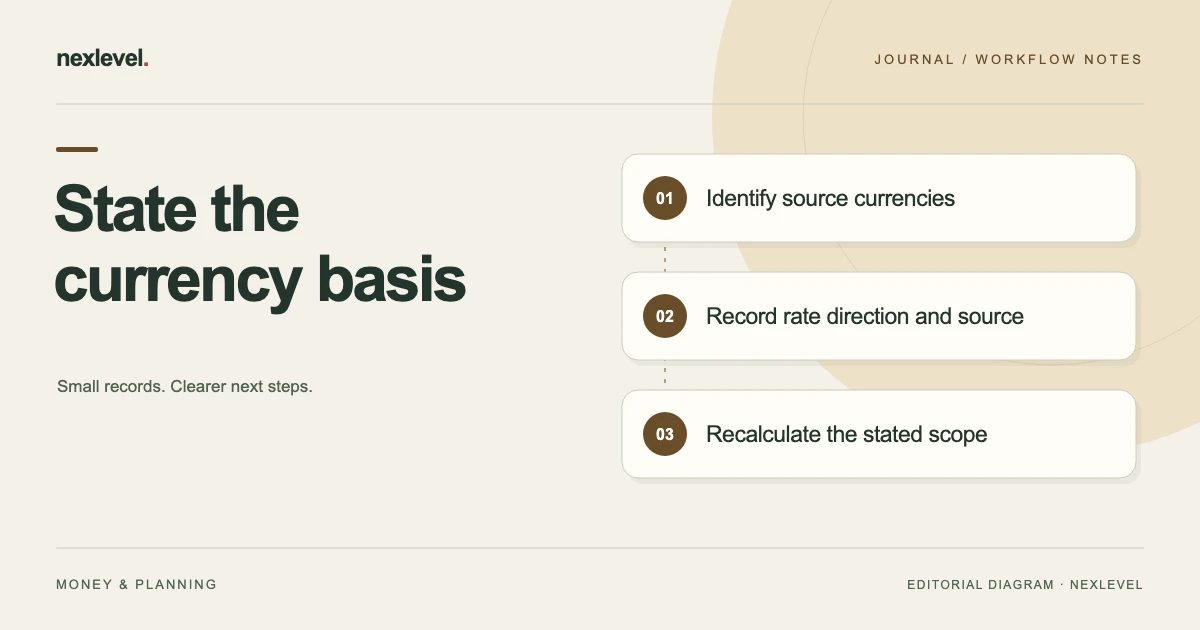
A travel currency assumption needs more than a number: state the source currency, comparison currency and rate direction in words. Preserve each source amount and occasion, and check whether a line is already converted before applying the rate.
Write what one unit of the entered rate means
- Choose the comparison currency and keep the original amount and currency for each source.
- Write how many comparison units equal one source unit and retain the rate source/date.
- Convert only the amounts on that stated basis, preserving per-person and shared charge scopes.
- Label alternative rate scenarios separately and inspect the saved decision's currency explanation.
Working fields:
Option | Source amount/currency | Comparison currency | Rate direction/value | Source/date | Converted amount | Scope/limit
Useful next steps: Build the complete trip budget, Check included and additional cost roles, Retain currency assumptions with the decision.
Choose the comparison basis
Identify the trip, travelers, selected options, and currency used to compare totals. A fare and a transfer can have different source currencies or scope.
Do not add unlike currency amounts as though their units were already equivalent. Keep the actual source currency attached until the stated comparison model converts it.
TripCost Guard’s current listing supports converting foreign fares using a recorded exchange rate and source. It does not fetch live fares, guarantee provider prices, or establish what a payment provider will charge.
Use a currency-assumption worksheet
Suggested fields are option reference, source amount, source currency, comparison currency, rate direction, entered rate, source reference, source occasion, converted amount, additional costs, and limitation.
| Check | Question |
|---|---|
| Amount | Is it still in the source currency or already converted? |
| Rate | How many comparison units per source unit? |
| Occasion | Which actual source and capture context support it? |
| Scope | Which travelers and journey does the result cover? |
These are independent review fields. They do not claim a native live-rate feed or automatic conversion of every possible custom line.
State the rate direction in words
For this guide’s fictional examples, a rate of 1.20 means 1.20 comparison-currency units per one source-currency unit. Multiplication converts the stated source amount into the comparison units.
Keep that sentence beside the number in the companion worksheet. A bare “1.20” can be mistaken for the inverse direction or a rate used for another currency pair.
This guide supplies no actual currency-pair quote. For real work, use the actual selected source and supported interface, preserving the source meaning rather than guessing from a familiar-looking value.
Work through a fictional one-traveler comparison
Imagine option A with a source fare of 100 foreign-currency units. Under the stated fictional 1.20 assumption, the converted fare is 120 comparison units.
Add a separate entered transfer of 20 already expressed in comparison units. The simplified A total is 140. Option B is entered as 135 comparison units plus a 10-unit transfer, totaling 145.
Under those stated inputs, A is 5 lower. The example excludes other costs and conditions. It does not establish that either option exists or is the appropriate booking choice.
Test a different assumption as a separate scenario
Keep the same fictional A fare and transfer, but use a separate rate assumption of 1.30 comparison units per source unit. The converted fare becomes 130, and A’s simplified total becomes 150.
B remains 145 under the unchanged stated inputs, so A is now 5 higher. At a separate illustrative rate of 1.25, A would total 145 and match B in this limited model.
This is sensitivity arithmetic, not a forecast of exchange rates or a recommendation about when to pay. Label each scenario rather than rewriting an earlier decision as though it used the later assumption.
Do not convert an amount twice
An amount displayed in comparison units may already include a conversion. Trace the source role before applying the entered rate again.
In the fictional exercise, the 20-unit transfer is already in comparison units. Multiplying it by 1.20 would change the stated model rather than improve its accuracy.
For related inclusion errors, use the separate included-cost review guide. Currency conversion and included-versus-additional status are different relationships that both need clear labels.
Keep traveler and journey scope explicit
A per-person fare and a whole-trip transfer should not silently share the same multiplier. Establish the actual source basis before calculating a group total.
The current TripCost Guard listing supports per-traveler and whole-trip charges. Use the actual supported controls and preserve the meaning in the intended copy.
For the separate group-transfer task, see the parking, rail, and transfer worksheet. The current example deliberately uses one traveler so the currency assumption remains isolated.
Preserve the source occasion
A retained rate source has an observation or capture context. The day a reviewer opens the worksheet is not automatically the day the source was checked.
Do not refresh an old rate’s source date merely because its numeric value remains convenient. If a source is newly checked, identify the actual new observation through the supported workflow.
A frozen comparison can remain useful history while a current planning scenario uses another source. The difference should be explained rather than hidden behind one unlabeled total.
Separate estimates from actual charges
A planning rate and a quoted fare are entered sources for a comparison. They do not independently establish final payment fees, card conversion terms, taxes, or provider availability.
Keep unknown conditions explicit instead of silently treating them as zero. This fictional guide supplies no payment-provider rule or real transaction method.
The app’s role is a transparent comparison from entered assumptions. Actual booking and payment decisions require their relevant current sources and responsible process.
Keep time-value preferences separate from currency
TripCost Guard’s current description includes an optional value for travel time and rankings by total, duration, or hassle. Those preferences answer different questions from converting a fare.
A personal time valuation is not an additional provider charge or an exchange rate. Keep the selected comparison question readable when explaining a ranking.
This guide recommends no value for time, currency assumption, or purchase. A numerical ranking can be useful while still depending on the stated scope and unresolved inputs.
Inspect the actual decision copy
The current listing describes freezing winning totals and assumptions and supported PDF or CSV sharing, with expanded options and PDF decision sharing under Pro.
Check actual feature access and open the intended output. Verify option identity, source currencies, rate direction, source context, converted amounts, and selected scope.
Do not assume every independent worksheet explanation appears automatically. A static file is a prepared representation, not a live exchange-rate feed or the full editable app.
Correct the appropriate source label
If the working inputs are accurate but a cover note reverses the rate direction, repair the explanation. Do not change good values merely to match a copied phrase.
If an actual input mistake is established, use the supported workflow and inspect the resulting comparison. Keep the original decision context identifiable where relevant.
A changed working note does not update every retained file elsewhere. Identify the intended replacement through the actual sharing arrangement without distributing unrelated private travel information.
Test the arithmetic and meaning separately
Reproduce 100 multiplied by 1.20 plus 20 equals 140; 135 plus 10 equals 145; and 100 multiplied by 1.30 plus 20 equals 150.
Then ask which units and source occasion each number represents. Correct arithmetic cannot repair an inverted rate, double conversion, or unmatched quote scope.
A short review receipt identifies the selected comparison, actual sources inspected, stated assumptions, calculation reproduced, and open question. It does not guarantee a final charge or external price.
Compare two traveler scopes without mixing the examples
The first fictional comparison uses one traveler. A has 100 source-currency units converted at 1.20 plus a 20-unit transfer, producing 140. B has 135 comparison units plus 10, producing 145. Keep that scope attached to the result.
For a separate two-traveler scenario, suppose the same fares are explicitly per traveler while the transfers remain whole-trip amounts. A’s source fare becomes 200. At the stated 1.20 assumption, that converts to 240, plus 20 for a total of 260.
B’s two fares total 270 comparison units, plus the whole-trip transfer of 10, for 280. Under these deliberately limited inputs, A is 20 lower. The multiplier belongs to the fares, not automatically to every line.
At a separate 1.30 rate assumption, A’s two fares convert to 260 and its total becomes 280. In this two-traveler model, it matches B. That differs from the one-traveler model because the fixed transfer difference is shared over another fare base.
These are sensitivity examples, not live prices or a recommended rate. Keep their labels separate. Do not copy the two-traveler total into a one-traveler decision or claim that the arithmetic predicts a future exchange rate.
The source review still comes before the calculation. Establish which actual quote is per traveler, which charge is whole trip, and which amounts are already in comparison units. A neat total cannot resolve an unknown source basis.
The independent worksheet can therefore retain one row per scenario with traveler count, fare basis, rate meaning, fixed extras, exclusions, and result. It need not claim that the app exposes this exact table layout.
Preserve the decision’s actual source context
Suppose a retained decision used the 1.20 assumption while a later planning note uses 1.30. The historical record should not be relabeled as though it used the later number. Identify the new scenario through the actual supported workflow.
If a cover summary says only “A costs 140,” add the comparison currency, traveler scope, and source context where the recipient needs them. The number alone does not explain whether it is a fare, total, per-person value, or retained estimate.
Do not treat a later actual charge as a silent replacement for the estimate. It has its own source and may involve conditions outside this simplified model. This article establishes none of those conditions.
Open the intended output after a correction. Check whether the source currency, rate direction, selected scope, and limitations remain readable. A companion note may be needed when the static file does not carry every explanation.
Ask the reader to reproduce both the one-traveler and two-traveler scenarios. Then ask them to identify what stayed fixed and what changed. This checks the meaning of the model, not just multiplication.
The app’s ranking can help organize entered assumptions while still requiring current provider information for an actual decision. This guide does not book travel, send a payment, select a currency service, or advise when to transact.
The review ends with actual sources identified, hypothetical calculations clearly labeled, and any unresolved real input retained as a question. That makes the comparison useful without presenting an entered rate or a frozen total as a guarantee of the eventual cost.
Keep provider capture time and rate-source occasion distinct when they differ. A newly checked fare does not automatically make a retained currency assumption current. Conversely, a new rate observation does not establish that an older provider price remains available. The comparison should show which source supports each input.
If one source remains unavailable, retain that specific question instead of refreshing every date to the day the worksheet was reviewed. A model can be useful as a clearly labeled scenario while still needing current information before any actual decision. The source dates help the recipient understand that limitation rather than mistake the frozen total for a live quote or guaranteed charge.
Use TripCost Guard for visible comparison assumptions
TripCost Guard organizes entered fares, extras, traveler scope, estimates, currency assumptions, and decision records. Its current Pro description expands trips, options, templates, and PDF sharing.
Check the official TripCost Guard App Store listing for current features and plan details. Keep the currency basis explicit so a ranking explains the assumptions you actually entered.