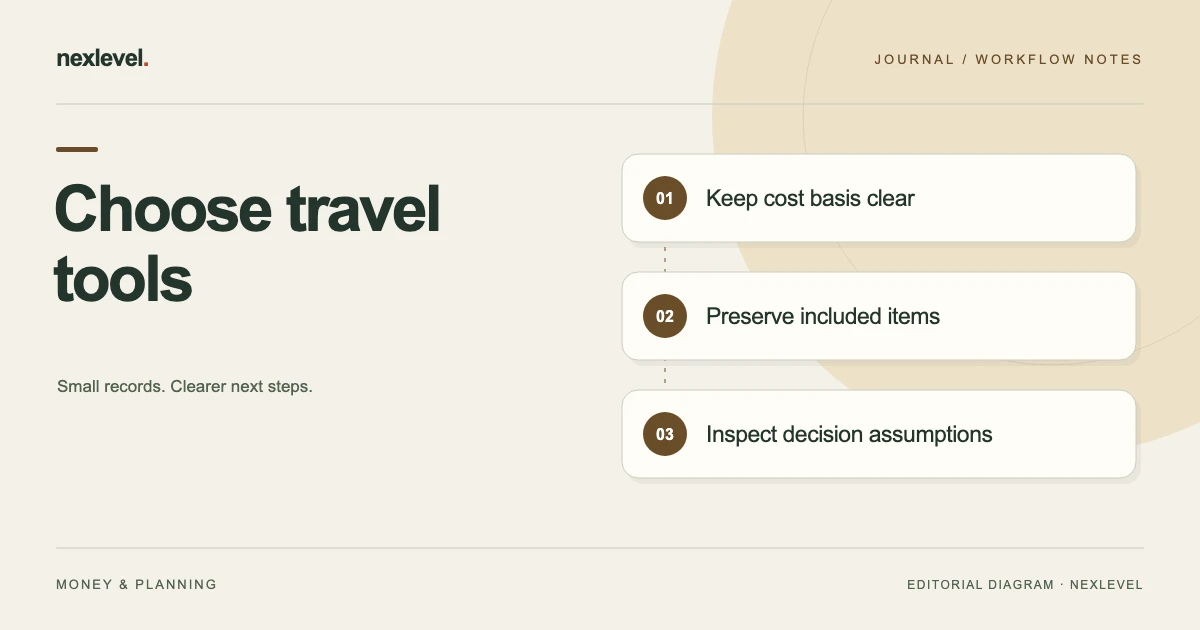
Choose a travel budget record system by following the same fictional options from source fares to a retained decision. Check charge bases, inclusions and source occasions, then see whether another traveler can reconstruct the total and understand the selected ranking criterion.
Test one complete comparison in each record method
- Define the trip scope, traveler count, cost units, reader and output needed.
- Use the same fictional fare, included item and whole-trip transfer in each candidate.
- Inspect formulas or manual conventions and the retained decision copy.
- Ask another reader to reconstruct both totals and record the missing context or maintenance.
Working fields:
Candidate | Source occasion | Traveler/shared basis | Inclusion handling | Decision criterion | Output inspected | Manual dependency
Useful next steps: Define the budget fields first, Test included-cost handling, Check retained decision context.
Define the actual comparison task
A fare list, a complete entered-cost model, and a saved decision record serve different purposes. State which tasks matter before comparing rankings or charts.
Write the selected trip scope, source arrangement, traveler count, cost units, currency basis, intended reader, and output. A method that suits a single fare may need more structure for included items and whole-trip charges.
Use fictional inputs during evaluation. There is no need to buy a ticket, contact a provider, or copy private traveler information into several systems merely to compare records.
Use a common comparison worksheet
Record demonstrated behavior, manual convention, actual output, and next question for every candidate. Apply the same prompts without assuming identical controls.
| Task | What to demonstrate |
|---|---|
| Source | Identify the selected fare and source occasion |
| Basis | Keep per-traveler and whole-trip charges distinct |
| Include | Explain which costs are already included |
| Compare | Reconstruct the entered total and ranking basis |
| Freeze | Preserve selected decision assumptions |
| Retrieve | Interpret the intended retained copy |
These are independent evaluation prompts, not a named comparison module inside TripCost Guard.
Set up two fictional options
Imagine trip T42 with two travelers in one invented currency. Option A has fare one hundred per traveler and a whole-trip transfer of thirty. Its selected source says the relevant baggage is included.
Under those explicit inputs, A’s entered total is two hundred plus thirty, or 230. Option B has fare ninety per traveler, baggage twenty per traveler, and a whole-trip transfer of twenty.
B’s entered total is 180 plus forty plus twenty, or 240. The simplified difference is ten. No other cost is assumed in this fictional trial.
Source references S2/S3, decision D6, and retained copy C8 concern separate roles. No real trip, fare, provider policy, ticket, currency conversion, purchase, or traveler recommendation is supplied.
Test a paper travel worksheet
Paper can use option headings, source references, traveler-count labels, separate cost rows, and an explicitly selected decision note. Demonstrate T42/A/B without relying on memory.
Keep the per-traveler basis beside the fare and the whole-trip basis beside the transfer. A total alone should not force another reader to guess which charges were multiplied.
Inspect the retained scan. If it loses an inclusion note or source occasion, repair that copy. Its limitation belongs to the actual representation rather than every paper method.
Test the spreadsheet’s formulas and rows
Decide whether a row represents an option, cost component, source observation, currency assumption, or decision snapshot. Repeated A references may describe several components rather than duplicate booking options to remove.
Inspect the actual formulas and intermediate values. A 230-unit total cannot explain whether the transfer was multiplied incorrectly or included baggage was counted twice.
Sort and filter the fictional data, then open C8. Option identity, source occasion, traveler basis, inclusions, and decision context should remain connected. Formulas and linked source notes are maintenance dependencies.
Evaluate TripCost Guard against its current listing
The verified current TripCost Guard description includes entered fares/providers, baggage, seats, fees, transfers, parking, meals, lodging, custom costs, per-traveler/whole-trip charges, inclusions, and estimates.
It describes rankings by total, duration, or hassle, optional time valuation, recorded exchange-rate/source context, and frozen winning totals and assumptions. It does not scrape fares, sell tickets, or guarantee third-party prices.
Check actual access. The initial bounded trip/options include the core comparison; Pro expands trips/options, templates, and PDF decision sharing. The app applies entered assumptions rather than independently verifying a provider’s current offer.
Keep cost basis beside each component
For the fictional trial, two traveler fares produce two hundred for A and 180 for B. The transfers of thirty and twenty remain whole-trip charges and are not multiplied again.
Use the group transfer-cost worksheet for a narrower basis question. Preserve its actual result or precise limitation.
This comparison recommends no group size or travel choice. Correct multiplication should not conceal uncertainty about what a real source amount covers.
Preserve included-cost context
A’s fictional source states the selected baggage is included, so the trial does not add another baggage charge for A. B’s source has a separate entered baggage amount.
Use the included-cost review guide for that narrower question. Do not assume two similarly named fare products have the same inclusions.
A source can be clear at one occasion without remaining current forever. Keep the selected cutoff and actual source route beside the retained assumption.
Keep currency assumptions explicit
The fictional A/B example uses one invented currency and no exchange conversion. A real multi-currency comparison needs the actual entered rate, source, and occasion.
Use the currency-assumption guide for that narrower record task. This comparison supplies no live rate or conversion recommendation.
A recorded rate can make a model reproducible without guaranteeing a bank’s actual charge, fee, or later exchange outcome. Preserve that boundary in the selected copy.
Separate total ranking from other preferences
A lower entered total, shorter door-to-door duration, and lower hassle are different comparison bases. A ranking should identify the selected criterion rather than present every preferred option as cheapest.
The current app describes optional travel-time value. A chosen time valuation is an entered assumption, not a universal market fact or recommendation.
The fictional trial gives no durations or time value. Its ten-unit difference concerns only the stated cost model and does not recommend a real booking.
Inspect the selected decision representation
TripCost Guard currently describes freezing selected totals and assumptions, with PDF/CSV sharing mentioned and Pro PDF decision sharing. Check actual access and open the representation used in the trial.
Inspect trip/option identity, source occasion, traveler basis, included costs, currency context, ranking criterion, and cutoff. A companion explanation may be needed for relationships not represented automatically.
The public description does not establish arbitrary spreadsheet import or universal full-workspace restoration. Keep output claims within actual supported capabilities.
Keep a saved decision separate from booking
D6 is a selected planning record. It does not independently establish that a ticket was purchased, a fare remained available, or a provider accepted a booking.
A prepared comparison, a chosen share destination, and another person’s current interpretation have different roles. C8 should preserve what the actual source establishes.
This comparison does not authorize buying travel or contacting a provider. The fictional retrieval exercise can be completed without a real booking action.
Run a second-reader exception test
Give a reader C8 and ask them to reconstruct A’s 230 and B’s 240 units. They should identify which charges are per traveler, whole trip, included, or omitted under the stated model.
Introduce another fictional option with a similar provider nickname. The reader should use actual source references rather than assign S2’s inclusions to the closest-looking name.
Then introduce later source clarification. It should retain its own occasion without making C8 appear to have known it earlier. A current working model and older decision snapshot can differ legitimately.
Choose from demonstrated maintenance
Paper may fit a bounded comparison with clear source and cost-basis references. A spreadsheet may fit flexible arithmetic where someone maintains components, inclusions, rates, and snapshots. TripCost Guard may fit repeated local door-to-door comparison and decision-record tasks.
These are conditional workflow comparisons, not measured savings or travel-success claims. Choose from the actual task, authorized source arrangement, intended output, and maintenance observed in the trial.
A decision note should name demonstrated relationships, actual representation inspected, manual dependencies, and next question. Selecting a tool should not make an uncertain provider source appear guaranteed.
Complete the cost-basis trial table
The C8 comparison can keep per-traveler and whole-trip charges on separate lines. This is an explanatory worksheet rather than a promise that every line appears as a native export field.
| Component | Fictional option A | Fictional option B |
|---|---|---|
| Fare basis | Two travelers × one hundred = two hundred | Two travelers × ninety = 180 |
| Selected baggage | Included under the stated source | Two travelers × twenty = forty |
| Transfer basis | Thirty for the whole trip | Twenty for the whole trip |
| Entered total | 230 | 240 |
| Difference | Ten units under the stated no-other-cost model | |
The amounts use one invented currency and no exchange conversion. They establish no actual price, booking, saving, or recommendation. The included-baggage note belongs only to the fictional source for A.
Ask each candidate to retain the source occasion and basis beside the final total. A number can be arithmetically correct while its retained representation loses which charge was multiplied or included.
Write a decision with its source assumptions
A practical choice may prioritize reconstructing the two totals and preserving inclusions over adding another ranking view. State the actual task, selected candidate, demonstrated relationships, manual dependencies, output inspected, and next question.
Suppose one candidate keeps the 230-unit figure visible but loses the whole-trip transfer basis. Repair that representation. Suppose another preserves components well but cannot establish which source confirms the inclusion note. Retain that separate question rather than treating baggage as universally included.
Then remove the original comparison conversation. Ask the reader to reconstruct A and B from C8 and identify the selected ranking criterion. They should distinguish lower entered cost from shorter duration, lower hassle, or a real booking decision.
Introduce later provider information. The reader should identify its own occasion and explain whether it updates current planning or clarifies the older source. It should not silently rewrite the selected decision cutoff.
The sharing boundary matters too. A prepared decision record, a chosen export, and another traveler’s current understanding can have different roles. The fictional trial requires no ticket purchase or provider contact.
Keep traveler count, cost basis, included items, currency context, and cutoff inside the decision note as well as in filenames. A copied file should not lose the assumptions that make the model reproducible.
A useful choice can remain conditional on a repaired output or maintained source index. It does not need a claim about savings achieved, guaranteed fares, or travel success to support the bounded recordkeeping decision.
The fictional figures remain teaching inputs. Reuse the structure with actual authorized sources while preserving current-provider uncertainty and the distinction between planning models, bookings, and actual payment outcomes.
For a final practical check, give the reader only C8 and the decision note. Ask them to identify each option’s source occasion, traveler basis, included items, whole-trip charges, currency context, selected criterion, and cutoff. They should reconstruct the two fictional totals without adding an included item again or multiplying the transfer twice. Then ask which source would resolve the most specific remaining provider question. Record any manual explanation needed. A useful comparison can make the next planning review clear while preserving uncertainty about current offers. It should not claim a guaranteed fare, actual saving, or completed booking merely because the model reconciles. Keep that evidence limit beside the affected assumption.
Use TripCost Guard for traceable entered comparisons
TripCost Guard connects entered fare sources, cost components, traveler basis, currency assumptions, rankings, and selected decision records without requiring an account.
Check the official TripCost Guard App Store listing for current capabilities and Pro access. Keep planning estimates, current provider information, and actual booking/payment evidence in their appropriate roles.