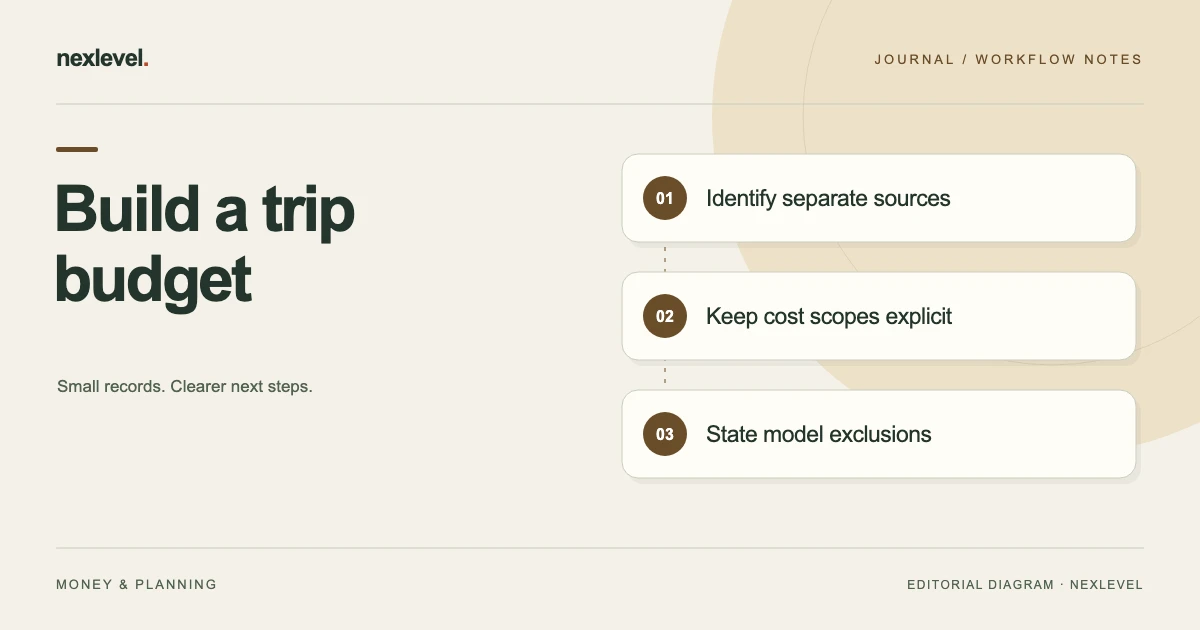
Build a door-to-door budget one cost source at a time. Match the fare and each extra to the intended option, traveler group and occasion, then apply the stated quantity basis. Keep included items, estimates and unknown costs visible before comparing totals.
Assign a source and quantity basis to every cost line
- Define the trip, group, options, currency and comparison boundary.
- Record each source amount with its date and per-traveler or whole-group basis.
- Add only the applicable extras and preserve the source for any inclusion.
- Recalculate each limited total and label exclusions before retaining a decision.
Working fields:
Trip/group | Option/source occasion | Component | Amount/currency | Quantity basis | Inclusion/estimate | Exclusion/question
Useful next steps: Use the complete travel budget template, Avoid double counting included components, Hand off mixed charge bases.
Define the comparison before collecting amounts
Write a bounded purpose: “Prepare two selected options for the same hypothetical trip and traveler group using the supplied cost sources.” Identify trip context, traveler count, relevant source occasions, intended comparison, and cutoff.
A fare comparison and a full trip budget can have different scopes. Keep the selected starting and ending context clear rather than assume every option includes the same transfers or extra costs.
The task is to build an understandable model, not prove that an option is currently available or that its final charge is guaranteed.
Use the app’s advertised cost roles
TripCost Guard advertises base fares and providers, baggage, seat selection, payment fees, transfers, parking, meals, lodging, and custom costs. It also distinguishes per-traveler and whole-trip charges, included costs, and estimated amounts.
Keep the selected role beside each source amount. Two identical numbers can have different effects when one is per traveler and the other covers the whole group.
Do not invent a native schema or assume the app fetches these amounts. The listing describes comparisons built from the user’s entered assumptions.
Create a controlled fictional source set
For this exercise, T92 identifies the trip model and G2 a group of two hypothetical travelers. A3 and B4 are option roles. Q5 and Q6 identify their selected source occasions, and N7 is the independent setup worksheet.
All amounts use one currency. The example supplies no actual destination, route, provider, fare, baggage policy, exchange rate, traveler data, or booking condition.
The source labels are companion references rather than native field names or an import format. No actual app comparison, purchase, or reservation is created here.
Record the base-fare basis exactly
In the teaching model, A3’s whole-group base fare is 80 and B4’s is 110. These are selected whole-trip inputs for the two-person group, not amounts to multiply by two.
If a real selected source instead states a per-person fare, preserve that different basis before using it. A matching currency label does not establish the same traveler scope.
The fictional base amounts establish only part of the model. They do not include every possible real-world cost or prove the appropriate comparison scope.
Add per-traveler and whole-trip extras separately
A3 has a hypothetical bag input of 5 per traveler and a transfer input of 30 for the whole trip. Two travelers make the independent bag amount 2 multiplied by 5, or 10. The transfer remains 30 under the stated group basis.
A3’s limited model total is therefore 80 plus 10 plus 30, or 120. Do not multiply the whole-trip transfer again merely because the group contains two people.
This is independent teaching arithmetic, not a statement of a native algorithm or an actual provider charge.
Keep included items from becoming another extra
For B4, the fictional selected source says the modeled bag item is included in the base fare. Its additional amount is therefore zero in this deliberately limited exercise, not a claim that bags are universally free.
B4’s transfer input is 5 per traveler, giving 10 for the group. Its limited model total is 110 plus zero plus 10, or 120.
For that narrower issue, use the included-cost double-counting guide. Keep the actual selected inclusion source visible rather than infer it from a familiar fare name.
State the model’s exclusions beside the result
The fictional totals exclude all other fees, taxes, seats, parking, meals, lodging, insurance, and custom costs. Excluded from this exercise does not mean zero in a real trip.
The result is a tie at 120 under the limited assumptions, despite different base fares. It is not a finding that the trips are commercially equivalent or that either is the cheapest real option.
Keep that limit visible before using a total elsewhere. A complete-looking number cannot establish missing source relationships.
Use a copy-ready initial-budget worksheet
A practical companion worksheet asks for trip/group context, selected options, source occasions, base-fare basis, each extra’s unit and traveler scope, included-item source, estimate status, currency, and explicit exclusions.
Add independent calculation basis, representation inspected, cutoff, unresolved questions, next source task, and retained-decision role when supplied.
These prompts are an administrative structure, not native required fields, an automated price verifier, or an import-ready format.
Read cost per traveler at the same scope
Under the two-traveler teaching model, each option’s total of 120 divided by two gives 60 per traveler. That derived value describes the same limited cost scope, not a separate provider fare.
Do not combine a per-traveler result from one group size with a whole-trip result from another and call the numbers directly comparable. Identify the actual selected basis first.
The example supplies no reimbursement arrangement or payment allocation. A cost-per-traveler model does not establish who paid for any item.
Keep estimated and sourced amounts distinguishable
The app advertises estimated amounts as part of the comparison. A value entered as an estimate should not become a confirmed quote merely because the report displays it neatly.
If a later actual source replaces an estimate, give it its own occasion and identify which input changed. Preserve the earlier model as history of its selected assumptions.
A copied label that wrongly calls an estimate confirmed needs an explanation correction, not an invented provider event.
Separate cost ranking from time and hassle
TripCost Guard advertises ranking by lowest total, fastest journey, or least hassle, with door-to-door duration and optional value of travel time. Those views answer different questions.
This fictional exercise supplies no journey duration, hassle inputs, or value-of-time assumption. It cannot rank options on those bases or prescribe a preferred choice.
Do not invent weighting or tie-break rules to make the equal limited totals produce a winner. The independent result remains a cost tie under stated assumptions.
Keep foreign-currency context explicit when relevant
The listing advertises conversion using an exchange rate and source the user records. The selected rate, direction, currency, and source occasion matter to understanding a real comparison.
This example deliberately uses one currency and performs no conversion. It supplies no current rate or advice about when to exchange money.
For the source-recording task, use the currency-assumption review guide. Keep an entered rate distinct from a live financial quote or guaranteed charge.
Review alternative transfer scopes
A parking amount covering a vehicle and a transfer amount covering individual travelers can have different bases. Preserve their actual units and group assumptions before comparing them.
Do not infer that a group transfer covers every person, bag, direction, or time merely from the label. The actual selected source needs to establish the relevant scope.
For that narrower comparison, use the group transfer and parking guide. This exercise recommends no route or transport provider.
Preserve a decision without claiming a booking
The app advertises freezing winning totals and assumptions in a decision record. A selected saved decision remains a planning representation; it does not establish provider availability, acceptance, or a completed reservation.
If a later quote changes, preserve its source occasion before preparing another model. Do not make the earlier decision appear to contain later information automatically.
For historical retention, use the travel comparison archive guide. Keep saved assumptions and actual charges in their respective roles.
Keep local planning and chosen sharing separate
The advertised workflow requires no account, and trips stay on device unless explicitly shared through PDF or CSV export. Preparing a local model should not introduce a new mandatory server or booking login.
The app does not scrape fares, sell tickets, or guarantee third-party prices. This worksheet likewise contacts no provider and makes no booking or payment request.
A portable copy should not be described as arbitrary import or guaranteed full restoration without documentation. This exercise imports nothing, restores nothing, and deletes no records.
State current access accurately
The first trip and first two booking options advertise the complete comparison for free. Pro expands trips and options and includes reusable cost templates and PDF decision sharing.
Trip Pass is a non-renewing 30-day purchase. Monthly and annual subscriptions renew; the annual seven-day trial appears only when Apple reports eligibility.
Do not infer a monthly trial or invent a localized price. Access cannot establish a source amount, validate a fare rule, or guarantee that an estimate becomes the final charge.
Run an initial-budget reading test
Give an authorized reviewer N7 and the fictional sources without the original folder context. Ask why A3’s 80 base fare leads to 120, why B4’s 110 also leads to 120, and which amounts are per traveler versus whole trip.
Then introduce a different traveler count or an unprovided inclusion source. The reviewer should identify the changed basis rather than reuse the earlier total by habit.
Record any explanation still needed. A useful result identifies the next cost-source question without recommending a purchase.
Write a bounded setup result
A compact fictional note can state: “T92/G2 uses two travelers and one currency. A3 models 80 whole-group fare, 10 bag total, and 30 group transfer; B4 models 110 fare, no additional modeled bag amount, and 10 transfer. Both limited totals are 120, or 60 per traveler.”
Keep exclusions and unprovided time/hassle context beside that result. No actual fare, availability, provider rule, or final charge is established.
For a reusable structure, use the complete-trip budget template. Preserve selected source roles when adapting it.
Check the basis before reusing a total for another group
If a third traveler is introduced, do not assume the hypothetical whole-group fare remains unchanged. The next source task is to establish which selected amounts apply to the new group context.
The same applies if another quote labels 80 as per traveler rather than whole trip. An unchanged number with a changed unit basis is a different input. Copying the earlier total would hide that difference.
The worksheet should identify which relationships are established and which remain unprovided before another calculation is treated as meaningful. This does not prescribe how a real provider prices groups.
Keep a partial review from appearing complete
Confirming the bag scope does not establish the transfer scope, and checking one fare does not validate every other cost. Record the actual sources inspected rather than conclude that the entire trip budget is verified.
If a required relationship is missing, identify the exact next question. “Does this transfer source cover the whole selected group?” is more useful than an unexplained instruction to check the total.
Likewise, if a companion note mislabels a sourced amount, correct that explanation rather than invent a changed provider price. A source update, a copied-label correction, and a new traveler group are different occasions.
Retain the setup review for the next comparison
Keep the selected options, source occasions, unit bases, exclusions, and unresolved questions beside the resulting note. A later reader should be able to reproduce the limited teaching model without reconstructing the original conversation.
When actual later material arrives, give it its own relationship before preparing another model. The earlier worksheet can remain accurate history without appearing to contain a quote, inclusion, or group basis that was not yet supplied.
Use TripCost Guard for explicit cost assumptions
TripCost Guard connects entered fares, cost scopes, included and estimated items, travel-time context, recorded exchange assumptions, and saved decisions.
Check the official TripCost Guard App Store listing for current capabilities and access. Keep model totals, shared outputs, booking actions, and actual charges distinguishable.