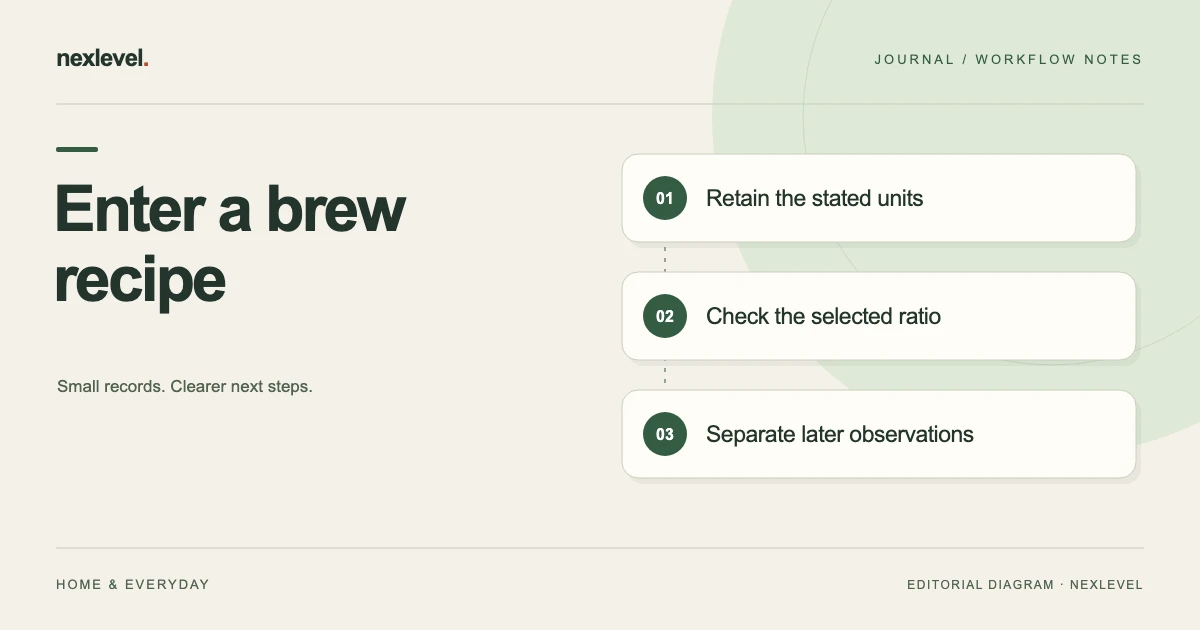
Enter a written recipe by matching each quantity to its source, keeping units attached and separating phase instructions from later tasting notes. Use two identified values to calculate the third. Leave unclear shorthand open instead of letting a precise calculator result supply a meaning the card never gave.
Copy the source meaning along with the numbers
- Identify the source card and decide whether it describes a plan or a completed brew.
- Copy coffee and water with their actual units and check the selected input pair.
- Calculate the ratio on that stated basis and compare the saved values with the card.
- Retain phase notes as planning and later observations with their own session context.
Working fields:
Source card/occasion | Recipe | Coffee/unit | Water/unit | Derived ratio/basis | Phase note | Later observation | Unclear shorthand
Useful next steps: Check units and scaling arithmetic, Review phase context before editing, Start separate session records.
Choose the written source and selected task
A recipe card, personal note, reusable plan, and completed-session observation have different roles. State which one is being entered before copying values.
Write the selected source reference, recipe identity, source occasion, intended local record, and precise question. A record about one source should not appear to represent every later variation.
Use fictional material during the exercise. There is no need to prepare coffee, scan a private notebook, or import a whole library merely to test manual intake.
Start from the current advertised calculator boundary
BrewRatio’s verified current 2.1 description includes calculating coffee, water, or ratio from any two selected values, method presets, mass/volume units, phase-aware timing, and session notes/ratings.
Pro currently expands recipes/history, custom phase choreography, grinder profiles, on-device coaching, trends, and JSON/CSV output. Check actual access.
The public description does not establish general recipe OCR or arbitrary handwritten-recipe import. This guide concerns manual source entry and an independent review worksheet.
Set up a fictional written recipe card
Imagine source card S17 and recipe reference R3. The invented quantities are eighteen grams of coffee and 270 grams of water.
On that explicit mass basis, 270 divided by eighteen gives a water-to-coffee ratio of fifteen. These are arithmetic inputs, not a recommended recipe or a record of a physical brew.
Phase-note reference P4 and later observation N5 concern separate roles. No actual method duration, temperature, preparation, taste result, or health state is supplied.
Use a manual recipe intake worksheet
| Source role | Question to establish | What to retain |
|---|---|---|
| Recipe identity | Which selected source does R3 represent? | Actual source reference/occasion |
| Coffee quantity | What amount and unit does S17 state? | Eighteen grams in the fictional case |
| Water quantity | What amount and unit does S17 state? | 270 grams in the fictional case |
| Derived ratio | Which stated basis produces the result? | Mass division, not a density conversion |
| Phase note | What is planning rather than completed work? | Actual P4 source role |
| Observation | Which later session does N5 describe? | Personal context separate from the recipe |
These are independent preparation prompts, not exact native field names or a promise that the app validates every source meaning automatically.
Preserve units before interpreting the ratio
A bare number can be ambiguous. The fictional card explicitly uses grams for both quantities, so the example needs no conversion between mass and volume.
Use the unit-and-scaling guide for that separate source question. Do not infer a general density relationship from the calculator result.
If the source is clear but a copied entry loses its unit, repair the entry/explanation. If the source itself is unclear, retain the precise question rather than choose a convenient unit.
Enter only what the selected source establishes
The current calculator can derive the third value from two inputs. The derived result should retain the basis of those entered values rather than become independent proof of physical measurement.
For S17/R3, compare the entered quantities and unit labels with the written source. A precise interface should not create certainty about an abbreviation the source never explained.
This guide supplies no universal procedure for every unit-picker or method preset. Inspect the actual supported workflow relevant to the selected record.
Keep source phase notes separate from session actions
P4 may describe reusable planning. A later start, early completion, or timer observation concerns a selected session rather than the written card itself.
For changes to a selected phase record, use the before-phase-edit checklist. Preserve its actual result or precise limitation.
The fictional intake supplies no phase duration or physical instruction. A copied label should not create a brew event.
Do not overwrite the recipe with a cup observation
N5 is personal context for a later selected occasion. It should not become a universal property of R3 or a prediction about another person’s cup.
Use the session-versus-recipe guide for that narrower relationship. Preserve the actual source question.
A note copied beside the wrong session should be repaired where the source establishes the relationship. Do not add an invented session or change accurate quantities to make a summary look consistent.
Check actual access for retained recipes and custom phases
The current listing places expanded recipes/beans/history, Recipe Studio, and other advanced tools under Pro. A companion intake note can still be prepared independently without claiming every native feature is Free.
A purchase does not establish a missing source meaning, guarantee physical repeatability, or validate a personal observation.
Use the actual supported workflow and inspect what it retains rather than assume every written field becomes a native recipe field automatically.
Inspect the selected JSON or CSV representation
BrewRatio Pro currently advertises JSON/CSV export. Open the actual representation relevant to the task and inspect recipe identity, quantities/units, phase context, source occasion, and cutoff.
A companion explanation may be needed for relationships not represented automatically. A clear working view does not prove every exported source meaning survives.
The public description does not establish arbitrary file import or universal full-library restoration. A portable copy can support bounded retrieval without being the complete editable app.
Run a reverse source test
Begin with the fictional ratio of fifteen and ask a reader to reconstruct the eighteen/270 gram basis. Then begin with P4/N5 and identify planning versus later personal observation.
Introduce another card with a similar recipe title but an unclear unit. The reader should preserve the source question rather than borrow R3’s meaning.
If the retained copy loses a relationship preserved in the source, repair the copy. If the original source remains uncertain, retain the exact question instead of reconstructing a plausible recipe.
Keep later corrections visibly later
A later source may clarify an amount, unit, or phase note. Retain its own occasion and connection to S17/R3 rather than make the earlier record appear to have known it originally.
A correction to an explanatory note is different from changing a recipe, recording another session, or entering a rating. Keep those purposes distinguishable.
A concise intake receipt can name sources inspected, selected inputs, calculation basis, actual copy correction if any, and precise next question.
Connect intake to sharing and retention
For another person receiving the recipe, use the recipe sharing guide. A copied card does not itself transfer an editable library or recipient understanding.
For historical material, use the recipe/session archive guide. For method selection, use the coffee-log comparison.
The fictional quantities remain teaching inputs. Reuse the intake worksheet with actual authorized sources while preserving unit meaning, personal-observation scope, and physical-brewing boundaries.
Keep a concrete manual-entry companion record
The fictional source card can be summarized in a companion worksheet without inventing a native import format. Keep the original reference available beside the entered values.
| Companion field | Fictional S17/R3 entry | Review question |
|---|---|---|
| Coffee source | Eighteen grams | Does the actual source state this amount and unit? |
| Water source | 270 grams | Is this mass rather than an assumed volume? |
| Derived relationship | 270 divided by eighteen equals fifteen | Is the stated basis retained? |
| Phase note | P4 | What is reusable planning rather than completed work? |
| Later observation | N5 | Which actual session does the note concern? |
| Open question | The source relationship not yet established | What bounded check comes next? |
The table is not a recipe recommendation, a physical measurement, or a claim that every listed companion field exists in the app.
Work through an explicit-unit intake
In one fictional branch, S17 clearly states both gram values and the selected R3 identity. The supported result is to preserve those two inputs and the derived mass ratio. A more elaborate source story is unnecessary.
In another branch, a different card has a water number without a unit. Do not borrow grams from S17 merely because the number looks similar. Keep the exact source question before presenting the result as established.
A third branch has an unlabeled note that could describe a phase, ratio, or personal shorthand. A calculator result should not silently give that note a meaning. Preserve the source role or leave it unresolved.
A fourth branch has N5 as a later session observation. Keep it tied to that occasion rather than rewrite R3’s recipe to appear to predict the note from the start.
Prepare an intake result another reader can reproduce
Give a reader only the fictional card reference, selected record, and companion worksheet. Ask them to reconstruct the eighteen/270 gram basis and explain what the derived fifteen represents.
Then ask them to distinguish P4 and N5. They should identify reusable planning versus later personal observation without needing to invent a physical brew or a cup-quality result.
If the working source is accurate while a copied label is wrong, repair the label. If the source itself is uncertain, retain the exact question. A documentation correction is different from a new recipe or session.
Record the actual supported workflow/representation inspected, source identity, selected inputs, unit basis, derived relationship, copy correction if any, and precise next question.
Keep those roles inside the receipt as well as in filenames. A copied export can lose its original source path.
A useful manual intake result can remain conditional on one missing unit or note relationship. It should not claim actual ingredient measurement, improved flavor, or physical repeatability merely because the arithmetic is exact.
The fictional quantities remain teaching inputs. Reuse the companion record with actual authorized sources while preserving planning, personal-observation, and physical-brewing boundaries.
Write a concrete manual-intake result
A fictional intake receipt can identify S17/R3, the two explicit gram inputs, the mass division producing fifteen, P4’s planning role, and N5’s later observation context. Those fields make the calculation and source meaning independently reviewable.
If a copied summary loses grams from the water amount while S17 remains explicit, restore the unit in the summary. There is no need to relabel an accurate source or create another recipe to make the copied record agree.
If another card has an unclear unit, retain that question rather than borrow S17’s mass basis. A visually similar number is not enough to establish what the source meant.
For a final check, give another reader only the fictional selected record and receipt. Ask them to reconstruct the ratio, locate the source quantities, distinguish phase planning from session history, and identify any remaining source question.
Record the supported representation inspected, actual copy correction if any, and manual explanation needed. The result should remain bounded to the selected data-intake task. It does not establish physical ingredient measurement, improved flavor, or a recommended method. Keep those limits inside the receipt so another reader can continue without reconstructing the original conversation.
Before retaining the entered record, compare the source card and saved view side by side. Check the recipe label, both gram quantities, and the ratio basis individually; a familiar title alone cannot establish that the quantities were copied correctly.
Use BrewRatio for clear manually entered recipe context
BrewRatio connects entered calculations, reusable plans, phase-aware timing, session details, personal observations, and plan-dependent outputs without requiring an account.
Check the official BrewRatio App Store listing for current capabilities. Keep written-source meaning, calculated ratio, reusable planning, and actual session outcomes in their appropriate roles.