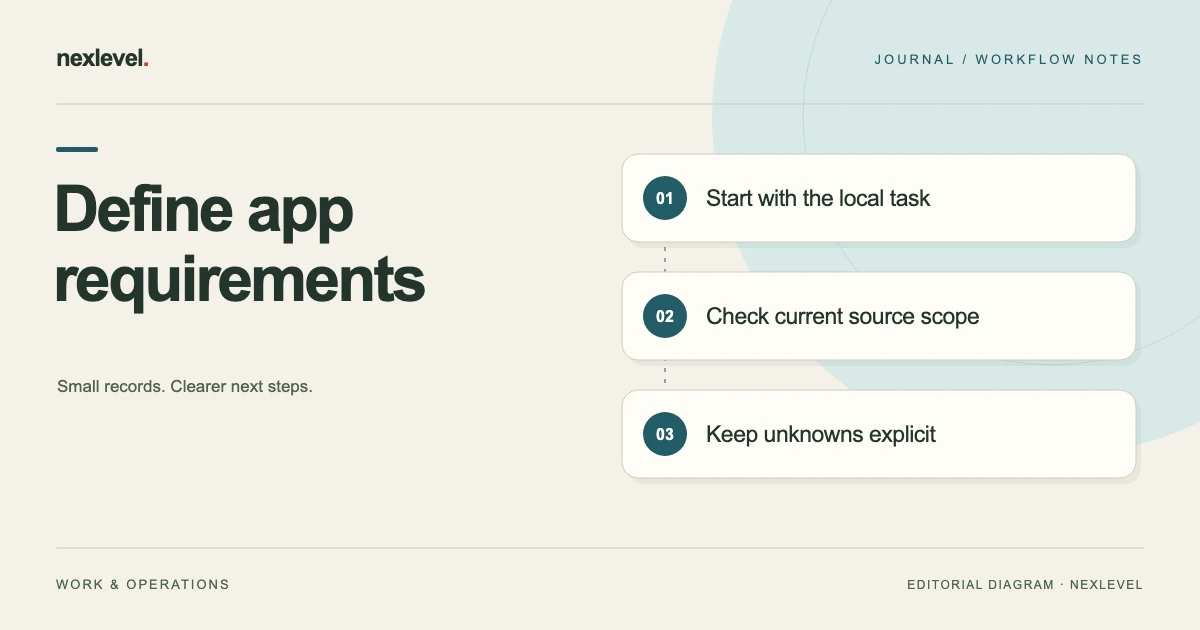
An app-selection checklist starts with the work you need to do and the evidence required to establish a fit. A familiar product name, attractive interface, or broad claim such as private or productive does not answer every workflow question.
This guide provides a fictional manual requirements exercise. It does not rank the market, recommend a purchase, claim independent native-app testing, or promise a best app. Keep requirements, current official product sources, unknowns, actual tests, purchase conditions, and chosen decisions distinguishable.
Define the workflow before naming a candidate
Write the selected task in concrete terms: what starts the work, what you need to record, which local steps matter, and what output another person needs.
A requirement such as prepare a local client questionnaire is more useful than “an app for everything.” It gives the next source review something specific to establish.
Keep the intended user/device context and next decision visible. Do not select a product first and silently rewrite every requirement to fit it.
Create a controlled fictional requirements brief
For this exercise, W31 identifies a workflow: prepare reusable client questions locally, review missing information, preserve a selected version, optionally collect online responses, and produce a Markdown handoff.
R2 identifies the independent requirement list, S3 a current official product-source role, M4 the manual comparison note, and D5 an actual decision role only when supplied.
No real client, candidate evaluation, account, budget, deadline, purchase, or project outcome is supplied. These labels are companion references, not native app fields.
Keep local core work separate from online operations
Ask whether launch, locally supported core tasks, saved local data, and the required local output can remain usable without a separate app account or server connection.
Record intrinsically online tasks separately. Publishing a client link or collecting remote responses has another network role from preparing a questionnaire locally.
This is a selection criterion, not a claim that every advertised feature of every app works offline. The exercise performs no native offline test.
Keep capability evidence separate from assumptions
Use the current official listing for identity and advertised scope. Preserve which source supports each selected requirement and what remains unprovided.
A source saying templates exist does not establish every template field, file type, integration, or validation rule. A source saying export exists does not establish every format.
Do not turn an unknown into a negative review or a favorable claim. Identify the next exact source or actual testing question instead.
Use an independent selection worksheet
| Requirement role | Evidence question |
|---|---|
| Local core task | What current source establishes the selected recording and saved-data workflow? |
| Output | Which actual format, access condition, and representation support the recipient’s task? |
| Online operation | What content leaves, when is the operation chosen, and what account context applies? |
| Version and review | What source establishes readiness, human review, or selected-version evidence? |
| Unknown | Which relationship is unprovided and what would establish it? |
The table is a manual reading aid, not an app-discovery engine, native comparison screen, or promised import schema.
Use Brievra as a requirements workspace, not a ranking service
Brievra currently advertises six templates covering brand, web, app, content, consulting, and photography projects, with locally editable briefs and questions.
A person can use a selected brief to organize their own requirements. The independent checklist here does not mean Brievra automatically searches stores, compares competitors, or recommends a product.
Its advertised gap review is deterministic and on device. It does not provide a managed AI service or guarantee complete requirements.
Fill the local-preparation branch
For fictional W31, the current Brievra source supports a local workspace for creating, duplicating, archiving, searching, and editing briefs, with templates, readiness, and on-device gap checks.
M4 can record that advertised scope while leaving exact project semantics and any unprovided field relationship for actual review.
The exercise creates no native brief and claims no observed app result. It establishes a source-backed way to frame the next question.
Keep readiness separate from every decision being resolved
A live readiness score and actionable gaps can support preparation without deciding every project-specific question. A filled field may still need a source or human decision.
For that distinction, use the filled-field and decision review guide.
Do not invent a native score formula or treat the independent checklist as a set of exact strings the app must accept or reject.
Record output format and access condition separately
Brievra Pro advertises Markdown export through the system share sheet. That supports a different output role from an inspection PDF.
Inspecova advertises structured inspection documentation and PDF reports within its own evidence workflow. A matching file extension alone would not make an inspection tool a complete client-intake replacement.
These are current source-scope examples, not a product ranking. Check the official Inspecova listing for its actual capabilities and plan boundaries.
Fill an output-mismatch branch honestly
If a fictional requirement instead calls for a native PDF brief, the selected Brievra description establishes Markdown export, not that PDF capability. M4 should retain the difference rather than invent a conversion feature.
Likewise, an app supporting PDF output does not establish every domain-specific question, response, or source workflow needed by W31.
The next task can be to clarify the actual required output. A useful selection brief does not need to manufacture a perfect match.
Keep purchase access separate from an app-login gate
A paid export or version feature is an access condition to record, not automatically a separate app-account requirement. Preserve what the current source actually says.
Apple purchase, eligibility, restoration, and renewal contexts should not be replaced with invented bypasses or assumptions about every offline entitlement state.
This guide makes no purchase and tests no entitlement. The checklist records what needs source confirmation for the selected task.
Read optional online intake within its advertised boundary
Brievra Pro advertises a no-account client link, with forms and responses encrypted before leaving the device or browser. The service stores ciphertext and operational records needed to deliver, limit, expire, and revoke links.
Do not describe that chosen online step as no server existing or no operational data being stored. Keep it separate from local questionnaire preparation.
The exercise publishes no link, sends no client message, and imports no answers.
Keep valid answers separate from complete requirements
The listing advertises importing valid encrypted responses into the working brief. A successful import is a source relationship, not automatic resolution of every semantic gap or baseline decision.
For that task, use the response-import review checklist.
The independent selection worksheet supplies no real client answer, acceptance rule, contract term, or project-success guarantee.
Read version evidence at its actual scope
Brievra Pro advertises canonical frozen versions with SHA-256 evidence and a readable timeline. Those features identify selected workflow records.
They are not an electronic-signature service, proof that every requirement is correct, or a legal completeness guarantee. Keep actual human decisions tied to their relevant sources.
For handoff context, use the client requirements handoff guide. This exercise freezes no version.
Record device and accessibility needs as questions
The official Brievra description advertises guided iPhone work, a three-column iPad studio, a Watch brief-health glance, both appearances, and motion respecting Reduce Motion.
Do not treat those statements as independent testing of every accessibility task or as a promise that every device has the same editor.
If a particular reader workflow is unprovided in the source, record the actual verification question. This guide performs no native-device or accessibility test.
Use a copy-ready requirements-review receipt
A practical receipt asks for selected workflow, requirement/source relationship, advertised support, access condition, output format, chosen online boundary, missing evidence, and actual testing still needed.
Add source occasions, cutoff, representation inspected, correction, next task, and decision stage. Keep candidate facts and user preferences separate.
These prompts are administrative structure, not native required fields or a market-ranking score.
State current Brievra access accurately
Free includes unlimited local briefs, all six templates, editing, on-device gap checks, both appearances, and the Watch glance.
Pro adds encrypted client-link publishing/import, frozen version evidence, and export. Monthly and annual access advertise eligible seven-day trials; Lifetime is a one-time purchase. Apple shows current localized prices.
A purchase cannot guarantee complete requirements, legal acceptance, or product fit. Keep entitlement separate from source evidence and actual decisions.
Run a workflow-to-source reading test
Give an authorized reader W31/R2/S3/M4 without the original planning conversation. Ask which tasks are local, which chosen operations are online, what output the source supports, and which access conditions apply.
Then introduce the PDF requirement and an unprovided candidate source separately. The reader should retain those different gaps rather than force a winner.
Record any explanation still needed. A useful checklist identifies the next source task without claiming every app was reviewed.
Write a bounded selection-brief result
A compact fictional note can state: “W31 requires local questionnaire preparation, human review, selected-version evidence, optional encrypted online intake, and Markdown handoff. Current Brievra sources establish their advertised scopes and access conditions. M4 is a manual requirements comparison, not automatic discovery, ranking, native testing, or a purchase decision.”
Add actual later sources or decisions only when they exist. For retention, use the brief archive guide.
The result is an understandable source-backed requirements record, not legal advice, a signature, a completeness guarantee, or an outcome claim.
Keep must-have questions separate from preferences
In the independent worksheet, identify which requirement is essential to the selected workflow and which is a preference. A missing essential output relationship should not disappear because several unrelated preferences look attractive.
These are human planning distinctions, not native Brievra ranking weights. The exercise supplies no numerical score or claim that one product is best for every reader.
An unknown can remain unknown until the relevant official source or actual supported workflow establishes it.
Preserve the product-source occasion
Record which current source was inspected before retaining a capability statement in the brief. A later listing or product version can be another occasion rather than proof that the earlier note was always wrong.
Likewise, a frozen brief identifies selected workflow content, not a guarantee that every external product fact remains current forever.
If a later source changes the relevant relationship, give it its own reference before preparing another comparison or decision record.
Keep a source gap separate from a negative review
If a format, accessibility task, or offline state is unprovided in the selected source, identify that exact question. Do not claim the product cannot support it merely because this packet lacks evidence.
The opposite overstatement is also unhelpful: a broad privacy or export phrase should not become proof of every required workflow. Keep support claims at their actual scope.
This makes the next review precise without inventing a market verdict, performance measurement, or independent native-app test.
Close the requirements task without forcing a winner
M4 can finish with clear requirements, current source relationships, access conditions, unprovided evidence, and next testing questions. A purchase decision is a separate actual stage.
The reader should be able to distinguish local preparation, optional online intake, selected-version evidence, and output format without reconstructing the original discussion.
A useful brief does not need to manufacture complete support or legal acceptance. It can preserve a bounded unresolved question while making the next source or workflow review concrete.
Use Brievra for clear requirement questions
Brievra can organize the brief behind a manual selection task while current official sources and actual review establish product capabilities.
Check the official Brievra App Store listing before choosing the relevant workflow or access option. Keep source facts, requirements, unknowns, actual tests, and decisions distinguishable.