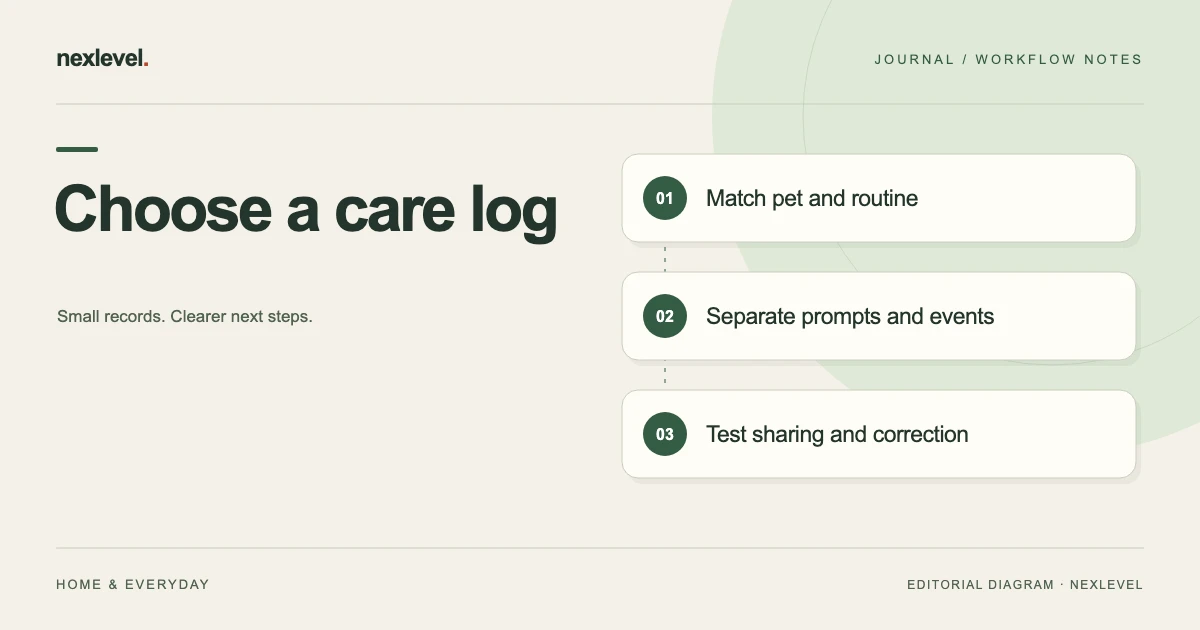
A pet-care handoff system needs to make the selected routine, recorded check-ins, caregiver context, and next question understandable. Paper, a spreadsheet, and an app can each support part of that work. The right comparison tests record continuity rather than assuming a checked box proves every physical care detail.
Run the same fictional handoff through setup, event logging, correction, retrieval, and a change in access. Record demonstrated behavior and manual conventions separately. Keep reminders and activity history distinct from veterinary instructions or medical decisions.
This guide provides an independent tool-choice worksheet. It gives no medication dose, feeding quantity, treatment, or animal-care schedule. Start with the pet-care handoff checklist for the underlying arrangement.
Define the household’s actual record task
One person maintaining a local routine has different requirements from several caregivers exchanging updates or a sitter with bounded access. List the actual responsibilities before comparing interfaces. A longer feature list does not automatically establish a better fit.
Identify the selected pet, routine scope, source period, intended readers, and next review. Keep the record system’s job narrow: explain what was entered, who entered it where supported, and what still needs a deliberate source check.
Use fictional data while evaluating candidates. There is no need to distribute actual household, sitter, or animal-health information across several tools simply to compare appearance or convenience.
Use one comparison worksheet
For each candidate, write what was demonstrated, what depended on a maintained convention, and what remains untested. A useful limitation is more informative than an unexplained numerical score.
| Task | What to demonstrate |
|---|---|
| Identify | Retrieve the selected pet and routine |
| Log | Distinguish an actual entered check-in from a reminder |
| Attribute | Understand the caregiver relationship where established |
| Correct | Handle an established mistaken entry |
| Continue | Find the next source question without the original writer |
| Share | Explain the actual access and portable-copy scope |
These are independent evaluation prompts, not a claim that every tool implements these as named controls or that a record comparison authorizes anyone to change care instructions.
Set up a fictional handoff
Imagine pet P7, routine reference R3, caregivers A and B, and recorded check-in E1. A separate reminder N1 prompts review of the selected routine. The exercise supplies no real care time, amount, medical information, or required interval.
Ask each candidate to preserve P7/R3/E1 and distinguish E1 from N1. A reminder is planning context. It should not be counted as a recorded check-in merely because it appears on the same day.
Now add a companion note whose pet relationship is unclear. The method should let the reviewer preserve that question rather than attaching the note to P7 because its wording resembles the routine. A tidy list is not a substitute for an established identity relationship.
Test a paper handoff log
A paper candidate can use a pet heading, routine reference, event rows, caregiver notation, and a separate question area. Demonstrate that a later reader can retrieve E1 without the original writer explaining a private abbreviation.
Check what a blank means in the chosen convention. It can represent no entry rather than proof that no physical action occurred. The comparison should preserve that limitation instead of turning an incomplete log into a complete account of the animal’s day.
Inspect a retained photo or copy of the page as well. A cropped image can lose the pet heading or source period. The readable original does not guarantee that every forwarded representation preserves the same context.
Test the spreadsheet’s row model
Decide whether a row represents a pet, routine, check-in, reminder, or companion question. Mixing those roles can make filters and totals difficult to interpret. A repeated pet reference may be a valid event relationship rather than a duplicate record.
For the fictional exercise, ask the reader to identify which row describes E1 and which describes N1. A visually similar mark should not make a planned reminder look completed. Inspect the actual maintained convention rather than assuming the software understands those roles automatically.
Then sort or filter the selected table. Pet identity, source period, caregiver context, and the open question should remain attached to the relevant rows. Record any actual manual dependency in the worksheet instead of treating it as a feature every spreadsheet provides.
Test PawHandoff against the current description
PawHandoff currently supports a local pet and daily routine without an app account. Its description includes check-ins, caregiver-attributed activity, recent duplicate warnings, optional local reminders, notes, photos, and correction of mistaken check-ins.
The paid Household offering expands multiple pets, caregivers, secure household synchronization, medication schedules, expiring sitter access, and private care-history export. Check actual access before designing an evaluation around those capabilities.
Local saving and remote household updates are different processes. Do not describe every shared feature as operating without a connection or assume another person’s view is current solely because a local check-in was saved. The actual supported state should establish what was confirmed.
Keep duplicate warnings in their actual role
A warning can help draw attention to a recent entry without proving that every physical action was duplicated or that every record is correct. Inspect the selected pet, routine, caregiver, and occasion before interpreting a pair of similar entries.
For a conflict, use the pet-care note reconciliation guide. Tool choice should preserve the actual source question rather than promise that software removes every ambiguity.
If a mistaken check-in is established, use the supported correction process and inspect its result. A correction is an administrative event; it does not itself describe another care action. Keep that distinction readable in the intended copy.
Compare local use and shared use separately
Test the selected local workflow without assuming a remote update occurred. A local record can remain usable while another person’s device needs a connection or confirmation. The comparison should identify what was actually demonstrated on each side.
A paper copy and a static spreadsheet export also have their own cutoff. They should not be described as a live shared source merely because two people possess similar files. The actual source rule needs to say which working record is maintained.
Do not invent a cloud database, import mechanism, or account requirement for a candidate that does not establish it. Conversely, do not promise that an optional shared service delivers every update immediately when connectivity is unavailable.
Test a bounded sitter-access task
Reading a selected routine and receiving ongoing household access are different responsibilities. Write the actual sitter scope before testing access features. A copy prepared for a short task should not automatically include unrelated household history.
PawHandoff currently describes expiring sitter access under Household. For the specific preparation task, use the sitter handoff and access-period guide. The comparison should record the actual supported arrangement rather than invent an administrative control.
A person receiving a packet should understand which source questions remain with the household or responsible professional. No tool-choice worksheet establishes authority to change an animal’s medication or other care requirements.
Inspect the actual portable record
Check what the intended output contains and which plan provides it. PawHandoff’s current description includes private care-history export in Household, but it does not establish a universal file format or arbitrary restore workflow.
For the selected copy, inspect P7, R3, E1, the source period, caregiver context, and the unresolved note relationship. A companion explanation may remain outside an exported field. Do not assume every worksheet prompt travels automatically.
Perform the same check for paper and spreadsheets. A useful method explains what is included, what remains elsewhere, and how a later correction will be recognized. File preparation is separate from delivery and recipient understanding.
Run the correction test
In the fictional continuation, the working record correctly associates E1 with P7, but a cover summary incorrectly labels it as another pet’s event. Repair the summary rather than changing a correct source to match the mistake.
Ask each candidate to preserve that distinction. The reader should identify which layer changed and why. An apparent disagreement between two copies does not automatically mean the underlying event was wrong.
Now inspect an older retained copy. It can remain a representation of the earlier cutoff without updating itself. The intended current explanation should be identifiable through the actual household convention, not an invented automatic merge feature.
Make a conditional choice
Paper may fit a small, consistently maintained local log. A spreadsheet may fit an explicit row model and retrieval convention. PawHandoff may fit when its pet, caregiver, reminder, correction, and optional sharing structure matches the demonstrated needs.
Write the choice with its assumptions: selected pet scope, local or shared task, actual plan, manual conventions, output requirement, and remaining limitation. Revisit it when those needs change rather than treating the first selection as permanent.
The result is an organizational fit, not a guarantee against missed care or a veterinary conclusion. A clear record can support responsible continuation while leaving the physical care question with its actual instructions and qualified sources.
Complete a candidate comparison for P7
Give each method the same first task: locate P7/R3 and identify E1 as the selected entered check-in. If caregiver A is established by the source, preserve that context. Do not infer the actor merely because A’s name appears elsewhere on the paper or in the shared workspace.
The second task is to locate N1 and explain that it is a reminder. A method can store both records usefully while still needing clear labels. A check mark beside N1 should not quietly become another care event or evidence that a particular physical instruction was followed.
The third task concerns the companion note with uncertain pet identity. Ask each candidate to preserve the exact missing relationship. Assigning it to P7 simply because that profile is currently open would make the record look complete without establishing its source.
The fourth task uses the cover-summary mistake. Keep E1’s correct working relationship and repair the summary that names another pet. Record which layer changed. This gives the comparison a correction test without requiring an invented new check-in or alteration of accurate history.
Now separate local and shared demonstrations. A locally saved entry is one result. A confirmed received update in the optional household arrangement is another. The worksheet should state what was actually inspected rather than treating one device’s successful action as proof of every remote view.
For a portable copy, name the selected output and its cutoff. Identify whether it includes the routine, events, caregiver context, and outstanding question needed for the task. Do not call an untested export complete solely because the file opened.
A useful result statement might say that identity and event roles were clear while a source question remained unresolved. Another candidate may require a maintained notation convention. Those are explainable differences; a numerical winner would hide the reasons the method fit or failed the selected household task.
Keep the fictional comparison separate from actual animal-care history. The evaluation can be reused with authorized sources later, while P7/R3/E1/N1 remain teaching references. The method should make records understandable without claiming a health outcome or authorizing a change to care instructions.
If caregiver references use initials or short codes, retain an appropriate private key for the intended reader. Attribution is useful when it identifies the actual source relationship; an unexplained letter should not force a sitter to guess who entered a check-in.
Use PawHandoff for understandable activity records
PawHandoff connects routines, check-ins, caregiver context, and optional household coordination while preserving a useful local starting point. Keep recorded activity distinct from reminders and unresolved source questions.
Check the official PawHandoff App Store listing for current features and Household access. Choose the method from the record tasks you actually need, and test whether another person can continue the selected handoff without guessing what the entries mean.